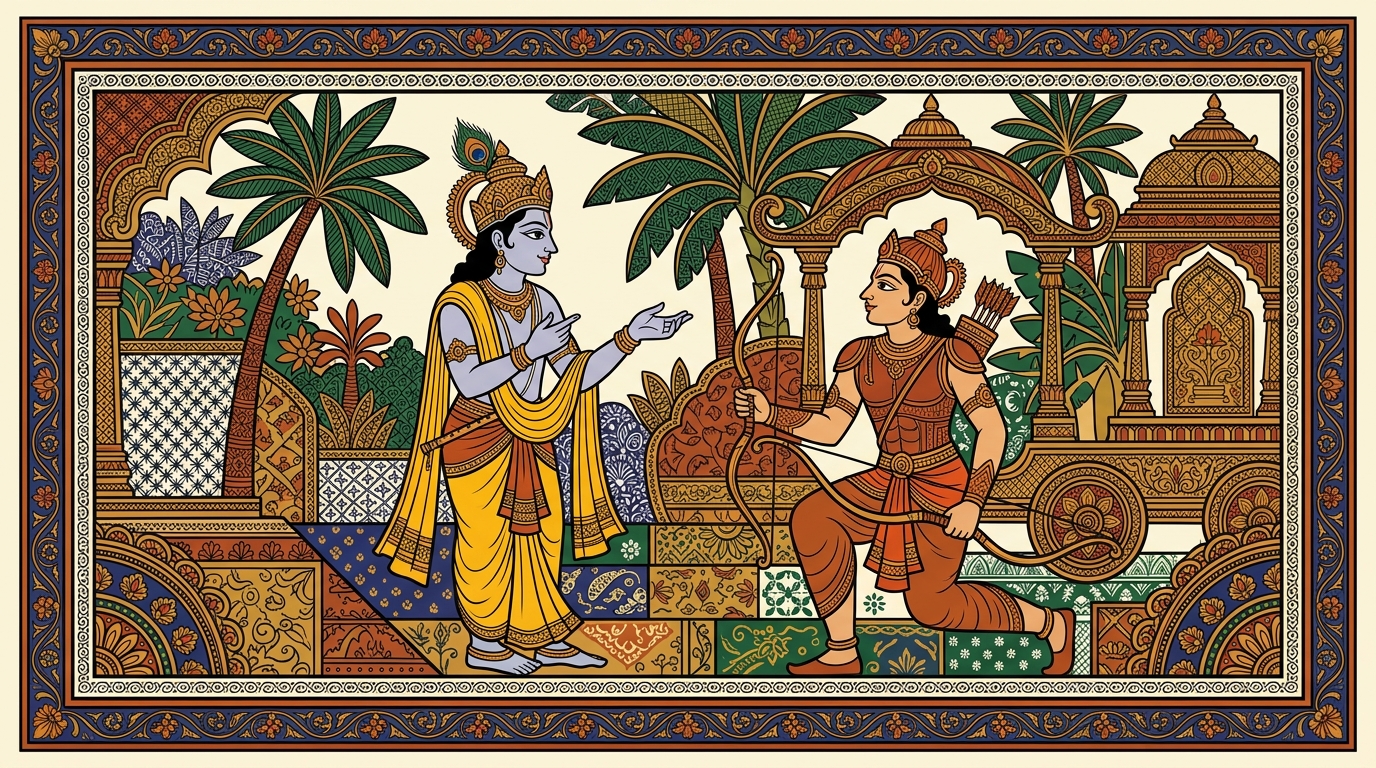
Until this moment, Krishna had been explaining.
He had been patient, almost gentle — a teacher at a blackboard, laying
out ideas one by one, giving Arjuna time to absorb each thought. He
spoke of duty. He spoke of nature. He spoke of the wheel of sacrifice
and the ancient kings who turned it. His voice had the warmth of a
friend sitting beside you on a long night, talking you through your
fear.
But now the voice changed.
Arjuna felt it before he heard the words. The air on the battlefield
shifted. The chariot horses stamped, as if they too sensed something
tighten. The conch shells on both sides had gone silent. Even the
wind, which had been pushing dust across the plain of Kurukshetra all
morning, paused.
Krishna turned to face Arjuna directly. His dark eyes were steady —
not angry, not cold, but utterly certain, the way the sky is certain
of the sun.
"Surrender every action to Me," he said. And the word "surrender" did
not sound like defeat. It sounded like relief — like a man setting
down a boulder he had carried across a mountain range and realizing
his shoulders could finally straighten.
"Let go of hope for reward. Let go of the fever that says 'this is
mine, that outcome belongs to me.' Let go of the burning inside your
chest that says you must control what happens next."
Arjuna's fingers, which had been slack against the Gandiva bow, began
to tighten. Not from fear this time. From something else — something
closer to readiness.
"Keep your hands on the bow," Krishna said. "Keep your eyes on the
field. Do not put down your weapon. I am not telling you to stop
acting. I am telling you to act without the weight."
The words landed like arrows, each one precise. Surrender the fruits.
Keep the action. Let Me carry what comes after.
Arjuna looked out at the army assembled against him — uncles, cousins,
teachers. The grief was still there. It would always be there. But
layered over it now was something new: a strange, clear stillness,
like the surface of a lake after the wind has died.
He did not feel brave. He did not feel fearless. He felt — lighter.
As if someone had taken the invisible pack from his back and said,
"I'll hold this. You walk."
Krishna's voice came once more, and this time it was a command, not
a suggestion. One word, ringing across the silence of Kurukshetra
like a bell:
"Fight."
The air crackled. The horses surged forward. And Arjuna, for the
first time since the armies had gathered, lifted his bow.