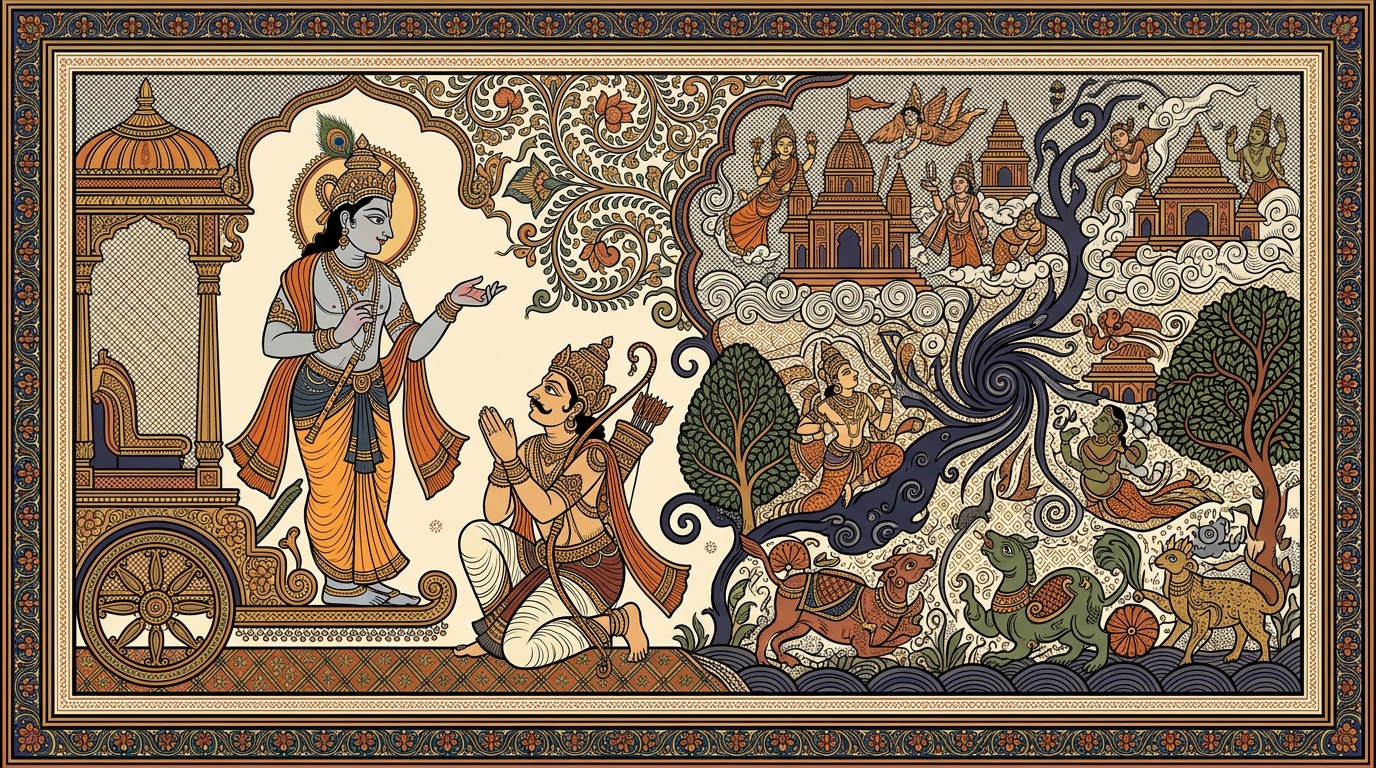
Krishna had given Arjuna a vision of the cosmos in motion — what
would happen if the divine stopped acting, if the great wheel of
duty ground to a halt. The vision did not end. It deepened.
Arjuna had already seen the charioteers drop their reins and the
farmers put down their plows. But now Krishna's words carried him
further — past the battlefield, past the villages, past the edges
of the world he knew, into something vast and frightening.
He saw the sun.
It hung in the sky as it always did, a blazing disc pouring gold
across the curve of the earth. But now, in this vision, it
hesitated. The light flickered — not dimming, but stuttering, the
way a lamp stutters when oil runs low. The sun had always risen
because something moved it. Some force, some will, some invisible
hand that nudged it along its path each day. And now that hand
was still.
The light grew uncertain. Shadows lengthened in the wrong
direction. Birds that flew by the sun's position circled aimlessly,
calling out in confusion.
Then the rivers.
The Ganga, which had flowed since the beginning of memory, slowed.
Not frozen — just slow, the way a person walks when they have
forgotten where they are going. The water grew shallow. Fish
surfaced, gasping. Reeds along the banks drooped and turned brown.
The sound of flowing water — that constant, gentle sound that
villages had built their lives around — went quiet.
Then the earth itself. Seeds that had been pressed into dark soil,
waiting for the signal to push upward, felt nothing. The signal
did not come. They lay still in the ground like small, closed fists
refusing to open. Wheat fields that should have been turning gold
stayed green and stunted. Rice paddies held their water but
produced nothing.
Arjuna watched all of this, and a cold feeling spread through his
chest. It was not the cold of winter. It was the cold of a world
losing its reason to move. Not destruction by fire or flood —
something worse. A slow unwinding. A forgetting.
"This," Krishna said, his voice steady as the vision swirled, "is
what happens when the one who holds the wheel lets go. Not war.
Not punishment. Just — stopping. And from that stopping comes
confusion. And from confusion comes suffering. And from suffering,
the end of everything."
He paused. The vision held for one more breath — a world grey and
still, beautiful and broken — and then it dissolved like mist in
morning sun.
Arjuna found himself back in the chariot. The horses breathed. The
sun shone. The rivers he could not see from here were flowing, he
knew, because he could feel their rhythm in the ground beneath the
wheels.
He looked at Krishna's hands on the reins. Steady. Unhurried. And
he understood, perhaps for the first time, what it cost to keep the
world turning — and why someone who owed the world nothing chose to
pay that cost anyway.