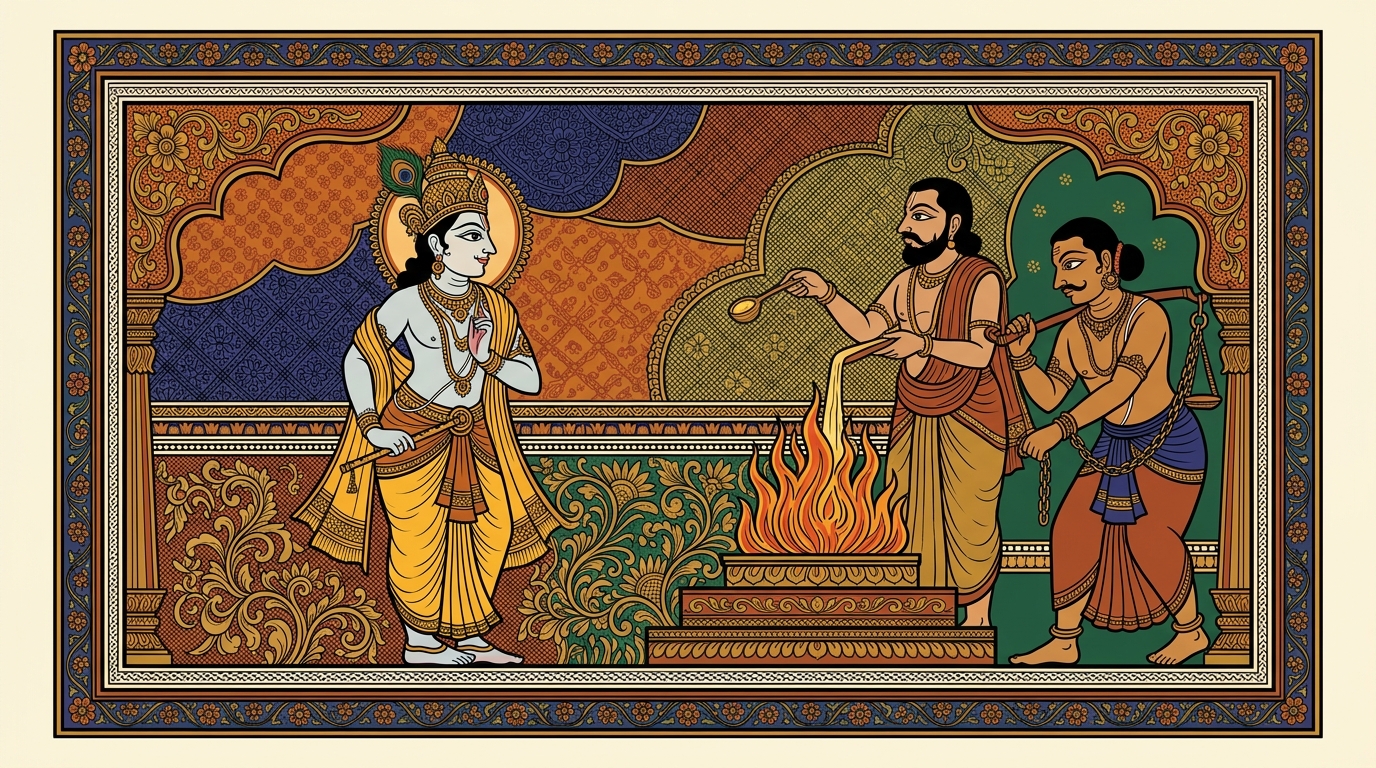
The sacred fire had been burning for three days.
It sat in a brick pit in the center of Rishi Angiras's ashram, fed
with dried mango wood that crackled and spat sparks like tiny orange
stars. The smoke rose straight up into the sky, as if the fire
itself were reaching for something above. The air smelled of ghee
and sandalwood and the faint sweetness of samagri herbs that the
rishi had gathered from the riverbank at dawn.
Arjuna knew this fire. Not this particular one, but fires like it.
He had sat before them as a child, watching Dronacharya perform the
morning yagna before weapons training began — the old teacher's
hands moving slow and deliberate, pouring clarified butter into the
flames while chanting in a voice that was half song, half prayer.
"Do you know what a yagna really is?" Krishna asked.
They were still in the chariot. The battle had not yet begun. But
Krishna spoke as if they had all the time in the world.
"It's a ritual," Arjuna said. "You light a fire and make offerings."
"That's the form. What's the meaning?"
Arjuna hesitated.
"Watch the fire," Krishna said, though there was no fire before them.
But Arjuna closed his eyes, and in his mind he saw Rishi Angiras's
fire — bright, steady, hungry. "When the rishi pours ghee into the
fire, does the fire ask him why?"
"No."
"Does it say, 'I will burn only if you give me something in return'?"
"No. It just... burns."
"Does it burn the sandalwood differently from the mango wood? Does
it prefer the expensive ghee over the simple one?"
"No. It takes everything the same."
"That," Krishna said, "is yagna. The fire accepts everything because
it wants nothing for itself. It transforms what is given — wood into
warmth, ghee into fragrance, herbs into healing smoke — and sends
it upward. It keeps nothing. It clings to nothing. And because it
clings to nothing, it is free."
He turned to Arjuna. "Now think of a man who works only for his own
reward. He fights for gold. He helps others so they will owe him.
Every action ties another rope around his heart — not because the
deeds are bad, but because he clings to what they bring him."
"And the man who works like the fire?"
"He acts fully. He holds nothing back. But when the work is done,
he opens his hands and lets the results go — up, away, like smoke.
He does not ask 'what will I get?' He asks 'what can I give?' And
that, Arjuna, is the difference between a chain and a wing."
The first war conch sounded across the field. Arjuna felt its
vibration in his ribs. He looked at his bow, then at his hands,
and he thought of fire — of giving without keeping, of burning
without asking why.