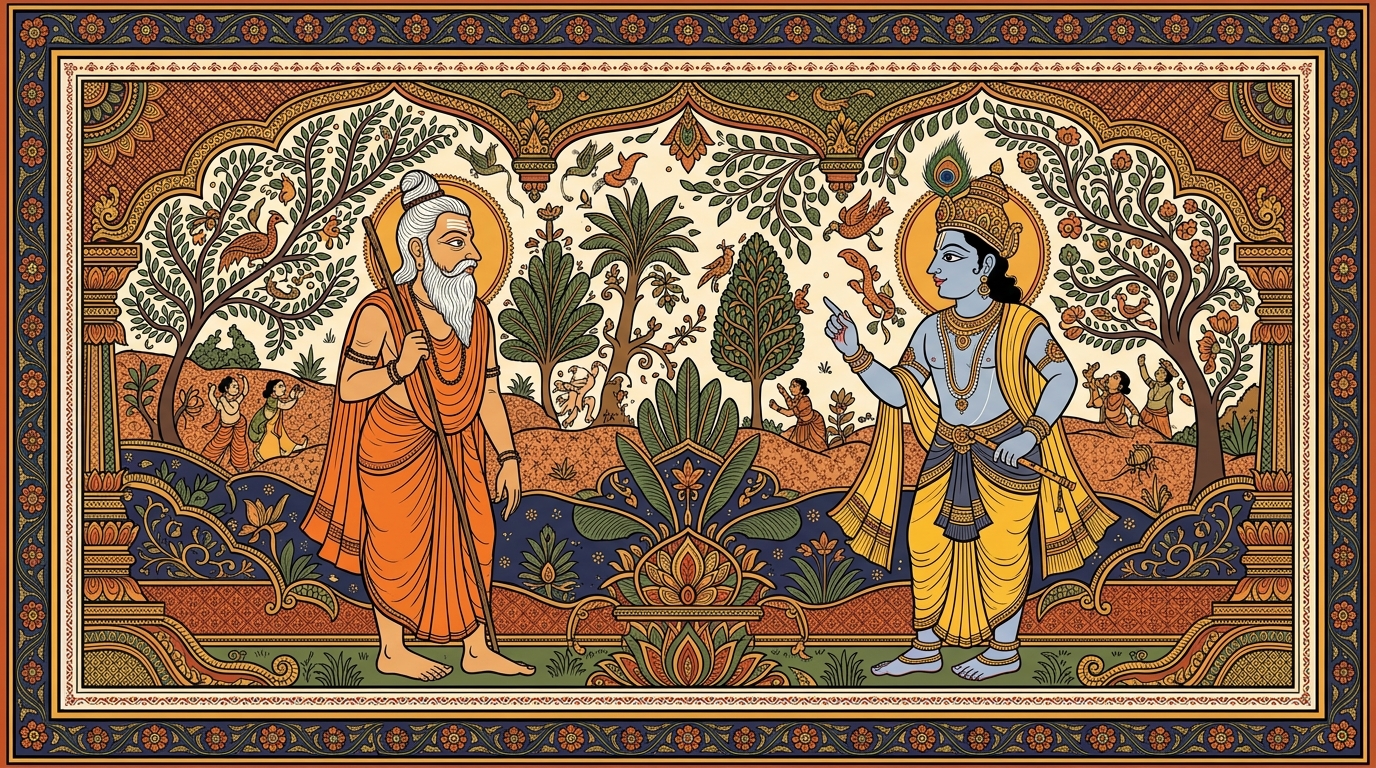
There was a prince named Vikrama whose father ruled a small kingdom
in the foothills of the Vindhya mountains. The kingdom was not wealthy,
but it was peaceful. Farmers grew millet in terraced fields that
climbed the hillsides like green staircases. The river ran clear. The
people, for the most part, were content.
Vikrama's father, King Harishchandra, was a quiet man who believed
in listening. Whenever a sage or scholar or travelling teacher came
to the court, the king would invite them to speak. He would sit on
his wooden throne — not gold, not jewelled, just well-made teak —
and listen with the patience of a man watching a river. Some sages
were brilliant. Some were ordinary. The king treated them all the
same.
Vikrama thought this was beneath him.
He was clever — genuinely clever, the kind of boy who could solve
puzzles faster than his tutors and recite verses after hearing them
once. But his cleverness had curdled into something sharp. He
interrupted the visiting sages. He pointed out errors in their
logic — sometimes real errors, sometimes invented ones. He rolled
his eyes when they spoke of dharma and duty and sacrifice.
"These are old ideas," he told his father. "I don't need them."
King Harishchandra said nothing. He had learned that some lessons
cannot be given — they can only be discovered.
The sages, one by one, stopped coming. Word spread: the prince of
the Vindhya kingdom mocks those who teach. The scholars went
elsewhere — to Kashi, to Magadha, to courts where their words were
received without contempt.
At first, Vikrama didn't notice. He had his own ideas, after all.
He didn't need anyone else's.
But then the kingdom began to struggle. A drought came, and Vikrama
had no advisor who understood irrigation. A dispute broke out between
two villages, and Vikrama had no elder who knew the old laws of land
division. A fever swept through the cattle, and the royal physician
— an old woman named Savitri who had once been the best healer in
three kingdoms — had left years ago, tired of being mocked for her
herbal "superstitions."
Vikrama tried to solve each problem alone. He was, after all, clever.
But cleverness without wisdom is like a sharp knife without a handle
— it cuts, but mostly it cuts the one holding it.
The drought deepened. The dispute turned violent. The cattle died.
One evening, Vikrama sat alone on the teak throne. The court was
empty. No sages. No scholars. No advisors. Just silence, and the
sound of wind through the hills.
He had not lost his intelligence. He had lost something harder to
name — the willingness to be taught. And without that willingness,
all the cleverness in the world was just a locked room with no key.
His father found him there, staring at the empty hall.
"They're not coming back, are they?" Vikrama said.
The old king sat beside his son. "Some might," he said. "If you
learn to sit with what you don't know."
It was the hardest lesson Vikrama ever learned — not any particular
truth, but the simple act of opening his hands and admitting he
needed one.
The next morning, Vikrama did something he had never done before.
He sat down and wrote a letter to Savitri, the healer he had once
mocked, asking if she would consider returning. He did not know if
she would come. But the letter itself was a beginning — the first
time his cleverness had been used not to prove he was right, but
to admit he had been wrong.