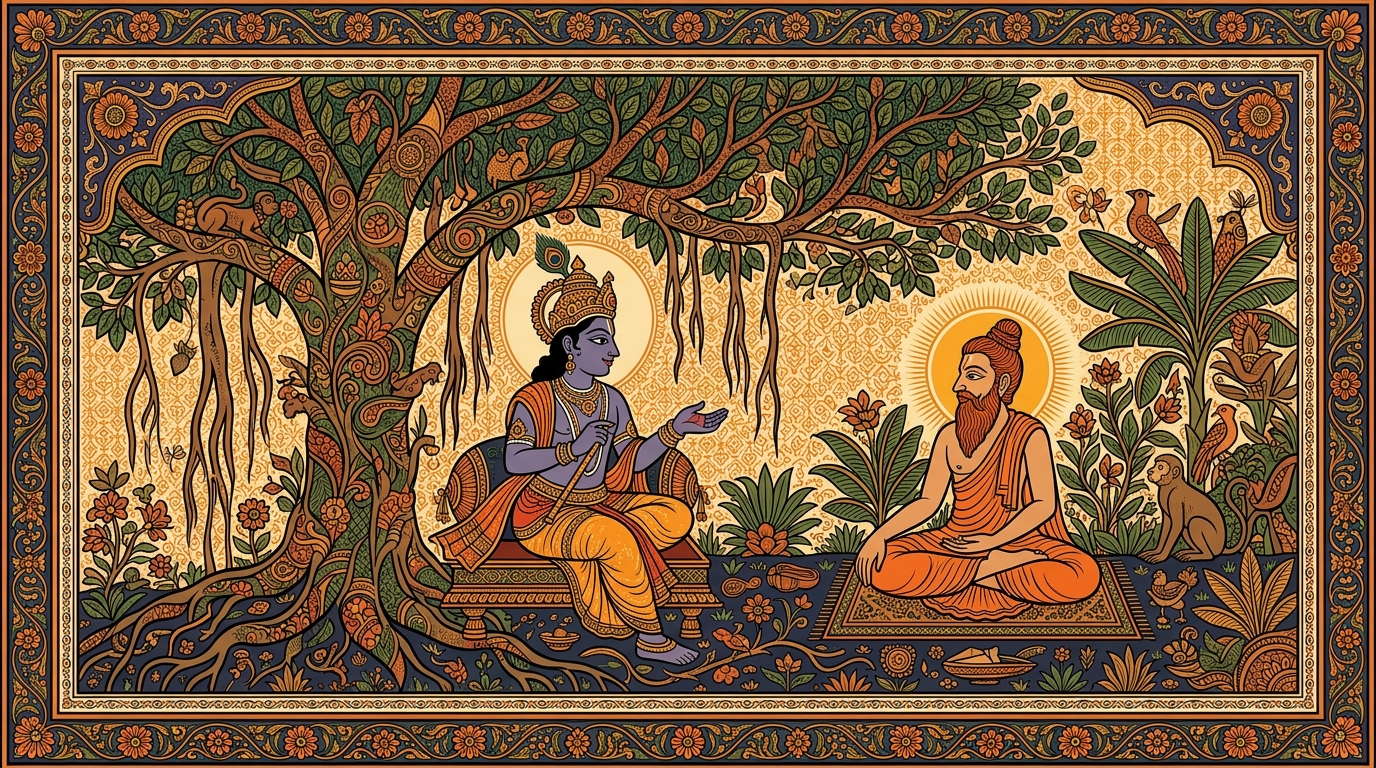
Nobody knew his name. The villagers near Naimisharanya simply called
him "the one under the banyan," the way you'd say "the well near the
temple" or "the mango tree at the crossroads." He was part of the
landscape — as still as the tree itself, as permanent as the roots
that twisted around him like the fingers of an old friend.
He sat cross-legged on a raised platform of earth that the roots had
shaped over decades, cradling him the way a palm cradles water. His
hair was white and hung past his shoulders. His eyes were open, but
they were looking at something that was not in front of him — or
perhaps at everything at once, the way a lake looks at the sky.
The animals came first. A family of langurs settled in the branches
above him, the mother grooming her baby without any fear. Parrots
perched on his shoulders and preened. A spotted deer walked right
up to him, sniffed his knee, and lay down. A cobra once slid across
his lap on its way to the river and he did not move, and the cobra
did not strike, and both of them seemed to understand something
about the other that words would only have ruined.
Then the travellers came. A merchant on the road to Kashi stopped to
rest under the banyan's shade and found himself staying for three
days. "I don't know why," he told his companions later. "I sat
near him and the restlessness just... stopped. Like someone had
blown out a flame I didn't know was burning."
A young widow arrived carrying grief so heavy it had bent her
shoulders. She sat a few feet from the sage and wept. He said
nothing. He offered no advice, no mantras, no promises. But when
she stood up an hour later, something had shifted. The grief was
still there — it would always be there — but it had loosened its
grip, just a little, like a fist slowly opening.
A group of students came from a nearby ashram, full of questions.
"Why don't you teach?" they asked. "Why don't you perform rituals?
Why don't you travel and share your wisdom? Surely you have a duty
to the world."
The sage looked at them for a long time. Then he smiled — not a
large smile, but the kind that starts deep inside and arrives at the
lips as something quiet and sure.
"A lamp does not go door to door," he said. "It stays where it is.
Those who need light come to it. And those who don't — they have
their own light."
He closed his eyes. The students waited, hoping for more. But there
was no more. The breeze moved through the banyan leaves. The langurs
chattered. The deer slept. And the sage sat in the center of it all,
needing nothing, complete in himself — a man for whom the world held
no obligation, because he had found something inside himself that the
whole world could not add to or take away.