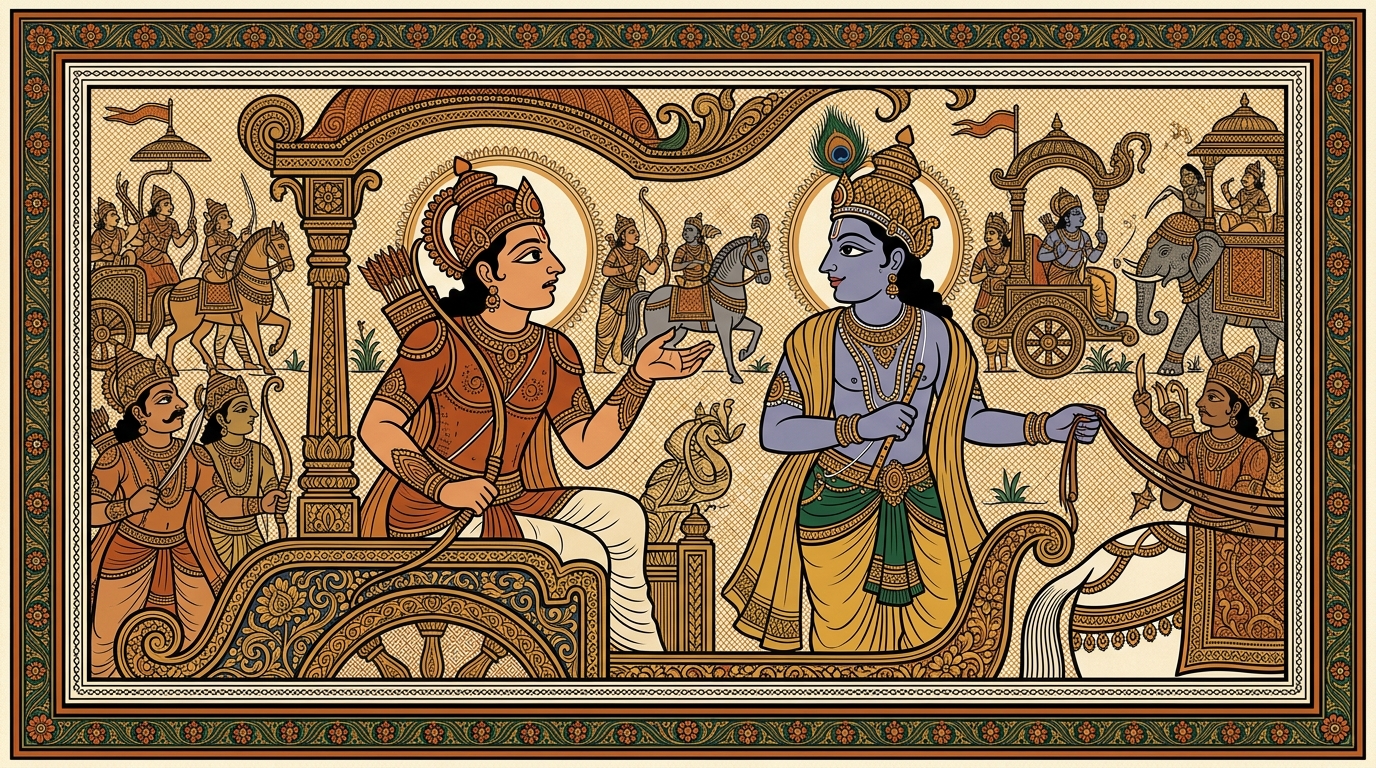
The morning mist had not yet lifted from Kurukshetra. It hung low
across the plain like a thin white blanket, hiding the feet of a
million soldiers but leaving their heads exposed, so the field looked
like a strange garden of helmets and spear-tips growing out of cloud.
Arjuna stood in his chariot, gripping the rail with both hands. His
knuckles were pale. Gandiva, his great bow, lay across the chariot
floor where he had dropped it the night before, and he had not picked
it up since. His arms felt too heavy. His mind felt heavier.
"I don't understand," he said.
Krishna sat beside him on the charioteer's seat, reins gathered loosely
in his hands. The white horses stamped and breathed clouds of their own
into the mist. He waited.
"Yesterday," Arjuna continued, his voice rising, "you told me that
wisdom matters more than anything. That a person of steady mind is
above the chaos of the world. You described this — this calm, this
stillness — like it was the highest thing a person could reach. I
listened. I believed you."
He turned to face Krishna. His eyes were rimmed with red. He had not
slept.
"And now, today, you tell me to fight. To charge into that." He pointed
at the field where the Kaurava army stretched to the horizon, a dark
tide of iron and leather. "That is not wisdom. That is not stillness.
That is war, Krishna. People will die. My cousins. My teachers. My
grandfather."
A conch shell moaned somewhere on the Kaurava side. The sound rolled
across the mist like a wave over sand.
"So which is it?" Arjuna's voice cracked. "If knowing is greater than
doing, why would you push me into the most terrible doing of all?
Pick one path. Give me one answer. Because right now your words feel
like two roads pulling my chariot in opposite directions, and the
wheels are about to come off."
He sank down onto the chariot floor, his back against the rail, and
pressed his palms over his eyes. The metal of his armguards was cold
against his forehead.
Krishna said nothing — not yet. He simply looked out at the field
with eyes that held no confusion at all. The answer was coming. But
first, Arjuna needed to finish asking the question with his whole
heart.
Sometimes the bravest thing a warrior can do is admit that he does
not know.