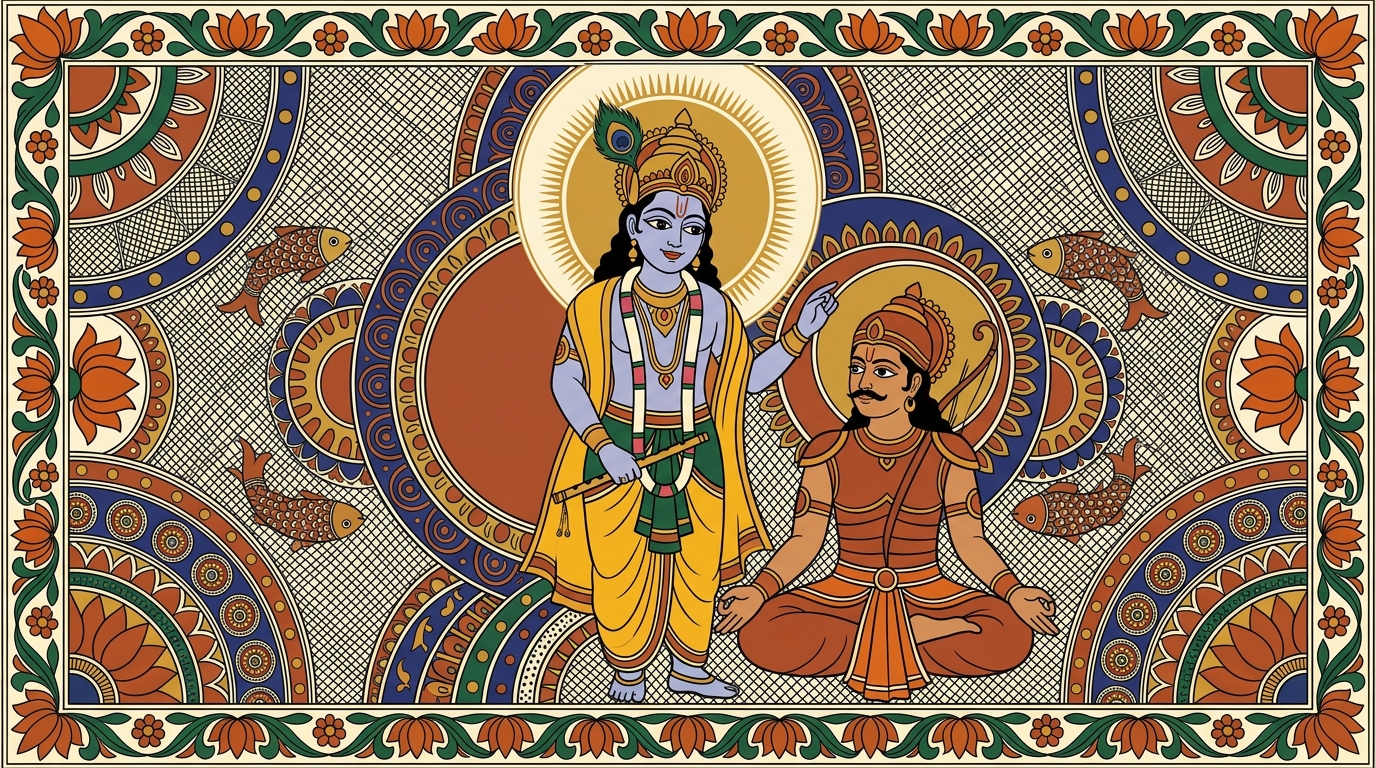
The Yoga of Meditation
ध्यानयोग
Krishna teaches Arjuna how to sit quietly and calm his mind through meditation. Arjuna says, "But Krishna, my mind jumps around like the wind!" Krishna agrees that the mind is restless, but with practice and patience, anyone can learn to tame it — just like training a playful puppy.
✶ Art Style: Madhubani from Bihar Learn more
Madhubani painting comes from the Mithila region of Bihar, where women have decorated their homes with these designs for thousands of years. The art uses bold outlines filled with vivid colors, and every empty space is filled with flowers, animals, birds, and geometric patterns. Traditionally painted on freshly plastered mud walls during festivals and weddings, Madhubani tells stories from mythology with a flat, two-dimensional style that feels both ancient and alive.
Signature Elements
- • Double-line borders with cross-hatched fills
- • Fish, peacock, and lotus motifs
- • Symmetrical compositions
- • Dense pattern-filling (horror vacui)
Did you know?
Madhubani art was almost lost to the world until the 1934 Bihar earthquake damaged many homes. When relief workers arrived, they discovered the stunning paintings on the crumbling walls and helped bring the art form to international attention.
अनाश्रितः कर्मफलं कार्यं कर्म करोति यः। स संन्यासी च योगी च न निरग्निर्न चाक्रियः॥
KrishnaKrishna says: a true renunciate is not the person who simply stops lighting the sacred fire or refuses to do any work at all. The real renunciate, the real yogi, is the one who does the work he ought to do without depending on its reward. Giving up the grabbing for results is what matters, not giving up the doing.
यं संन्यासमिति प्राहुर्योगं तं विद्धि पाण्डव। न ह्यसंन्यस्तसङ्कल्पो योगी भवति कश्चन॥
KrishnaKrishna tells Arjuna a surprising thing: what people call renunciation is exactly the same as yoga. They are not two different paths. Why? Because no one ever becomes a yogi without giving up the selfish wanting inside, the scheming for "what's in it for me." Letting go of that grabbing motive is the heart of both.
आरुरुक्षोर्मुनेर्योगं कर्म कारणमुच्यते। योगारूढस्य तस्यैव शमः कारणमुच्यते॥
KrishnaKrishna explains there are two stages on the path. For the person still climbing toward yoga, busy doing good work is the way up. But for the person who has already reached the top, quietness and stillness become the way. First you act your way upward; then, once you have arrived, you rest.
यदा हि नेन्द्रियार्थेषु न कर्मस्वनुषज्जते। सर्वसङ्कल्पसंन्यासी योगारूढस्तदोच्यते॥
KrishnaHow do you know when someone has reached yoga? Krishna says it is when a person no longer clings to the things their senses crave, nor clutches at their own deeds, and has let go of every selfish plan inside. Such a person stands steady, pulled neither by sweet things nor sour ones.
उद्धरेदात्मनात्मानं नात्मानमवसादयेत्। आत्मैव ह्यात्मनो बन्धुरात्मैव रिपुरात्मनः॥
KrishnaKrishna gives one of his most important pieces of advice: lift yourself up by your own effort, and never let yourself sink down. You are your own best friend, and also your own worst enemy. Nobody else can do the lifting for you. The same self that drags you down is the very self that can raise you up.
बन्धुरात्मात्मनस्तस्य येनात्मैवात्मना जितः। अनात्मनस्तु शत्रुत्वे वर्तेतात्मैव शत्रुवत्॥
KrishnaKrishna explains the riddle from the verse before. For the person who has mastered themselves, who rules their own mind instead of being ruled by it, the self becomes a loyal friend. But for the person who has not, that same self turns against them and acts just like an enemy. Whether your self is friend or foe depends entirely on whether you have learned to govern it.
जितात्मनः प्रशान्तस्य परमात्मा समाहितः। शीतोष्णसुखदुःखेषु तथा मानापमानयोः॥
KrishnaWhen a person has conquered their own mind and become deeply calm, the highest Self shines steadily within them. Then cold and heat, pleasure and pain, being praised and being insulted: none of these can rattle that inner steadiness. The same quiet Self stays bright through all of it.
ज्ञानविज्ञानतृप्तात्मा कूटस्थो विजितेन्द्रियः। युक्त इत्युच्यते योगी समलोष्टाश्मकाञ्चनः॥
KrishnaKrishna describes the steady yogi: someone so content with true knowledge and deep understanding that nothing in the world can shake them. They have mastered their senses, and they stand unmoved like a mountain peak. To such a person a lump of mud, an ordinary stone, and a piece of gold are all worth the same, because their happiness no longer depends on what they own.
सुहृन्मित्रार्युदासीनमध्यस्थद्वेष्यबन्धुषु। साधुष्वपि च पापेषु समबुद्धिर्विशिष्यते॥
KrishnaKrishna says the very highest person is the one who can look with the same calm, equal eye on everyone: a dear well-wisher and a friend, an enemy and a stranger, a person who hates them and a relative, the saintly and the sinful alike. Such a person does not split the world into "the people I love" and "the people I can't stand." They see the same deep Self shining in everyone.
योगी युञ्जीत सततमात्मानं रहसि स्थितः। एकाकी यतचित्तात्मा निराशीरपरिग्रहः॥
KrishnaKrishna explains how meditation begins. The yogi should practise steadily, every day, in a quiet place all by himself, keeping his mind and his thoughts gathered in. He should let go of wanting things and of piling up possessions, so that nothing tugs at his attention. With a calm, simple, settled life, the mind has room to grow still.
शुचौ देशे प्रतिष्ठाप्य स्थिरमासनमात्मनः। नात्युच्छ्रितं नातिनीचं चैलाजिनकुशोत्तरम्॥
KrishnaKrishna describes how to set up a seat for meditation. Find a clean spot and make there a firm, steady seat — not piled up too high, not pressed too low. Spread it with a cloth, a soft skin, and kusha grass, layered so that the seat is comfortable and unmoving. A clean, settled place helps a clean, settled mind. (Krishna's instruction continues into the next verse.)
तत्रैकाग्रं मनः कृत्वा यतचित्तेन्द्रियक्रियः। उपविश्यासने युञ्ज्याद्योगमात्मविशुद्धये॥
KrishnaNow Krishna finishes the instruction begun in the last verse. Once seated, the yogi makes his mind one-pointed, gathering it from everywhere onto a single point, and holds the busy movement of his thoughts and senses quietly in check. Sitting like this, he practises meditation in order to make his inner self clean and clear.
समं कायशिरोग्रीवं धारयन्नचलं स्थिरः। सम्प्रेक्ष्य नासिकाग्रं स्वं दिशश्चानवलोकयन्॥
KrishnaKrishna describes how to hold the body in meditation. Keep the body, head, and neck straight and in one even line, steady and unmoving. Let the gaze rest softly toward the tip of your own nose, without glancing here and there at everything around you. When the body is still and the eyes stop wandering, the mind finds it far easier to grow still too.
प्रशान्तात्मा विगतभीर्ब्रह्मचारिव्रते स्थितः। मनः संयम्य मच्चित्तो युक्त आसीत मत्परः॥
KrishnaKrishna names the inner mood of the meditator. Let him sit with a serene, peaceful heart, free of fear, steady in a pure and simple way of life. With his mind fully gathered and held, let him rest his whole attention on Me, the one Self shining in all, keeping Me as his highest goal. Then he is united in yoga.
युञ्जन्नेवं सदात्मानं योगी नियतमानसः। शान्तिं निर्वाणपरमां मत्संस्थामधिगच्छति॥
KrishnaKrishna shows where steady practice leads. The yogi who keeps uniting his mind in this way, day after day, with his thoughts gathered and calm, comes at last to the highest peace — a peace so deep it sets him free, like a flame that gently goes out into stillness. That peace is to rest forever in Me, the one boundless Self.
नात्यश्नतस्तु योगोऽस्ति न चैकान्तमनश्नतः। न चातिस्वप्नशीलस्य जाग्रतो नैव चार्जुन॥
KrishnaKrishna gives a gentle rule about balance. Yoga is not for someone who stuffs himself with food, nor for someone who starves himself; it is not for someone who sleeps far too much, nor for someone who never rests at all. Every extreme upsets the mind. Meditation grows best on a life lived in the calm middle.
युक्ताहारविहारस्य युक्तचेष्टस्य कर्मसु। युक्तस्वप्नावबोधस्य योगो भवति दुःखहा॥
KrishnaKrishna names the reward of a balanced life. For the one who is moderate in eating and resting, balanced in work and play, and steady in sleeping and waking, yoga becomes the very thing that wears away all sorrow. A life kept in gentle balance lets meditation do its quiet, healing work.
यदा विनियतं चित्तमात्मन्येवावतिष्ठते। निःस्पृहः सर्वकामेभ्यो युक्त इत्युच्यते तदा॥
KrishnaWhen your mind grows so quiet and well-trained that it rests in the calm Self inside you — and stops reaching out to grab at this wish and that wish — then, Krishna says, you are "united." A united person is not someone who got everything they wanted, but someone who no longer needs to want, because they have found a fullness right inside themselves.
यथा दीपो निवातस्थो नेङ्गते सोपमा स्मृता। योगिनो यतचित्तस्य युञ्जतो योगमात्मनः॥
KrishnaHere Krishna gives one of the most beautiful pictures in the whole Gita. A flame in a room with no wind stands perfectly straight and still. It does not waver or dance about. The mind of a yogi who has learned to settle down, resting steadily in the Self, is just like that quiet flame. No gust of worry or wanting blows it sideways. It simply burns, calm and bright.
यत्रोपरमते चित्तं निरुद्धं योगसेवया। यत्र चैवात्मनात्मानं पश्यन्नात्मनि तुष्यति॥
KrishnaWhen the mind, stilled by patient practice, finally grows quiet and stops its endless running about, something happens: with that calm, clear mind a person catches sight of the Self — the bright, peaceful "you" that was always there underneath the noise. And seeing it, they are content. They have stopped looking outside for happiness, because they have found it shining within.
सुखमात्यन्तिकं यत्तद्बुद्धिग्राह्यमतीन्द्रियम्। वेत्ति यत्र न चैवायं स्थितश्चलति तत्त्वतः॥
KrishnaThere is a happiness, Krishna says, that is endless, bigger and steadier than any treat or prize. You cannot reach it with your eyes, ears, or tongue; it is too deep for the senses. It is caught only by a still, clear mind. And once a person tastes this inner joy, they settle into it and never drift away from the truth again, because nothing outside could ever be sweeter.
यं लब्ध्वा चापरं लाभं मन्यते नाधिकं ततः। यस्मिन्स्थितो न दुःखेन गुरुणापि विचाल्यते॥
KrishnaOnce you have found this deep inner joy, Krishna says, you no longer think any other prize could be better. There is simply nothing greater to wish for. And here is the wonderful part: a person standing firmly in this joy cannot be knocked over even by the heaviest sorrow. Trouble may come, but it cannot shake them loose, because their happiness does not depend on things going well.
तं विद्याद् दुःखसंयोगवियोगं योगसंज्ञितम्। स निश्चयेन योक्तव्यो योगोऽनिर्विण्णचेतसा॥
KrishnaKrishna now tells Arjuna what yoga really means: it is the un-joining of yourself from pain: gently snipping the threads that tie you to worry and sorrow until you are free. And this yoga, he says, must be practised with firm determination and a heart that does not give up, even when it feels hard. Don't get discouraged. Keep at it, day after day, with a steady, cheerful resolve.
संकल्पप्रभवान्कामांस्त्यक्त्वा सर्वानशेषतः। मनसैवेन्द्रियग्रामं विनियम्य समन्ततः॥
KrishnaKrishna says: let go of every craving that the mind dreams up, all of them, with none left hiding in a corner. Then, using the mind itself as a gentle rein, draw all the senses inward from every direction. Like a watchman calling everyone home at dusk, the yogi gathers his wandering senses into one quiet place.
शनैः शनैरुपरमेद्बुद्ध्या धृतिगृहीतया। आत्मसंस्थं मनः कृत्वा न किंचिदपि चिन्तयेत्॥
KrishnaKrishna says: do not try to still the whole mind in one big leap. Little by little, with a clear and patient understanding, let it grow calm. Once the mind is resting gently in the Self, let it think of nothing else at all. Just rest there, quiet and full.
यतो यतो निश्चरति मनश्चञ्चलमस्थिरम्। ततस्ततो नियम्यैतदात्मन्येव वशं नयेत्॥
KrishnaKrishna says: the mind is restless and jumpy, and it will keep running off to this thing and that. That's all right. Wherever it runs, gently catch it and bring it back, and rest it again in the quiet Self. Not with anger, just patiently, again and again, the way you would call back a puppy that keeps scampering away.
प्रशान्तमनसं ह्येनं योगिनं सुखमुत्तमम्। उपैति शान्तरजसं ब्रह्मभूतमकल्मषम्॥
KrishnaKrishna says: the very highest joy comes to the yogi whose mind has grown deeply peaceful, whose restless energy has settled into stillness, who is spotless and has become one with Brahman, the vast, quiet Self that lives in everyone. This is not the small happiness of getting something we want; it is a boundless joy that rises from within.
युञ्जन्नेवं सदात्मानं योगी विगतकल्मषः। सुखेन ब्रह्मसंस्पर्शमत्यन्तं सुखमश्नुते॥
KrishnaKrishna says: the yogi who joins his mind to the Self again and again, day after day, slowly becomes spotless inside. And then something wonderful happens: what once took great effort becomes easy. He touches Brahman, the vast quiet Self, and tastes a joy that has no end. The hard practice has ripened into effortless happiness.
सर्वभूतस्थमात्मानं सर्वभूतानि चात्मनि। ईक्षते योगयुक्तात्मा सर्वत्र समदर्शनः॥
KrishnaKrishna teaches the great secret of oneness. The yogi whose mind is joined to the Self sees the same Self living inside every single being, and sees all beings resting inside that one Self. He looks everywhere and sees the same quiet light shining in a deer, in a child, in a tree, in a stranger. It is one Self wearing a thousand different faces.
यो मां पश्यति सर्वत्र सर्वं च मयि पश्यति। तस्याहं न प्रणश्यामि स च मे न प्रणश्यति॥
KrishnaKrishna says: the one who sees Me everywhere, the same Self in every being, and sees everything resting in Me, never loses Me, and I never lose him. Once you truly see that one Self living in all things, you are never alone and never far from the divine, because it is shining right there in front of you, in everything you meet.
सर्वभूतस्थितं यो मां भजत्येकत्वमास्थितः। सर्वथा वर्तमानोऽपि स योगी मयि वर्तते॥
KrishnaKrishna says: the yogi who stands firm in the truth that all is one, and who lovingly serves Me as the Self living in every being, abides in Me no matter what he is doing. He does not need to leave his work or his ordinary life. If he serves each person he meets as the divine itself, then whatever he does, he is always with Me.
आत्मौपम्येन सर्वत्र समं पश्यति योऽर्जुन। सुखं वा यदि वा दुःखं स योगी परमो मतः॥
KrishnaKrishna says: the very greatest yogi, Arjuna, is the one who feels everyone else's joy and sorrow as if it were his own. Because he sees the same Self in all, when another person is happy he feels glad, and when another person hurts he feels their hurt too. Seeing yourself in everyone is the highest yoga of all.
योऽयं योगस्त्वया प्रोक्तः साम्येन मधुसूदन। एतस्याहं न पश्यामि चञ्चलत्वात्स्थितिं स्थिराम्॥
ArjunaArjuna speaks up honestly. "This yoga of an even, balanced mind that You have just described, Krishna. I cannot see how it could ever hold steady in me. My mind is so restless that I do not see where such calm would find a firm place to stand." He is not arguing; he is admitting that the calm Krishna praises feels out of reach.
चञ्चलं हि मनः कृष्ण प्रमाथि बलवद्दृढम्। तस्याहं निग्रहं मन्ये वायोरिव सुदुष्करम्॥
ArjunaArjuna says it plainly now. "The mind is restless, Krishna. It churns and stirs and will not sit. It is strong, and it is stubborn. Trying to hold it down feels to me as hard as trying to catch the wind in my hands." This is one of the most famous lines in the whole Gita, because almost everyone who has tried to quiet their mind knows exactly what he means.
असंशयं महाबाहो मनो दुर्निग्रहं चलम्। अभ्यासेन तु कौन्तेय वैराग्येण च गृह्यते॥
KrishnaKrishna does not argue with Arjuna at all. "You are absolutely right," He says. "The mind is restless and very hard to hold. There is no doubt about it." But then He gives the secret. The mind can be held in two ways: by abhyasa, steady practice done a little every day, and by vairagya, gently letting go of clinging to things you crave. Not by force, but by patience.
असंयतात्मना योगो दुष्प्राप इति मे मतिः। वश्यात्मना तु यतता शक्योऽवाप्तुमुपायतः॥
KrishnaKrishna is honest about both sides. "For someone who has not gathered himself in at all, yoga really is hard to reach. That is my opinion." But then comes the hopeful part. "For the one who keeps striving, who works gently at mastering himself, yoga can certainly be won, as long as he goes about it the right way." The door is open to anyone willing to try patiently.
अयतिः श्रद्धयोपेतो योगाच्चलितमानसः। अप्राप्य योगसंसिद्धिं कां गतिं कृष्ण गच्छति॥
ArjunaArjuna has a new worry. "Krishna, what about the person who has real faith and truly wants to do this, but who just can't keep his mind steady? His thoughts wander, he slips, and he dies before he ever reaches the goal. What happens to someone like that?" Arjuna is asking, kindly, about every sincere seeker who tries hard but does not finish.
कच्चिन्नोभयविभ्रष्टश्छिन्नाभ्रमिव नश्यति। अप्रतिष्ठो महाबाहो विमूढो ब्रह्मणः पथि॥
ArjunaNow Arjuna says his deepest fear out loud. "Doesn't such a person fall from both sides at once, losing both the ordinary life he gave up and the higher goal he never reached? Doesn't he just scatter and vanish like a cloud torn apart by the wind, with nothing solid to stand on, lost and confused on the path to the Highest?" It is the worry of falling between two stools and being left with nothing.
एतन्मे संशयं कृष्ण छेत्तुमर्हस्यशेषतः। त्वदन्यः संशयस्यास्य छेत्ता न ह्युपपद्यते॥
ArjunaArjuna turns fully to Krishna with complete trust. "This doubt of mine, Krishna, please cut it away completely, leaving none of it behind. There is no one but You who could ever clear it up." He is no longer pretending to figure things out alone. He puts the tangled knot in his heart directly into the hands of the one he trusts most.
पार्थ नैवेह नामुत्र विनाशस्तस्य विद्यते। न हि कल्याणकृत्कश्चिद्दुर्गतिं तात गच्छति॥
KrishnaKrishna answers Arjuna's worry with the warmest promise in the whole chapter. "Dear friend," he says, "the one who tries sincerely is never destroyed, not in this life and not in any life to come. No one who does good ever comes to a bad end." Every honest step you take toward goodness counts. Even if you do not finish, nothing of your effort is ever lost.
प्राप्य पुण्यकृतां लोकानुषित्वा शाश्वतीः समाः। शुचीनां श्रीमतां गेहे योगभ्रष्टोऽभिजायते॥
KrishnaWhat happens to the seeker who tried but did not reach the goal before his life ended? Krishna explains kindly. Such a person first dwells for a long, happy time in the bright worlds where good people go. Then he is born again into a clean-hearted, blessed family that will love him and help him grow. The good he began is never thrown away; it waits for him in his next life.
अथवा योगिनामेव कुले भवति धीमताम्। एतद्धि दुर्लभतरं लोके जन्म यदीदृशम्॥
KrishnaThere is an even rarer, even more wonderful path the fallen seeker may take. Instead of a comfortable home, he may be born straight into a family of wise yogis — people who have spent their lives learning to quiet the mind. Krishna says such a birth is very hard to win in this world. To be born already surrounded by stillness and wisdom is a rare and precious gift.
तत्र तं बुद्धिसंयोगं लभते पौर्वदेहिकम्। यतते च ततो भूयः संसिद्धौ कुरुनन्दन॥
KrishnaWhen the seeker is born again, something quiet and wonderful happens. The understanding he won in his earlier life comes back to him — like a key he thought he had lost, found again in a new pocket. And so he does not start from nothing. He picks up where he left off and strives even harder than before toward the goal. Krishna calls Arjuna "joy of the Kurus" as he tells him this good news.
पूर्वाभ्यासेन तेनैव ह्रियते ह्यवशोऽपि सः। जिज्ञासुरपि योगस्य शब्दब्रह्मातिवर्तते॥
KrishnaThe pull of all that earlier practice is so strong that the reborn seeker is drawn toward yoga almost without choosing, carried onward even when his ordinary plans point elsewhere. And merely wishing to know this path is already enough to lift him above empty rituals and recited words. The longing itself begins to carry him home.
प्रयत्नाद्यतमानस्तु योगी संशुद्धकिल्बिषः। अनेकजन्मसंसिद्धस्ततो याति परां गतिम्॥
KrishnaKrishna finishes his answer with the long, hopeful view. The seeker keeps striving, life after life, and with each one he grows a little cleaner, a little wiser, until every fault is washed away. Perfected over many births, he finally reaches the highest goal of all: perfect peace, oneness with the Self. No effort was ever wasted; it was all one long climb home.
तपस्विभ्योऽधिको योगी ज्ञानिभ्योऽपि मतोऽधिकः। कर्मिभ्यश्चाधिको योगी तस्माद्योगी भवार्जुन॥
KrishnaKrishna gives his verdict. The yogi, the one who quiets the mind and rests in the Self, is greater than the person who does harsh penances, greater than the one who has read every book, and greater than the one who performs grand ceremonies. Knowing the Self directly matters more than punishing the body, more than only knowing about things, and more than busy outer rituals. "So, Arjuna," he says, "of all the things you could be — be a yogi."
योगिनामपि सर्वेषां मद्गतेनान्तरात्मना। श्रद्धावान्भजते यो मां स मे युक्ततमो मतः॥
KrishnaKrishna ends the whole chapter with his deepest secret. Of all the yogis, every kind of seeker there is, the one he holds dearest and most perfectly united is the one who turns his inmost heart toward the Self with love and trust. Quieting the mind is good; doing it with a heart full of devotion is best of all. Love, Krishna says, is the highest meditation.