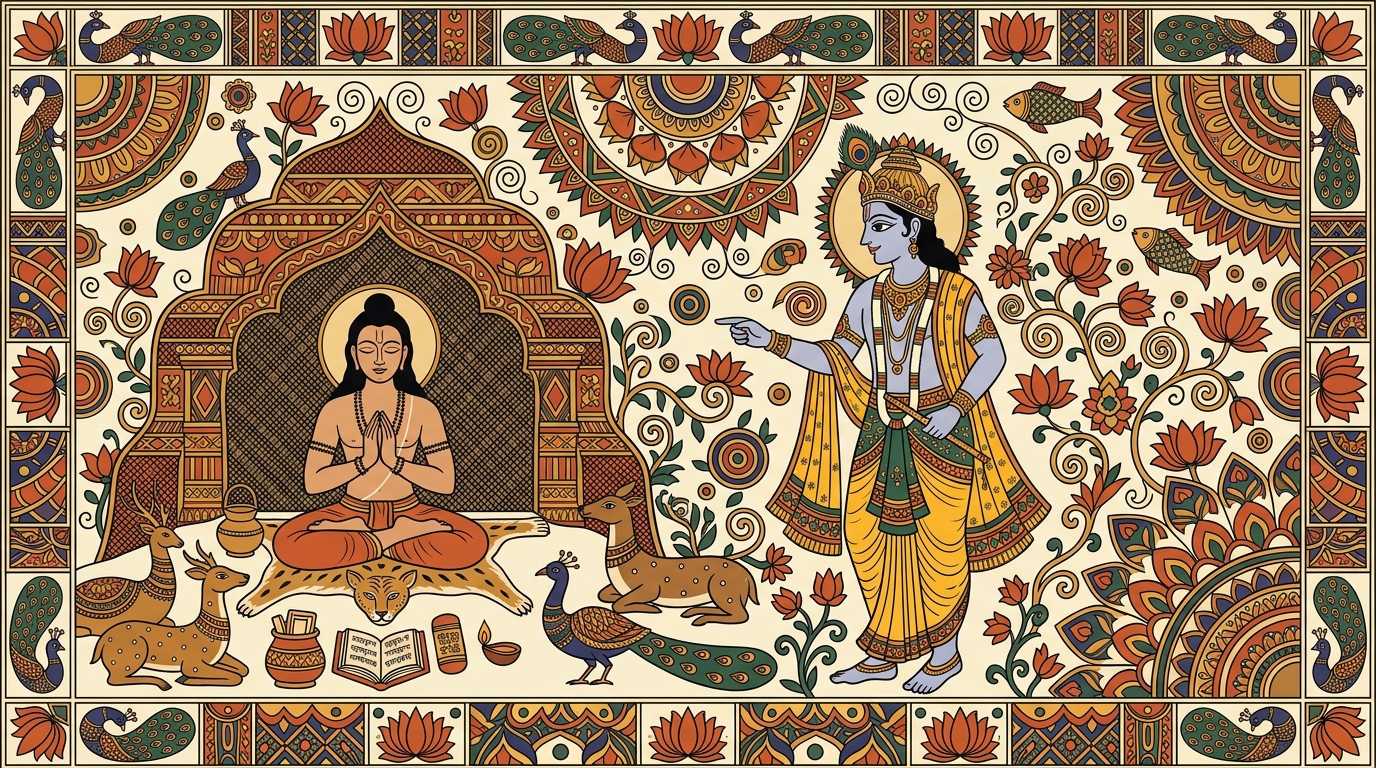
Young Devadatta had lived all his life in a busy forest ashram. From
before dawn the place hummed: students sweeping the yard, milk pails
clanking, the older boys reciting verses, cows lowing at the gate.
He loved it. But whenever he sat to meditate, the noise crept in
behind his closed eyes — a half-heard joke, the smell of cooking
rice, the worry that he had left a chore undone.
One evening he knelt before his teacher. "Master, I try to steady my
mind, but it runs out the door after every sound. What am I doing
wrong?"
The old sage smiled and pointed up the hillside, where a single cave
sat above the treeline. "Nothing wrong. You have only chosen a noisy
riverbank to learn to float. Go up there. Take a water pot, a mat,
and nothing else. No spare robe to fuss over, no basket of fruit to
guard. Sit alone. Practise a little each day, at the same hour, the
way you would water a young plant."
So Devadatta climbed to the cave. The first day was the hardest.
Without the ashram's clamour, his own thoughts grew suddenly loud,
as if they had been shouting all along and he had only just heard
them. He did not chase them. He simply sat, came back to his breath,
and sat again the next day, and the next.
He owned almost nothing now, and strangely he missed nothing. With
no things to mind and no one to impress, his wanting quietened first,
and then his thoughts. By the time the moon had grown round and thin
and round again, he could sit through a whole dawn with a mind as
still as the pool outside the cave.
When at last he came down the hill, his teacher saw it in his face.
"You have not become someone new," the sage said. "You have only
stopped scattering yourself. That steady, daily sitting — alone,
wanting nothing, holding nothing — is where every yogi begins."