The Yoga of the Supreme Self
पुरुषोत्तमयोग
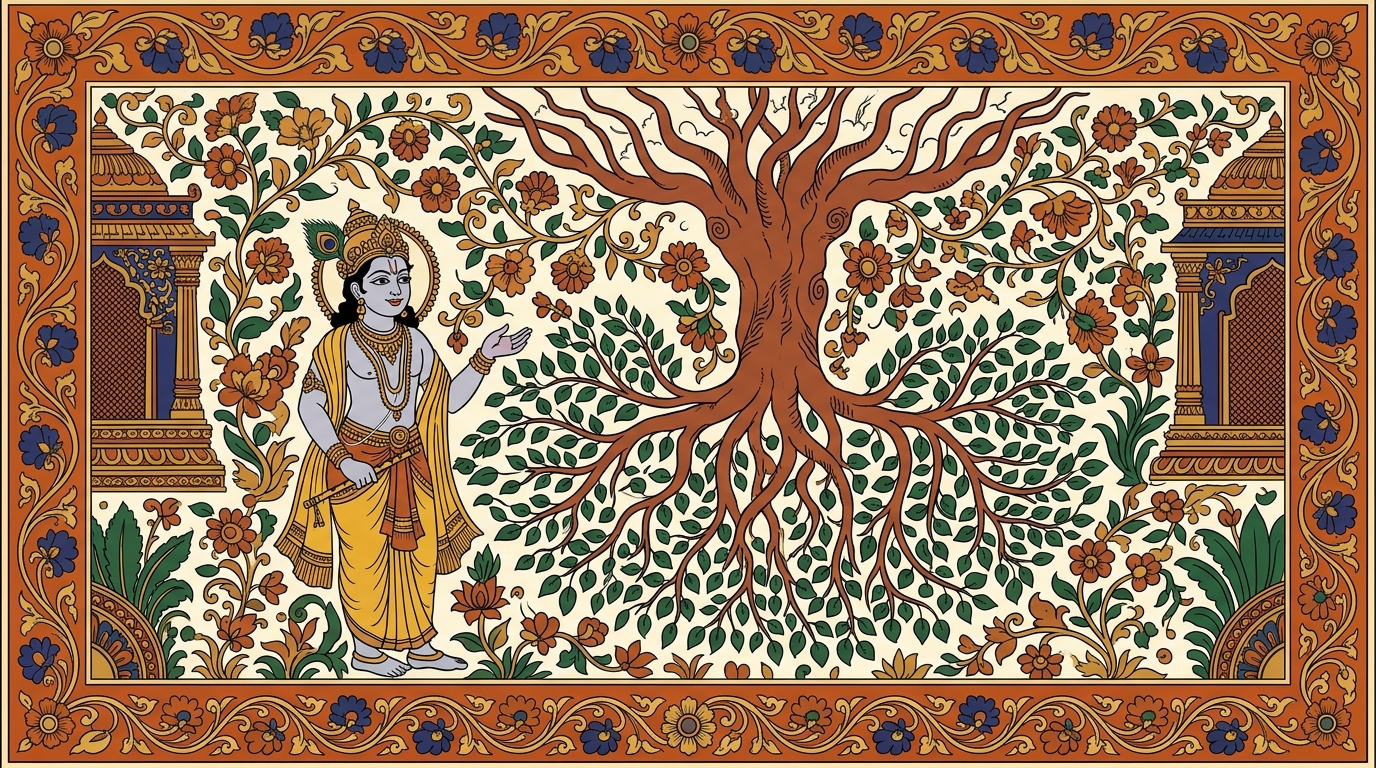
Krishna describes the universe as a great upside-down tree — its roots reach up to heaven and its branches spread down into the world. This magical tree represents all of life's attachments. A wise person learns to look beyond this tree to find the Supreme Self, the source of all light and love.
All 20 verses — Sanskrit and English, side by side. Read with illustrations →
| # | Sanskrit | English |
|---|---|---|
| Verse 15.1 | ऊर्ध्वमूलमधःशाखमश्वत्थं प्राहुरव्ययम्। छन्दांसि यस्य पर्णानि यस्तं वेद स वेदवित्॥ ūrdhvamūlamadhaḥśākhamaśvatthaṁ prāhuravyayam | chandāṁsi yasya parṇāni yastaṁ veda sa vedavit || | Krishna Krishna describes an extraordinary upside-down tree called the ashvattha. Its roots grow upward into heaven, and its branches spread downward into the world. The sacred hymns of the Vedas are its leaves. Anyone who understands this cosmic tree understands all of wisdom. |
| Verse 15.2 | अधश्चोर्ध्वं प्रसृतास्तस्य शाखा गुणप्रवृद्धा विषयप्रवालाः। अधश्च मूलान्यनुसन्ततानि कर्मानुबन्धीनि मनुष्यलोके॥ adhaścordhvaṁ prasṛtāstasya śākhā guṇapravṛddhā viṣayapravālāḥ | adhaśca mūlānyanusantatāni karmānubandhīni manuṣyaloke || | Krishna The branches of this cosmic tree stretch both upward and downward, fed by the three gunas: sattva, rajas, and tamas. The buds on these branches are our sense-pleasures: the things we see, hear, taste, and want. And secondary roots grow downward into the human world, tying people to their actions through karma. |
| Verse 15.3 | न रूपमस्येह तथोपलभ्यते नान्तो न चादिर्न च संप्रतिष्ठा। अश्वत्थमेनं सुविरूढमूलमसङ्गशस्त्रेण दृढेन छित्त्वा॥ na rūpamasyeha tathopalabhyate nānto na cādirna ca saṁpratiṣṭhā | aśvatthamenaṁ suvirūḍhamūlamasaṅgaśastreṇa dṛḍhena chittvā || | Krishna No one can see the true shape of this tree while living inside it. It has no visible end, no clear beginning, and no solid foundation you can stand on. But there is a way through: take the strong axe of non-attachment and cut the tree down. Not with anger or force, but with calm, steady detachment from all the desires that keep its roots growing. |
| Verse 15.4 | ततः पदं तत्परिमार्गितव्यं यस्मिन्गता न निवर्तन्ति भूयः। तमेव चाद्यं पुरुषं प्रपद्ये यतः प्रवृत्तिः प्रसृता पुराणी॥ tataḥ padaṁ tatparimārgitavyaṁ yasmingatā na nivartanti bhūyaḥ | tameva cādyaṁ puruṣaṁ prapadye yataḥ pravṛttiḥ prasṛtā purāṇī || | Krishna Once you have cut through the tree of attachment, search for that supreme place from which no one ever returns to this cycle of birth and death. Surrender to the very first Being, the ancient source from whom all of creation has been flowing since the beginning of time. |
| Verse 15.5 | निर्मानमोहा जितसङ्गदोषा अध्यात्मनित्या विनिवृत्तकामाः। द्वन्द्वैर्विमुक्ताः सुखदुःखसंज्ञैर्गच्छन्त्यमूढाः पदमव्ययं तत्॥ nirmānamohā jitasaṅgadoṣā adhyātmanityā vinivṛttakāmāḥ | dvandvairvimuktāḥ sukhaduḥkhasaṁjñairgacchantyamūḍhāḥ padamavyayaṁ tat || | Krishna Those who are free from pride and confusion, who have conquered the pull of attachment, who stay connected to their inner Self, and who have let go of cravings — they are no longer tossed back and forth by pleasure and pain. These clear-eyed people reach the eternal, unchanging home. |
| Verse 15.6 | न तद्भासयते सूर्यो न शशाङ्को न पावकः। यद्गत्वा न निवर्तन्ते तद्धाम परमं मम॥ na tadbhāsayate sūryo na śaśāṅko na pāvakaḥ | yadgatvā na nivartante taddhāma paramaṁ mama || | Krishna Neither the sun, the moon, nor fire can illuminate that supreme abode of Mine. It shines by its own light. Nothing outside it is needed to make it bright. And those who reach that place never have to come back. It is the ultimate home of the soul. |
| Verse 15.7 | ममैवांशो जीवलोके जीवभूतः सनातनः। मनःषष्ठानीन्द्रियाणि प्रकृतिस्थानि कर्षति॥ mamaivāṁśo jīvaloke jīvabhūtaḥ sanātanaḥ | manaḥṣaṣṭhānīndriyāṇi prakṛtisthāni karṣati || | Krishna The living self in every being is none other than Brahman, says Krishna. Just as one sun is reflected in a thousand pots of water, never broken into pieces, the one infinite Self shines as countless beings. But caught in material nature, each reflection struggles with the five senses and the mind, and forgets its true nature: that it was never separate from the whole. |
| Verse 15.8 | शरीरं यदवाप्नोति यच्चाप्युत्क्रामतीश्वरः। गृहीत्वैतानि संयाति वायुर्गन्धानिवाशयात्॥ śarīraṁ yadavāpnoti yaccāpyutkrāmatīśvaraḥ | gṛhītvaitāni saṁyāti vāyurgandhānivāśayāt || | Krishna When the soul takes on a new body, or when it leaves an old one, it carries the mind and senses along with it, the way wind carries the fragrance of flowers from a garden. The body is left behind, but everything the soul has learned and felt travels onward to the next life. |
| Verse 15.9 | श्रोत्रं चक्षुः स्पर्शनं च रसनं घ्राणमेव च। अधिष्ठाय मनश्चायं विषयानुपसेवते॥ śrotraṁ cakṣuḥ sparśanaṁ ca rasanaṁ ghrāṇameva ca | adhiṣṭhāya manaścāyaṁ viṣayānupasevate || | Krishna The soul presides over the ears, the eyes, the skin, the tongue, and the nose, and the mind, which makes six. Through these six windows, the soul experiences all the sights, sounds, tastes, smells, and textures of the world. The senses are just instruments. The soul is the one doing the enjoying. |
| Verse 15.10 | उत्क्रामन्तं स्थितं वापि भुञ्जानं वा गुणान्वितम्। विमूढा नानुपश्यन्ति पश्यन्ति ज्ञानचक्षुषः॥ utkrāmantaṁ sthitaṁ vāpi bhuñjānaṁ vā guṇānvitam | vimūḍhā nānupaśyanti paśyanti jñānacakṣuṣaḥ || | Krishna The deluded cannot perceive the soul — whether it is leaving the body, dwelling in it, or enjoying through the senses under the influence of the gunas. But those who have the eye of knowledge can see it clearly. Wisdom is like a special kind of seeing that goes beyond what the ordinary eyes can show. |
| Verse 15.11 | यतन्तो योगिनश्चैनं पश्यन्त्यात्मन्यवस्थितम्। यतन्तोऽप्यकृतात्मानो नैनं पश्यन्त्यचेतसः॥ yatanto yoginaścainaṁ paśyantyātmanyavasthitam | yatanto'pyakṛtātmāno nainaṁ paśyantyacetasaḥ || | Krishna Yogis who work hard to purify their minds can eventually see the soul shining within themselves. But those who have not disciplined their minds, even if they try just as hard, cannot perceive it, because their inner vision is clouded. |
| Verse 15.12 | यदादित्यगतं तेजो जगद्भासयतेऽखिलम्। यच्चन्द्रमसि यच्चाग्नौ तत्तेजो विद्धि मामकम्॥ yadādityagataṁ tejo jagadbhāsayate'khilam | yaccandramasi yaccāgnau tattejo viddhi māmakam || | Krishna The brilliant light of the sun that illuminates the entire world, the soft glow of the moon, and the dancing brightness of fire — all of that radiance comes from Krishna. Every source of light in creation is a tiny fraction of his splendour. |
| Verse 15.13 | गामाविश्य च भूतानि धारयाम्यहमोजसा। पुष्णामि चौषधीः सर्वाः सोमो भूत्वा रसात्मकः॥ gāmāviśya ca bhūtāni dhārayāmyahamojasā | puṣṇāmi cauṣadhīḥ sarvāḥ somo bhūtvā rasātmakaḥ || | Krishna Krishna enters the earth and holds up every creature with his strength. He becomes the moon, Soma, whose cool light fills every plant with nourishing sap. The mountains stand firm and the smallest seed pushes through dark soil because a divine energy flows through the earth itself. |
| Verse 15.14 | अहं वैश्वानरो भूत्वा प्राणिनां देहमाश्रितः। प्राणापानसमायुक्तः पचाम्यन्नं चतुर्विधम्॥ ahaṁ vaiśvānaro bhūtvā prāṇināṁ dehamāśritaḥ | prāṇāpānasamāyuktaḥ pacāmyannaṁ caturvidham || | Krishna Krishna becomes the digestive fire, Vaishvanara, that lives inside every creature's body. Working together with the incoming and outgoing breath, this sacred fire digests the four kinds of food: food that is chewed, swallowed, licked, and sucked. Every belly carries a tiny temple. |
| Verse 15.15 | सर्वस्य चाहं हृदि सन्निविष्टो मत्तः स्मृतिर्ज्ञानमपोहनं च। वेदैश्च सर्वैरहमेव वेद्यो वेदान्तकृद्वेदविदेव चाहम्॥ sarvasya cāhaṁ hṛdi sanniviṣṭo mattaḥ smṛtirjñānamapohanaṁ ca | vedaiśca sarvairahameva vedyo vedāntakṛdvedavideva cāham || | Krishna Krishna says, "I sit in the heart of every living being. From Me come memory, knowledge, and even forgetfulness. I am the one who is to be known through all the Vedas. I composed the Vedanta, and I alone truly know what the Vedas mean." |
| Verse 15.16 | द्वाविमौ पुरुषौ लोके क्षरश्चाक्षर एव च। क्षरः सर्वाणि भूतानि कूटस्थोऽक्षर उच्यते॥ dvāvimau puruṣau loke kṣaraścākṣara eva ca | kṣaraḥ sarvāṇi bhūtāni kūṭastho'kṣara ucyate || | Krishna Krishna tells Arjuna there are two kinds of beings in the world. One kind is perishable — every creature that is born, lives, and dies. The other is imperishable, the unchanging soul that watches from within. Understanding this difference is the first step toward knowing the Supreme. |
| Verse 15.17 | उत्तमः पुरुषस्त्वन्यः परमात्मेत्युदाहृतः। यो लोकत्रयमाविश्य बिभर्त्यव्यय ईश्वरः॥ uttamaḥ puruṣastvanyaḥ paramātmetyudāhṛtaḥ | yo lokatrayamāviśya bibhartyavyaya īśvaraḥ || | Krishna But beyond both the perishable and the imperishable, there is a supreme reality, called Paramatma, the Supreme Self. This infinite awareness pervades all three worlds and sustains them, the way one ocean holds every wave without being diminished. This is Brahman, the imperishable ground of all existence. |
| Verse 15.18 | यस्मात्क्षरमतीतोऽहमक्षरादपि चोत्तमः। अतोऽस्मि लोके वेदे च प्रथितः पुरुषोत्तमः॥ yasmātkṣaramatīto'hamakṣarādapi cottamaḥ | ato'smi loke vede ca prathitaḥ puruṣottamaḥ || | Krishna Because this supreme reality is beyond everything that changes and even beyond the unchanging individual soul, it is known in the world and in the Vedas as Purushottama — the Supreme Self. When Krishna says "I am Purushottama," he speaks as Brahman itself, the non-dual reality that is the true identity of all beings. This gives the chapter its name. |
| Verse 15.19 | यो मामेवमसम्मूढो जानाति पुरुषोत्तमम्। स सर्वविद्भजति मां सर्वभावेन भारत॥ yo māmevamasammūḍho jānāti puruṣottamam | sa sarvavidbhajati māṁ sarvabhāvena bhārata || | Krishna One who sees Krishna clearly — without confusion — as the Supreme Person becomes the knower of all things. Such a person worships Krishna with their whole being, not just with rituals or words, but with every breath and every thought. This knowing is not just of the mind; it is of the heart. |
| Verse 15.20 | इति गुह्यतमं शास्त्रमिदमुक्तं मयानघ। एतद्बुद्ध्वा बुद्धिमान्स्यात्कृतकृत्यश्च भारत॥ iti guhyatamaṁ śāstramidamuktaṁ mayānagha | etadbuddhvā buddhimānsyātkṛtakṛtyaśca bhārata || | Krishna Krishna brings his teaching to a close. This, he tells Arjuna, is the most secret of all teachings. Anyone who understands it becomes wise and has fulfilled everything they needed to do in this life. The chapter ends quietly, with the stillness of something complete. |