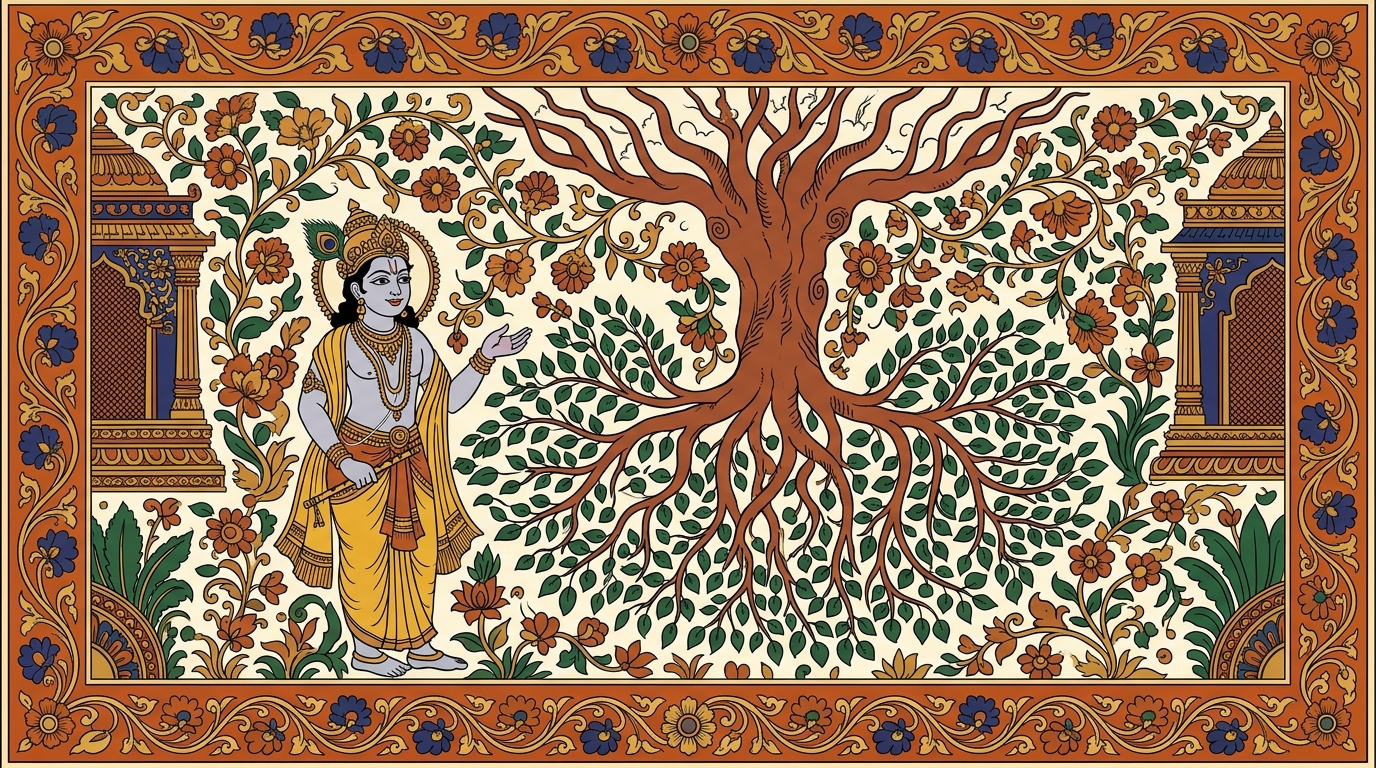
Arjuna smelled sandalwood smoke before he saw anything change.
One moment they were standing on the dry earth of Kurukshetra, the
chariot wheels still, the horses flicking their ears at flies. The
next, a ripple passed through the air, like heat shimmer off summer
stone, and the battlefield was gone.
In its place stood a tree.
But not like any tree Arjuna had ever climbed as a boy in the palace
orchards of Hastinapura. This tree was upside down. Its roots reached
upward, pale and silver, threading into a sky that had no end — no
clouds, no sun, just light, vast and steady and impossibly old. Its
trunk descended from that brightness, thick as a temple pillar, its
bark the colour of dark honey. And its branches, thousands upon
thousands of them, spread downward and outward in every direction,
each one heavy with shimmering leaves that caught the light and
hummed.
Yes, hummed. Each leaf was singing.
Arjuna stepped closer. The sound grew. It was not one voice but
millions — overlapping, braiding, echoing — and he recognised
fragments. The Rig Veda. The Sama Veda. Hymns his mother Kunti
had chanted at dawn. Prayers the priests had sung at his wedding.
Every sacred word ever spoken seemed to rustle in those leaves.
"Krishna," he whispered, "what is this?"
Krishna stood beside him, the peacock feather in his hair perfectly
still despite a wind that seemed to come from everywhere. "This is
the ashvattha," he said. "The tree of everything. Its roots drink
from Brahman — the source that has no source. Its branches become
the world you know. Every creature, every desire, every lifetime
hangs from it like fruit."
Arjuna reached out to touch a branch. It was warm, alive, pulsing
with a slow rhythm — like a heartbeat, but deeper. Through the bark
he could feel the hum of the leaves, the pull of the roots, the
whole living engine of creation trembling under his fingertips.
"It's called ashvattha," Krishna continued, "because nothing in it
stays till tomorrow. The leaves fall, new ones grow. Worlds are
born and dissolve. Yet the tree itself never dies."
Arjuna looked up into the roots, into that endless silver light. He
looked down into the branches, where shadows gathered like sleeping
animals. Somewhere far below, he thought he could hear rivers, and
children laughing, and the creak of cart wheels on a dusty road.
"The wise," Krishna said, "are the ones who see the whole tree — not
just the branch they are sitting on."