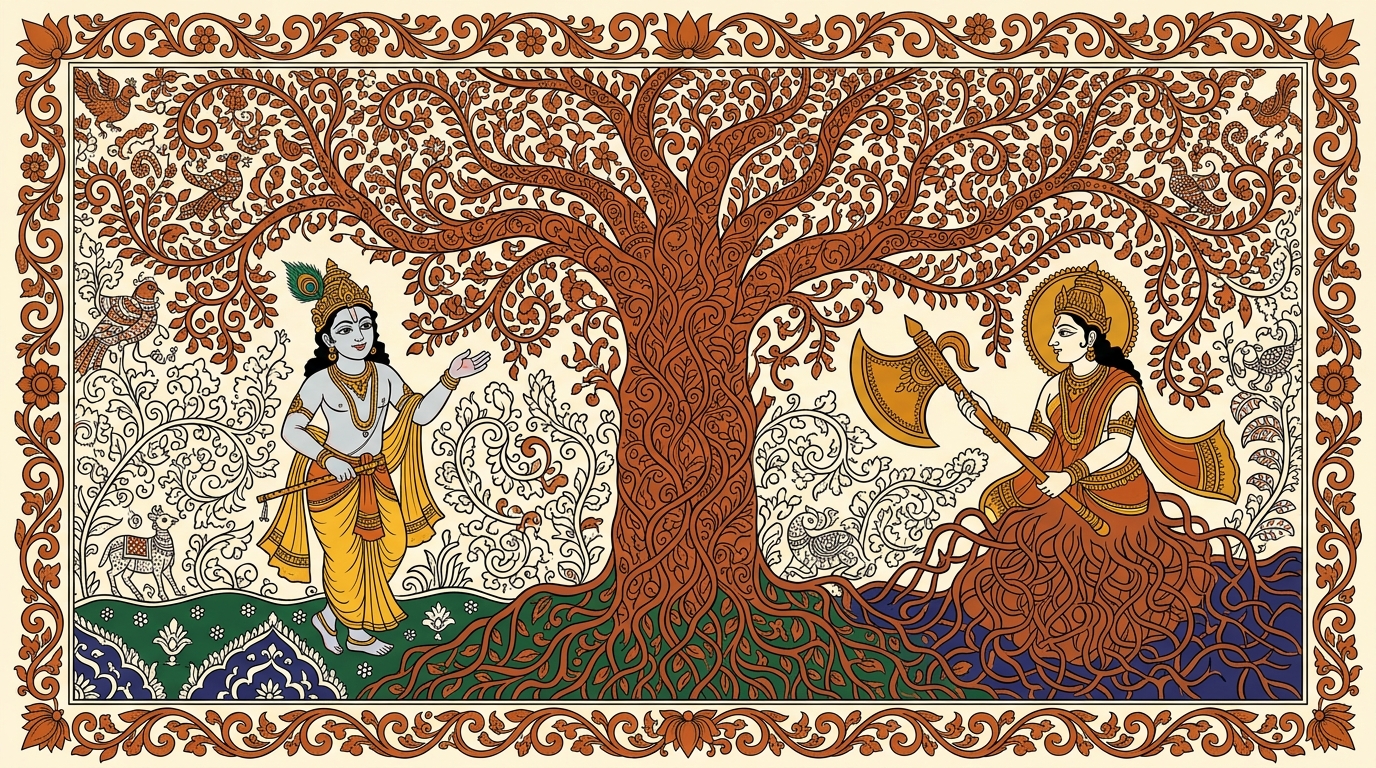
Narada had been walking for seven years when the boy found him.
The sage was crossing a forest of teak trees somewhere between
Varanasi and the mountains, his one-stringed veena slung across his
back, his feet bare and calloused from roads without end. He heard
the boy before he saw him — a voice calling from behind a boulder,
high and sharp and frustrated.
"Gurudev! I know you are Narada. Please stop."
Narada stopped. The boy scrambled out from behind the rock. He was
perhaps eleven, thin-armed, with ink stains on his fingers and a
worn satchel of palm-leaf manuscripts bouncing against his hip.
"My name is Dhruvan," the boy said, catching his breath. "I have
studied the Vedas for three years. I know the ashvattha tree — the
tree of creation, roots above, branches below. My guru told me I
must cut it down to find freedom." He held up his hands, helpless.
"But how? I cannot see it. I cannot find where it begins or ends.
How do I cut something I cannot even find?"
Narada sat on the boulder. He plucked a single note on his veena
and let it hang in the warm air.
"Dhruvan," he said. "When you woke this morning, what was the first
thing you wanted?"
The boy blinked. "I wanted to find you."
"And before that? Yesterday?"
"I wanted to finish copying the Sama Veda. And before that I wanted
my mother's kheer because the ashram food is terrible. And before
that I wanted a new stylus because mine is cracked." He paused. "Why?"
"Each wanting," Narada said, "is a branch. You are already inside
the tree. You cannot see its shape because you are woven into it —
your wanting for kheer, your cracked stylus, your wish to find me.
They are all branches you are sitting on."
Dhruvan frowned. "Then how do I cut them?"
Narada held up his hands. They were empty. "The axe is not made of
iron. It is made of letting go. When your mother's kheer appears in
your mind and you smile at it and let it pass — that is a cut. When
your cracked stylus annoys you and you notice the annoyance without
grabbing it — that is another cut. Each time you hold a desire
lightly instead of tightly, the blade falls."
He played another note on his veena.
"You will not cut the tree in one swing. No one does. But every act
of gentle letting-go loosens the roots. And one day you will find
that the tree you could never see has quietly fallen, and you are
standing in open sky."
Dhruvan sat down on the forest floor, his manuscripts forgotten.
He closed his eyes. Somewhere in his mind, the image of his
mother's kheer rose, warm and sweet and milky. He looked at it.
He smiled. He let it go.
It was the smallest cut. But it was his first.