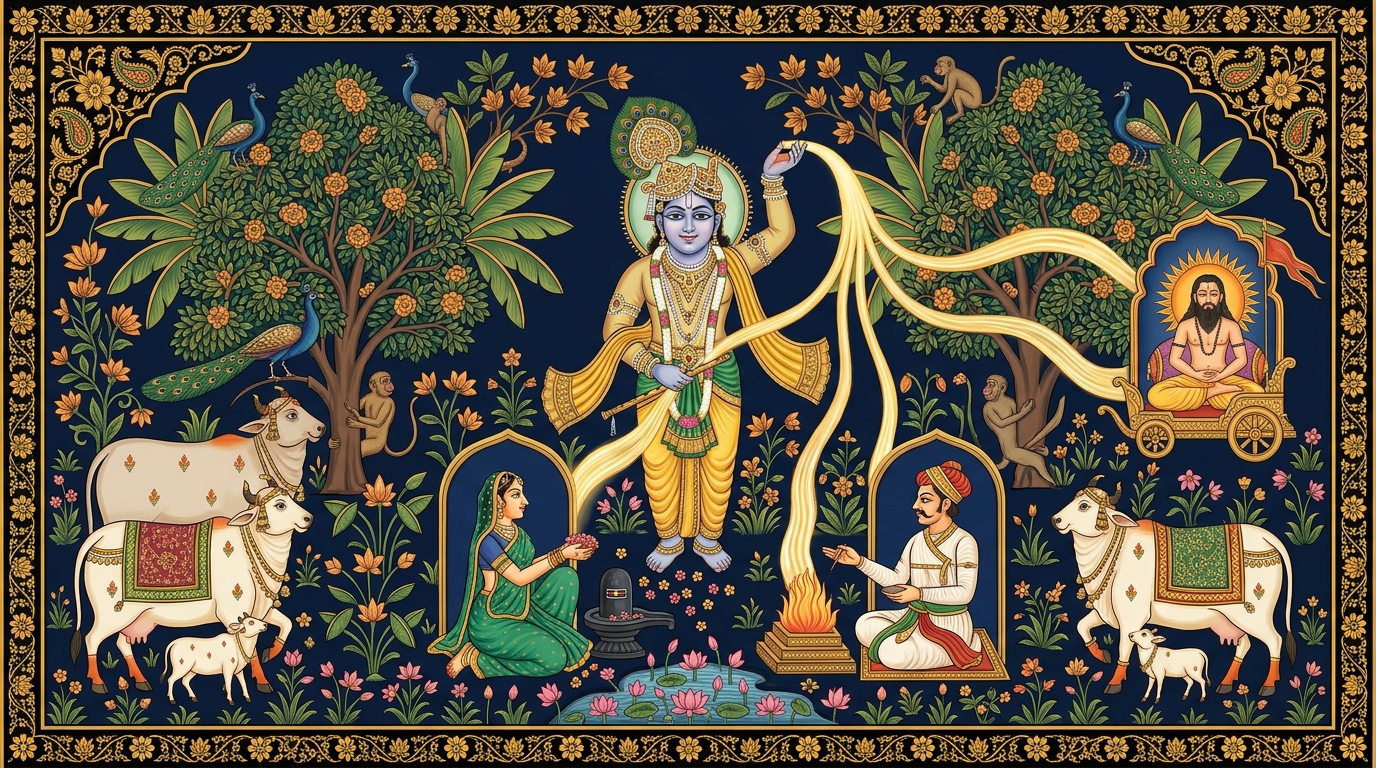
In a dry corner of the land, where the rains were late and the wells ran
low, there lived a farmer who loved his village deity with all his heart.
The deity was a small bright image kept in a shrine at the edge of the
fields — garlanded with marigolds, its little lamp tended faithfully. When
the clouds refused to come and the soil cracked like old pottery, the farmer
went to the shrine. He swept the floor, lit the lamp, folded his rough hands,
and prayed with everything in him: "Send us rain. Just enough. Please."
For three days he prayed. On the fourth morning the sky filled with grey
bellies of cloud, and by afternoon the rain came down in long silver ropes,
soaking the thirsty earth until it breathed out that sweet smell of relief.
The whole village ran out into it, laughing, faces turned up.
"My deity sent the rain!" the farmer cried joyfully.
Now, an old sage happened to be resting under a tree at the village edge,
watching the rain make rings in a puddle. The farmer ran to him, bursting to
share the good news. "My little shrine-god answered me! See how powerful he
is!"
The sage smiled and pointed to the village. "Come, let me show you
something." He led the farmer to the place where, that very week, the
villagers had dug a new system of channels. From one hidden underground
spring, clay pipes ran out in every direction — to the potter's house, to the
weaver's, to the temple, to the farmer's own field. At each end stood a
different spout, and from each spout poured clear, cool water.
"The potter says the water comes from his tap," said the sage. "The weaver
says it comes from hers. Each is sure of his own spout. But you and I have
seen the spring. Every spout, every tap, every channel — all of it is fed by
one source, deep in the earth, that none of them can see."
The farmer stood quiet, the rain still falling around him.
"Your faith was true, and so your wish was granted — that part is real," the
sage said gently. "But the rain did not come from a small god in a small
shrine. It came, as all gifts come, from the one divine spring behind every
form. The deities are only the spouts. The water is always His."
The farmer looked at his shrine, then up at the wide grey sky, and for the
first time he saw them as one and the same.