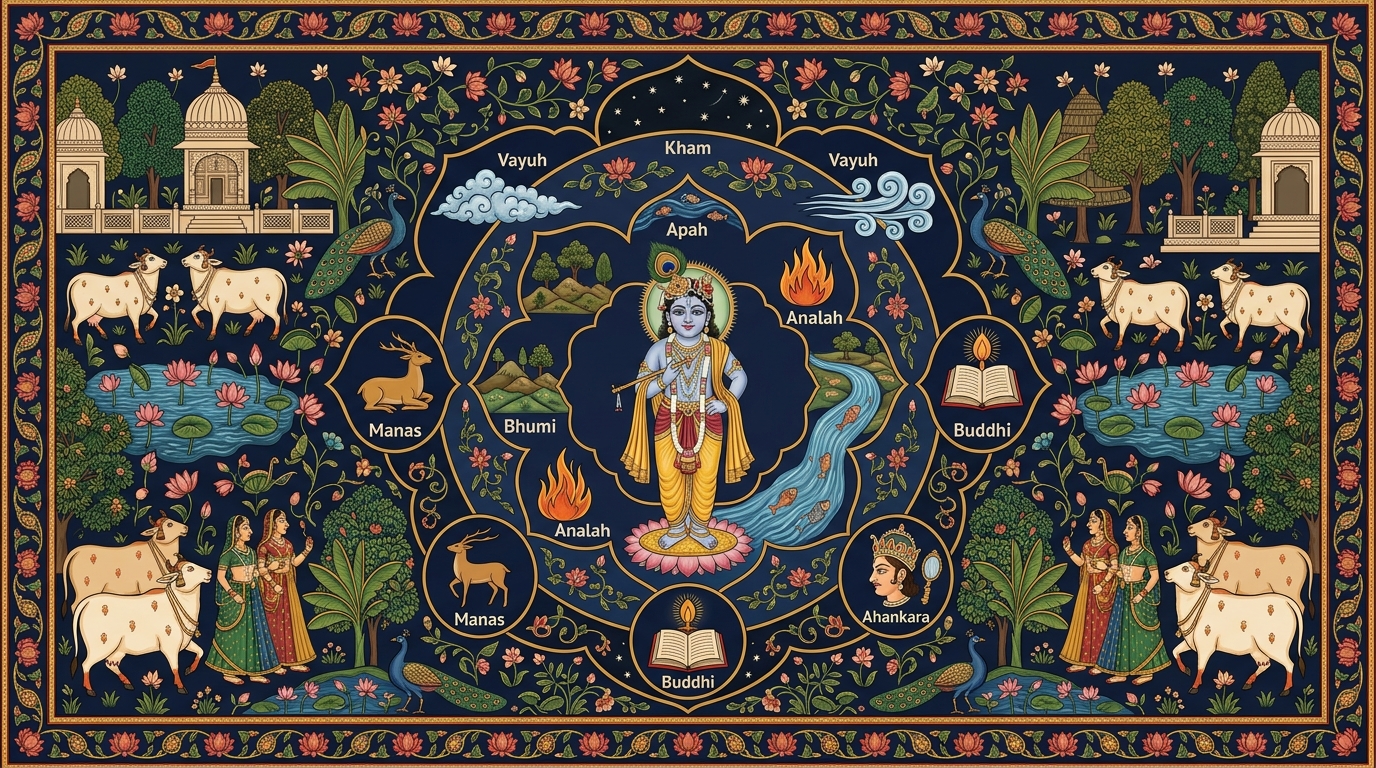
In a clearing deep in the forest, where the morning light came down in
slanting golden bars, an old sage sat with a ring of students around him.
They had asked him a big question: "What is the whole world made of?"
The sage did not answer in words right away. Instead he reached down and
picked up a clay pot from beside the fire.
"Touch this," he said, passing it around. The students felt its rough, cool
sides. "This is earth — the firm, solid stuff. The ground under you, the
mountains, your own bones. That is the first."
He tipped a little water from the pot into his palm. It caught the light.
"Water — the flowing stuff. The river, the rain, the blood in your veins,
the tears in your eyes. That is the second."
He held his hand near the small fire. "Feel the warmth? Fire — the burning,
shining stuff. The flame of this lamp, the heat of the sun, the warmth that
keeps you alive. That is the third."
A breeze stirred the leaves. "Air — the moving stuff you cannot see but feel.
The wind, your own breath going in and out. The fourth."
Then he spread his arms wide at the empty space between the trees. "And this
— the room that holds everything else. Space. The sky, the gap between two
stars, the emptiness inside a pot that lets you fill it. The fifth."
The students nodded slowly. Five things. Earth, water, fire, air, space.
"But that is only the outside world," the sage said, tapping his own
forehead. "Now look inward. The part of you that thinks, that races from
one thought to the next — that is mind. The sixth."
"The part of you that weighs things and decides, that says yes or no —
that is the intellect. The seventh."
He smiled. "And the smallest, trickiest one of all: the little voice that
says 'I, me, mine.' The sense that you are a separate someone. That is the
ego. The eighth."
The students sat very still. The same eight pieces, the sage told them, made
up everything — the pot and the river, the lamp and the breath, and even the
busy little 'I' that had asked the question in the first place. All of it was
the outer nature of the One behind it all.