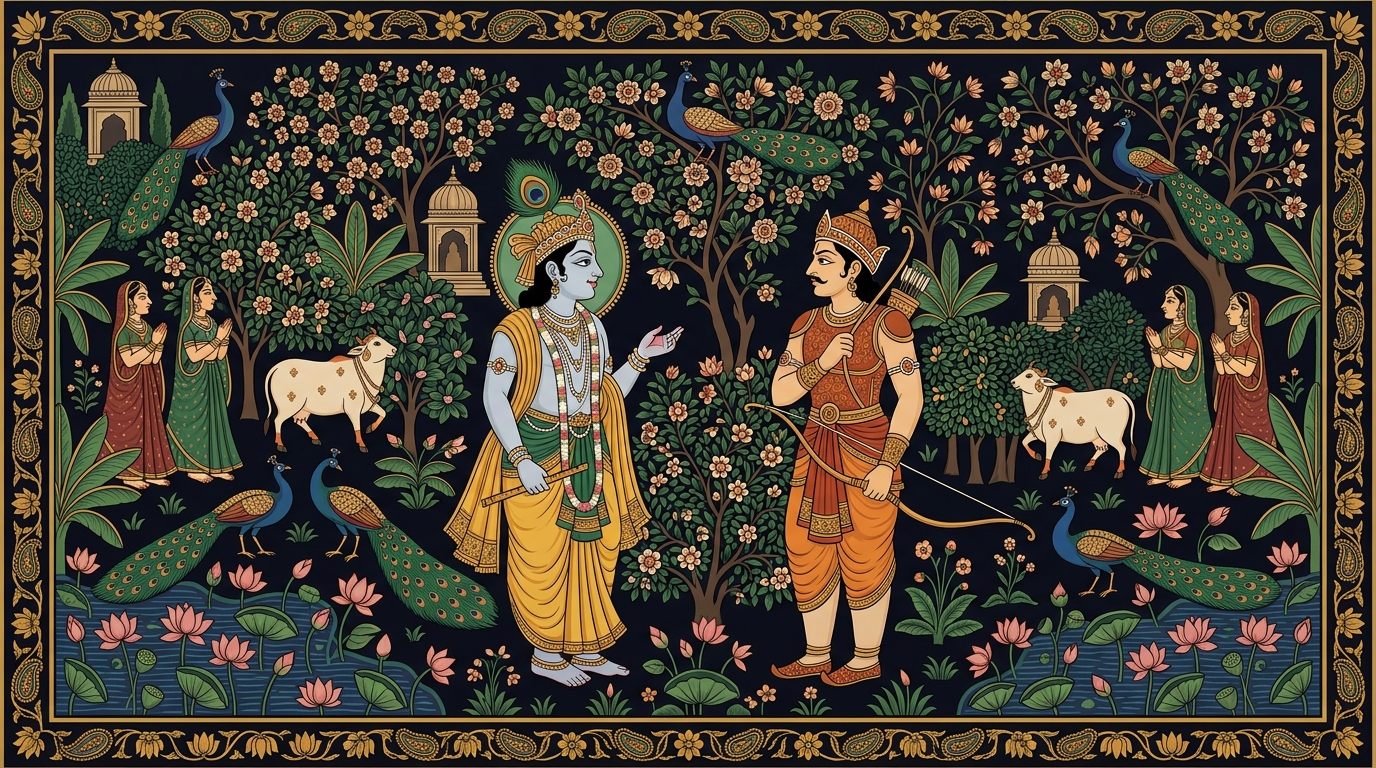
Meera was proud of always telling the truth. In Nathdwara, near the
Shrinathji temple where her grandfather painted, she had a name for being
honest — sometimes a little too honest.
On Tuesday her friend Anaya showed her a clay diya she had painted for the
festival. The paint had run, and one side was lumpy. "Do you like it?" Anaya
asked, eyes shining.
"It's lopsided," Meera said at once. "And the colours are smudged." It was
true. Every word of it was true. But Anaya's shining eyes filled with tears,
and she put the diya behind her back and walked away.
Meera felt strange all afternoon. She had not lied. So why did it feel so
bad?
She found Dadaji on the temple steps, grinding a fresh pot of yellow paint
for a Pichwai cloth. She told him everything.
"Was what you said true?" Dadaji asked.
"Completely," said Meera.
"And was it kind?"
Meera was quiet.
"There is an old teaching," Dadaji said, dipping his brush. "Good speech has
to pass through three gates before it leaves your mouth. The first gate asks:
is it true? The second asks: is it kind? The third asks: is it helpful?" He
held up three paint-stained fingers. "You opened the first gate, beti. You
forgot the other two."
"But if I'm kind, am I lying?" Meera asked.
"Not at all," said Dadaji, smiling. "Truth has many true things you can
choose to say. You could have said, 'I love that you painted it yourself —
and look, the next one will be even better if you let this layer dry first.'
True. Kind. Helpful. All three gates open."
That evening Meera found Anaya and tried again, slowly, choosing her words.
She told her the truth — the warm, helpful part of the truth — and showed her
Dadaji's trick of letting one colour dry before adding the next.
Anaya brought the diya back out from behind her. By the festival, it glowed
in the window with the rest, smudges and all, and Meera found she liked it
best of the whole row.