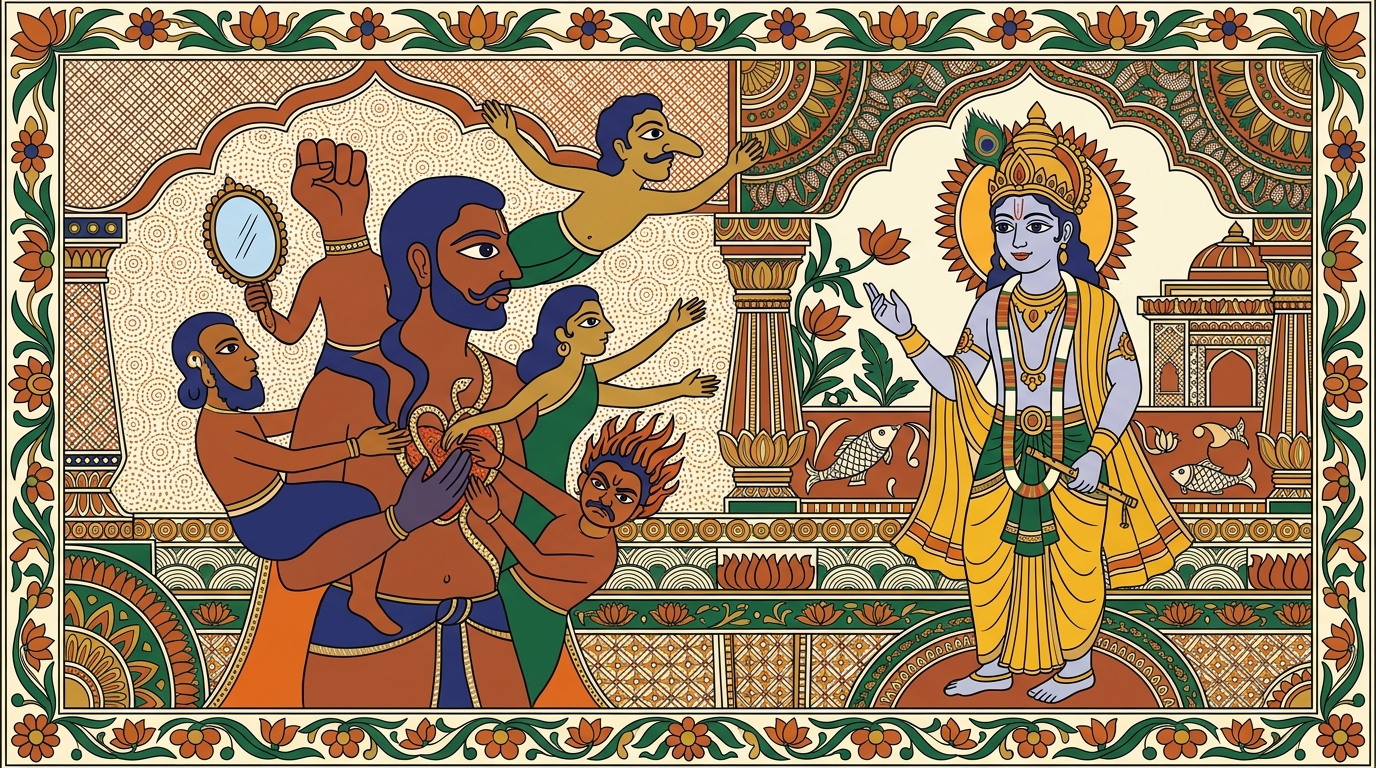
King Hiranyakashipu had a son unlike himself in every way, small Prahlada,
whose heart was so full of love for the Divine that it spilled out as
kindness to everyone he met.
The boy was gentle with servants. He shared his food with stray creatures.
When other children quarrelled, Prahlada was the one who made peace. And all
day, quietly, he remembered the Lord who lives in every heart, and his face
shone with a calm the whole palace could feel.
You might think a father would be proud. But Hiranyakashipu's heart was
crowded — packed tight with ego, with the love of force, with arrogance,
with greedy wanting, and with a quick, hot anger. There was no room left in
it for tenderness. And so, strangely, the gentleness of his own little boy
*annoyed* him.
"Why do you praise this Lord?" he would roar. "*I* am your lord! Praise me!"
The more peaceful Prahlada grew, the angrier his father became — for the
boy's quiet goodness was a light, and Hiranyakashipu had wrapped himself in
so many heavy feelings that the light hurt his eyes.
Here is the deep thing the storytellers point to. The same gentle Divine
that glowed in Prahlada also lived, unnoticed, inside Hiranyakashipu
himself. By resenting the goodness in his son, the king was really fighting
the very best part of his own heart, the soft, bright part buried under all
that ego and anger.
Prahlada understood this, even as a child. He never hated his father back.
"He carries something heavy," the boy thought, "and one day he may set it
down." He kept loving him, the way you keep a lamp burning in a window for
someone still out in the dark.
Krishna tells Arjuna that this is what those five heavy feelings do: they
make a person resent the goodness in others and in themselves. And the way
out is not anger in return, but the steady, patient kindness of a Prahlada —
a light left burning, in case the lost one turns toward home.