In the great stone palace of King Hiranyakashipu, every wall told the same
story: I am the strongest, I am the greatest, bow to me. The king had grown
his pride so tall that he could no longer see the sky beyond it.
His little son Prahlada lived in that same palace, and the king tried, day
after day, to pour his own hardness into the boy. "Hate those who do not
obey us," the king taught. "Crush those who are weaker. Take whatever you
want. That is what makes a person great."
Prahlada listened, and Prahlada quietly chose another way.
When a servant dropped a tray, Prahlada helped pick it up instead of
scolding. When the palace dogs were hungry, he shared his own bread. When the
king's soldiers spoke cruelly to the gardeners, Prahlada learned their names
and thanked them for the flowers.
His father raged. "Why are you so soft? Hate makes you strong!"
But Prahlada had noticed something his powerful father could not see. The
king never rested. Every night he lay awake, certain that someone was
plotting against him. Every gift made him suspicious. Every friend looked
like an enemy in waiting. The more he hated, the smaller and darker his
world became, until the whole palace felt like a locked room with no windows.
"Father," Prahlada said gently one evening, "you have everything, and you
are not happy. I have only my small kindnesses, and my heart is light. Which
of us is truly rich?"
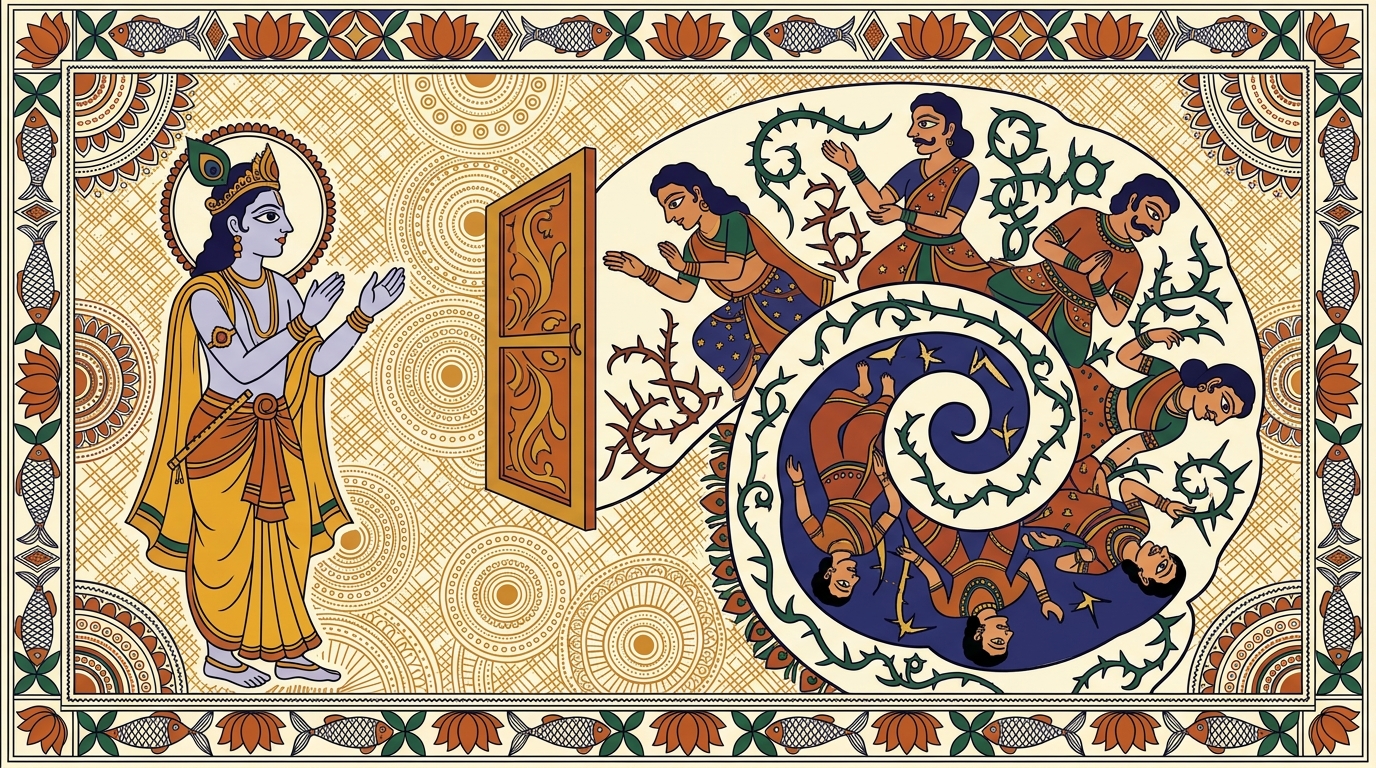
Krishna, telling this to Arjuna, said: the cruel and hateful ones build their
own dark rooms, birth after birth, and keep waking up inside them. Not because
anyone shut them in, but because hatred, fed long enough, becomes the only
house it knows how to build. There stood a door out of that darkness, the
same door Prahlada walked through every day. It was open the whole time. Its
name was kindness.