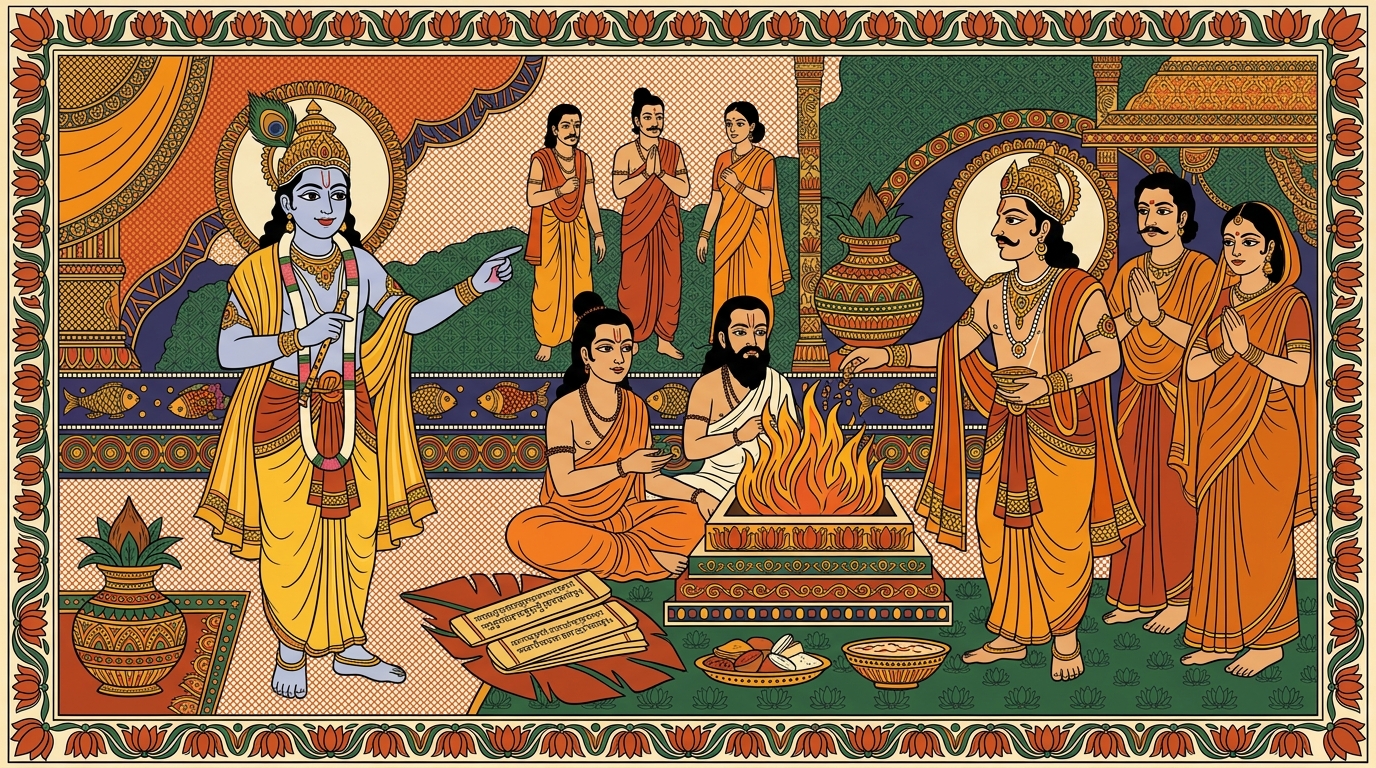
There was once a wealthy lord named Garvaka — and *garva* means pride — who
decided to hold the grandest sacrifice the land had ever seen.
He did not do it to thank the heavens or to share with his people. He did it
so that everyone for a hundred miles would say, "Have you heard? No one is
as great, as rich, as generous as Garvaka!"
He hired the most famous priests, not for their wisdom but for their fame.
He piled up gold and silk in great heaps where the crowds could gawk at
them. He stood at the centre of it all with his chin high and his back
stiff, accepting bows.
But Garvaka could not be bothered with the careful old rules of the rite. A
humble priest stepped forward and said gently, "My lord, the offerings must
be prepared just so, and the words spoken in their proper order, with a calm
and grateful heart — otherwise it is only a show, not a sacrifice."
Garvaka waved him away. "Who are you to instruct me? I am the richest man
here. The rules can bend for me." And so the great fire was lit in a hurry,
the sacred words mumbled out of order, the whole thing arranged to dazzle
the eye rather than to honour anything at all.
The crowds did gasp at the gold. They did praise his name as he hoped. But
that evening, when the fires died and the visitors went home, Garvaka stood
alone in the smoke and felt strangely empty, as hollow as a drum, all loud
surface and nothing within.
Nearby, in a tiny shrine, an old woman lit a single clay lamp, folded her
hands, and offered one flower with her whole quiet heart. Her ceremony cost
almost nothing, and no crowd ever saw it. Yet she walked home full and warm.
This is what Krishna means, Arjuna. Worship done only to show off, in name
alone and against the proper way, fills no one, not even the one who
performs it. It is the heart behind the offering, never the size of it, that
makes a thing sacred.