Skip to content
Chapter 16 · Verse 15
🪈 Krishna speaks
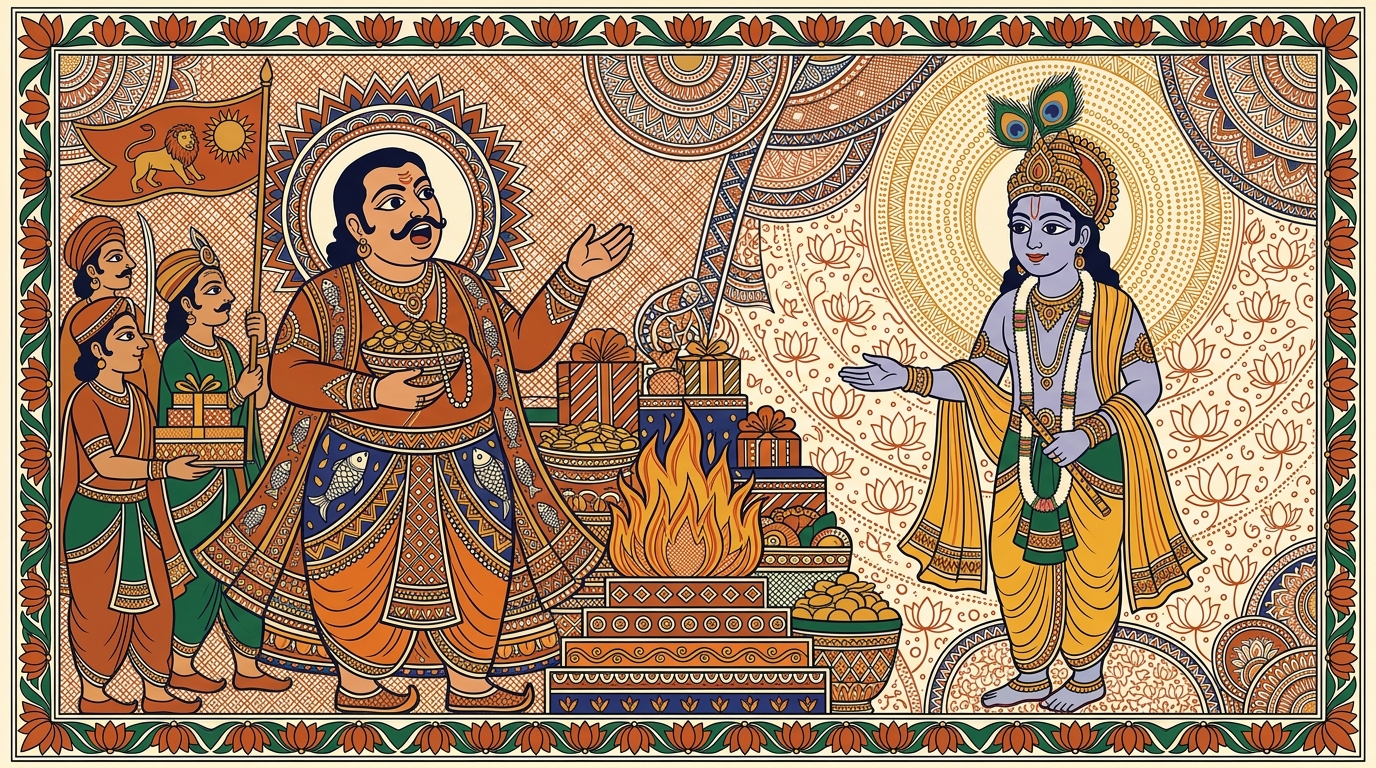
Illustration for Chapter 16, Verse 15

आढ्योऽभिजनवानस्मि कोऽन्योऽस्ति सदृशो मया। यक्ष्ये दास्यामि मोदिष्य इत्यज्ञानविमोहिताः॥

āḍhyo'bhijanavānasmi ko'nyo'sti sadṛśo mayā | yakṣye dāsyāmi modiṣya ityajñānavimohitāḥ ||

Word by Word 13 words
आढ्यः
āḍhya rich, wealthy

rich, wealthy

अभिजनवान्
abhi towards jan to be born vat having

of noble birth, high-born, well-connected

अस्मि
as to be

I am

कः
kim who, what

who

अन्यः
anya other

other, anyone else

अस्ति
as to be, to exist

is, exists

सदृशः
sa together, like dṛś to see, to resemble

equal to, like, a match for

मया
mad I, me

to me, with me

यक्ष्ये
yaj to sacrifice, to worship

I shall perform sacrifice

दास्यामि
to give

I shall give, I shall make gifts

मोदिष्ये
mud to rejoice, to be glad

I shall rejoice, I shall make merry

इति
iti thus, so

thus, in this way

अज्ञानविमोहिताः
a not jñā to know vi intensely muh to be deluded, confused

deluded by ignorance, confused by not-knowing

Here the boastful voice reaches its loudest. "I am rich. I come from a great family. Who in all the world is even equal to me? I'll hold grand ceremonies, I'll give gifts so everyone praises me, and I'll have a wonderful time!" Even the giving and the worship are really about showing off. ends the three boasting verses with a single gentle word of diagnosis: such people are *deluded by ignorance*, fooled by not knowing who they truly are. They are not wicked monsters; they are simply lost, and lost people can always be found again.

कथा

The Boast of Ten Heads

From the Ramayana

On the golden island of Lanka ruled a king with a famous mind — Ravana, of whom the old tales say he had ten heads, one for each kind of cleverness he was proud of.

Ravana was rich beyond counting. His palace shone with jewels; his halls rang with music; scholars and singers filled his court. And he had come from a great line — his grandfather was a revered sage. Ravana never forgot to mention it.

"Who is my equal?" he liked to ask his court, sweeping all ten faces across the hall. "Am I not the richest? The highest-born? The cleverest king who has ever lived?" The court would erupt in praise, and Ravana would smile all ten of his smiles.

He held enormous ceremonies — great fires, great feasts, great gifts handed out in golden bowls. But if you watched closely, you would see that Ravana never gave quietly. Every gift was given where crowds could see. Every sacred fire was lit so the whole city would speak of his greatness. "I shall worship, I shall give, I shall celebrate," he announced, and what he really meant was *I shall be admired*.

Yet for all ten heads of cleverness, there was one simple thing Ravana could not see: that his riches, his birth, his strength were gifts he had been given, not trophies he had made. He thought he stood above everyone. And the sages of the tale say this was not because his heart was made of stone, but because it was *covered over*, like a lamp wrapped in a thick cloth, its light still there but hidden by the heavy folds of *I, me, mine*.

That covering has a name, tells . It is called ignorance, simply not yet knowing the truth. And the good news hidden in the tale is this: a cloth, however thick, can always be lifted. The lamp underneath was never put out.
चिन्तनम्

Have you ever wanted to do something kind mostly so others would notice and praise you? How does a quiet, secret kindness feel different inside?