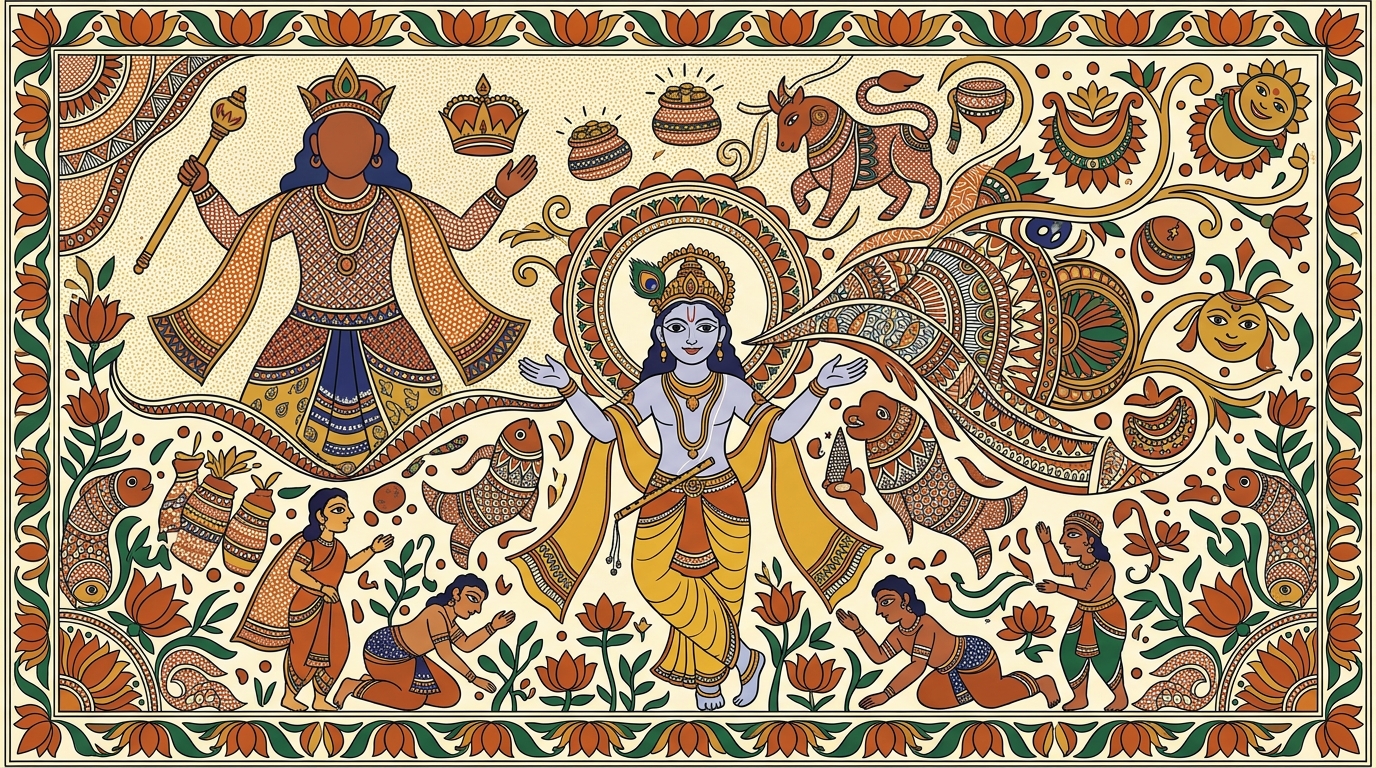
Long ago there lived a king named Hiranyakashipu, whose palace was carved
from gold and whose voice could shake the pillars of his own great hall.
He had won battle after battle. He had practised fierce penance until even
the heavens trembled, and he had been granted a boon that made him almost
impossible to harm. And so, each evening, he would climb the steps of his
throne, look out over his conquered lands, and recite his victories aloud
like a song he never tired of.
"That foe," he would say, pointing to an empty horizon, "I struck him down.
And the next, and the next — I shall crush them all in time. Who can stand
against me?" His courtiers nodded quickly, afraid to do anything else.
"I am the lord of the three worlds," he went on, his rings flashing. "I am
the one all pleasures belong to. I am the strongest. I am the most
successful. I am the happiest being alive."
But here is the strange thing the storytellers always notice. A truly happy
person does not need to announce it. Hiranyakashipu repeated *I am happy, I
am happy* the way someone repeats a word they are trying to believe. His
halls were full of treasure and empty of laughter. His guards feared him.
His ministers flattered him. No one loved him — except, quietly, his own
small son, Prahlada, who watched his father shout from the throne and felt
only a gentle sadness.
For all his boasting, Hiranyakashipu had forgotten the one thing that makes
a person genuinely strong: he thought every victory was his alone, won by
his own greatness. He never once looked up and wondered who had given him
his breath, his strength, his very life. And a heart that thinks it is the
lord of everything, Krishna teaches, has quietly made itself small and
lonely indeed.