Long ago, in a palace of black stone, there lived a king named
Hiranyakashipu who had decided he needed no one's guidance — not the
sages', not the gods', not even his own kind heart's.
He had a wise minister, an old man with white eyebrows who had served
three kings before him. One morning the minister came with two scrolls.
"Maharaja," he said, "here are two lists, as you asked. On the first
scroll, the things a good king should do: feed the hungry in a famine,
listen before he punishes, keep his promises. On the second scroll, the
things a good king should never do: take what is not his, harm those who
cannot fight back, speak a lie to win."
Hiranyakashipu did not even unroll them. "Why should I learn which is
which?" he laughed. "I am strong. Whatever I want is the right thing,
and whatever stands in my way is the wrong thing. That is my whole law."
The minister lowered the scrolls. "But Maharaja, then how will you know,
when the moment comes, whether to give or to grab? Whether to forgive or
to crush?"
"I will not need to know," said the king. "I will simply do as I please."
And so it went. When farmers came begging in a dry year, he could not
tell that feeding them was the doing-thing and hoarding the grain was the
leaving-alone-thing — the two had become the same blur to him, because he
had never bothered to learn the difference. His clothes were washed in
perfume, yet his words were never clean. His court was grand, yet there
was no honesty in it; ministers told him only what he wished to hear,
because the truth had stopped living in that palace.
His own small son, Prahlada, watched all this with quiet eyes. The boy
asked questions his father never asked: "Is this kind? Is this fair? Is
this true?" And because he kept asking, the boy stayed gentle in a house
that had forgotten gentleness.
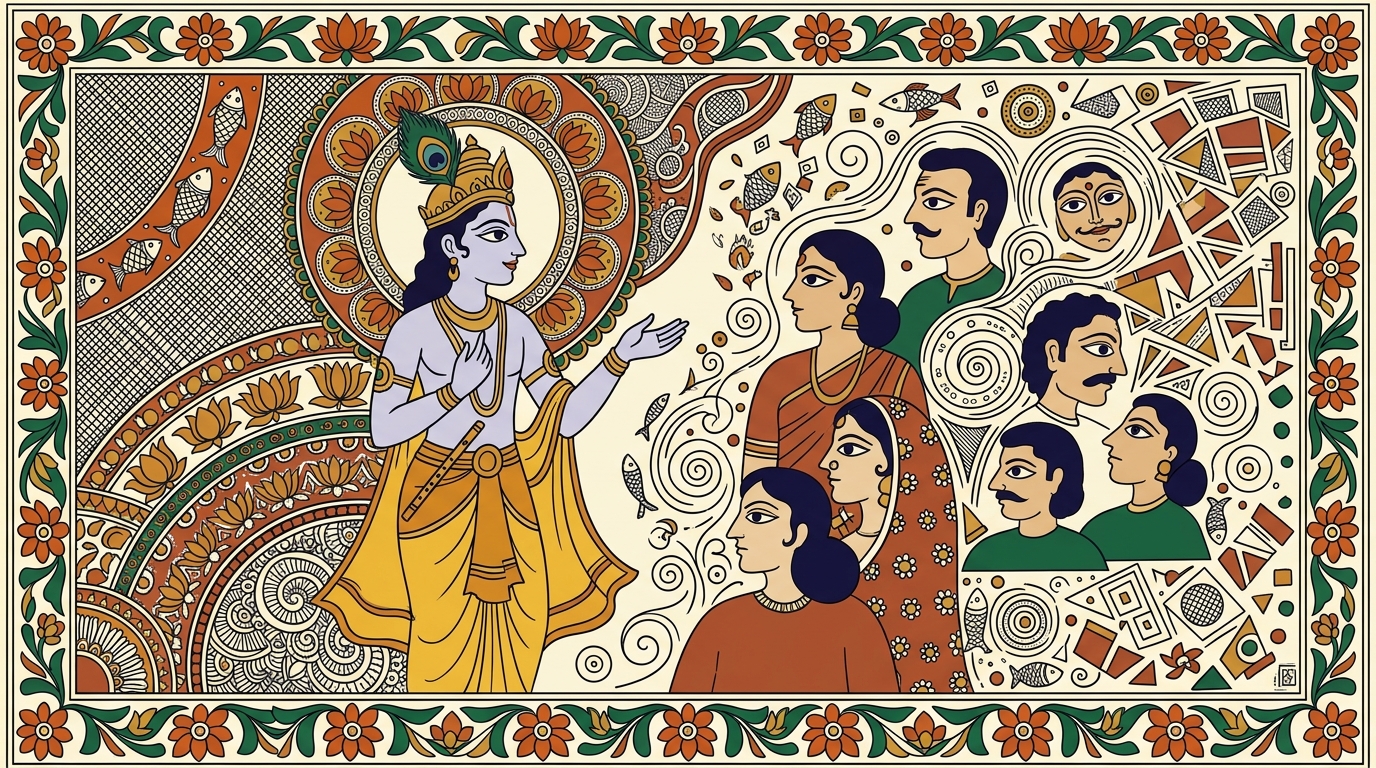
"See the difference," Krishna told Arjuna. "It is not strength that makes
a person good or selfish. It is whether they still ask which path is which,
and the grasping mind has simply stopped asking."