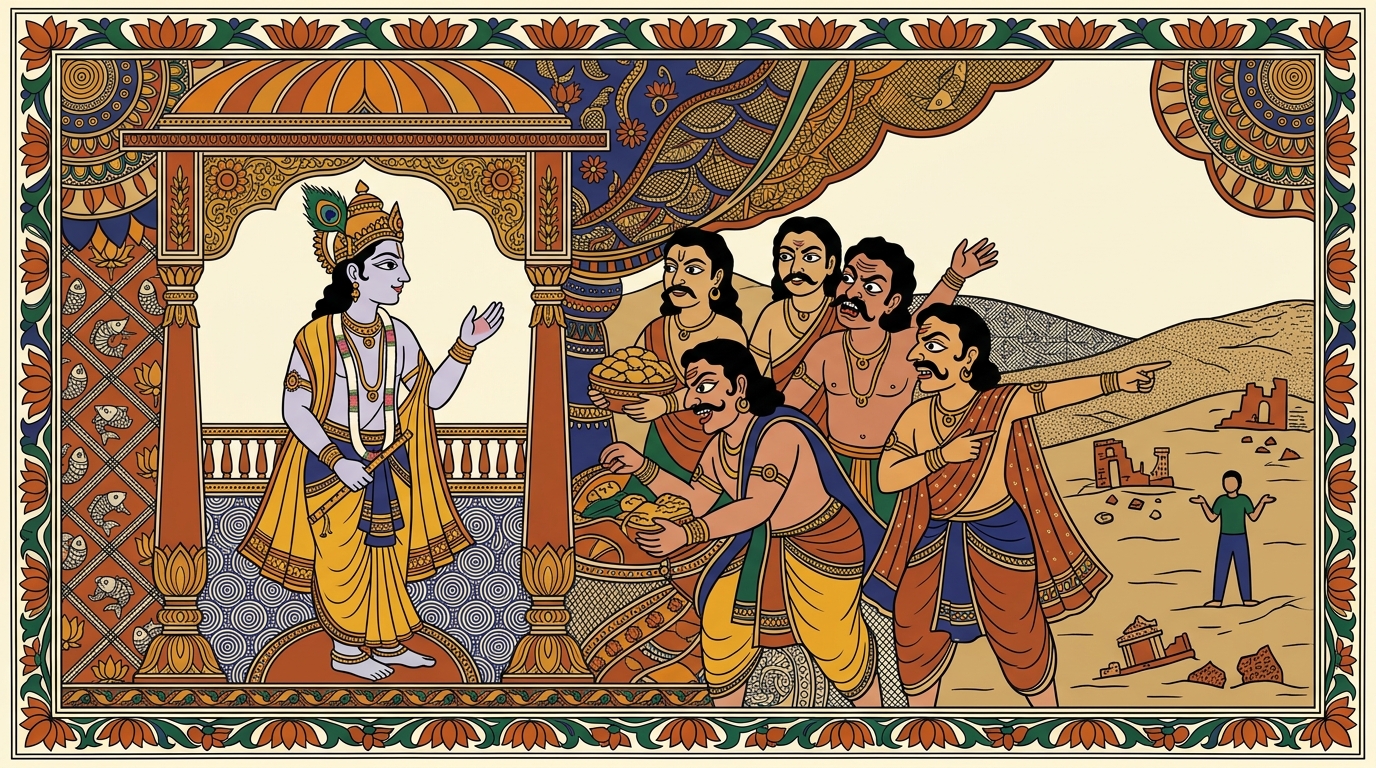
In the city of Lanka, Ravana the ten-headed king walked through his
garden at dawn, and a gardener bowed before him with cupped hands full
of jasmine.
"Maharaja, the first flowers of the season. The temple priests asked if
they might offer them at sunrise."
Ravana plucked the jasmine from the man's hands and crushed it idly
between his fingers. "Offer them to whom?" he said. "There is no one up
there to receive them. The world is a heap of things, gardener: no
truth holds it up, no god looks down on it. It all came together by
accident, like dust blown into a pile. Why pretend it means anything?"
The gardener did not know what to say.
"Listen," Ravana went on, and his ten faces all smiled at once. "If
nothing is sacred, then nothing is forbidden. There is no real right and
no real wrong — only what I want and what I do not want. That is the only
truth I believe in: my own desire. Everything else is a story weak people
tell each other."
He swept his arm across the garden. "These flowers, this city, those
stars — they are mine to use however I please, because they belong to no
one and mean nothing." And believing this, he saw no reason not to take
whatever caught his eye, no reason to keep a promise, no reason to spare
anyone. If the world was empty, then kindness was just a waste of time.
Far away, a small monkey-messenger named Hanuman would one day enter that
same garden, and he would treat a single blade of grass as something
worthy of care, because he believed the very opposite: that the world is
full, full of meaning, watched over, woven through with truth.
"Notice," Krishna said to Arjuna, "where the selfish view begins. Not
with a cruel act but with a cruel idea: that nothing matters. Once a person
decides the world is empty and only wanting is real, every unkind thing
becomes easy. Guard the idea, and the acts take care of themselves."