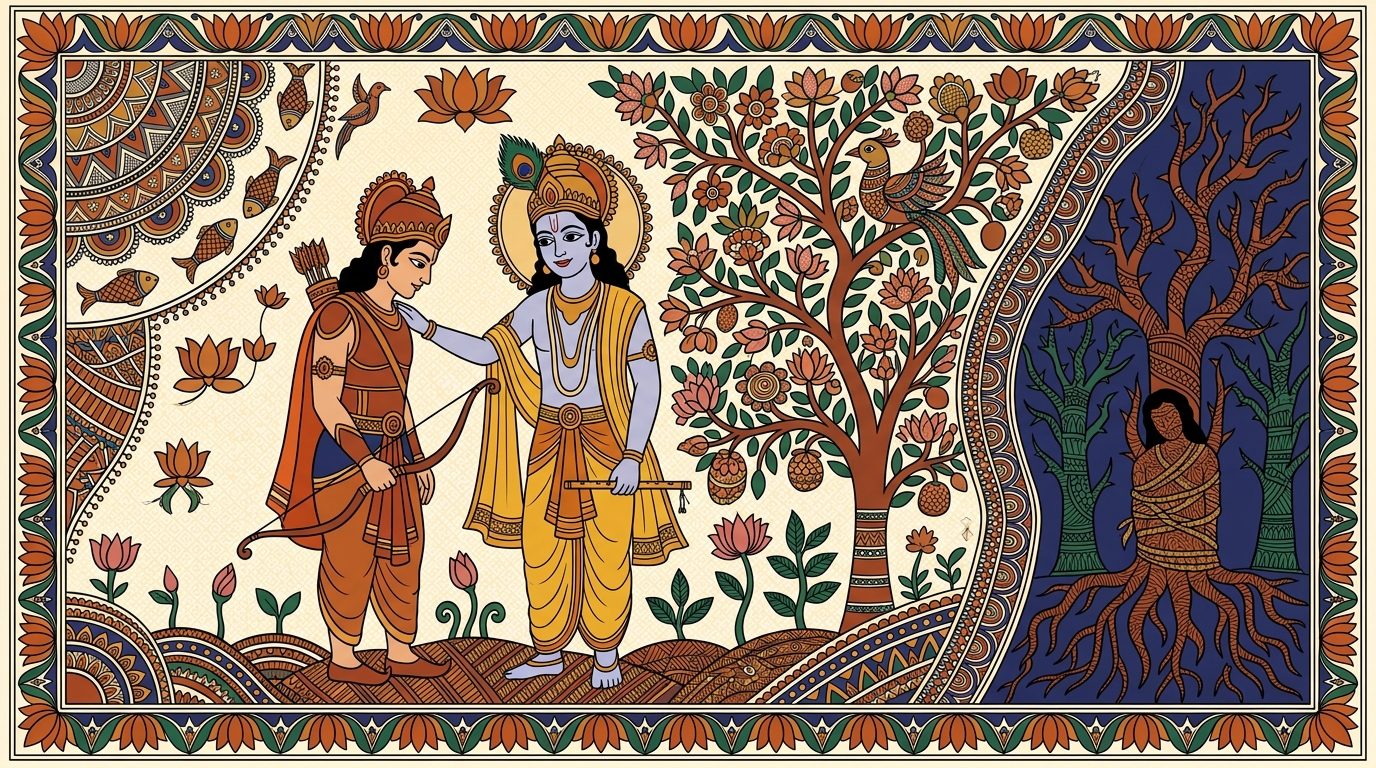
After hearing about the demonic qualities — the showing off, the anger,
the harsh words — Ravi grew very quiet. He sat on the step with Moti's
head in his lap and would not look up.
"What is it?" Nani asked, settling beside him.
"Nani," he said in a small voice, "yesterday I lost my temper at Aman.
And sometimes I do show off. And once I told a fib so I wouldn't get in
trouble." His chin trembled. "What if I'm the demonic kind? What if those
bad seeds are the ones growing in me?"
Nani did not laugh, and she did not brush it away. She took his hand.
"Listen to me carefully," she said, "because Krishna said this very thing
to a worried friend long ago, and it is the most comforting line in the
whole song." She paused. "Do not grieve. You are born to the divine
nature."
Ravi looked up. "But the fibs — the temper —"
"Every garden has a few weeds, my love. That does not make it a weed
patch. It makes it a garden with weeds, which you pull as you find them."
She gestured at her half-painted wall, where a peacock was taking shape
among unfinished lines. "Do you see this peacock? When I started, it was
just a few crooked marks. A stranger might have said, 'That is a mess.'
But I knew the peacock was already there in the lines, waiting. I only had
to keep going."
She squeezed his hand. "The kind seeds — the brave one, the honest one,
the giving one — they are already planted in you. I have watched them
sprout all summer. The fact that you feel sorry about the temper and the
fib? That sorrow is itself a divine seed. A hard heart would not
care at all."
Ravi felt something loosen in his chest, like a knot coming undone.
"So I'm not the demonic kind?"
"You are born to the divine kind," Nani said firmly. "Now stop grieving
and go water it. Be brave today. Be honest today. That is all freedom
ever asks."