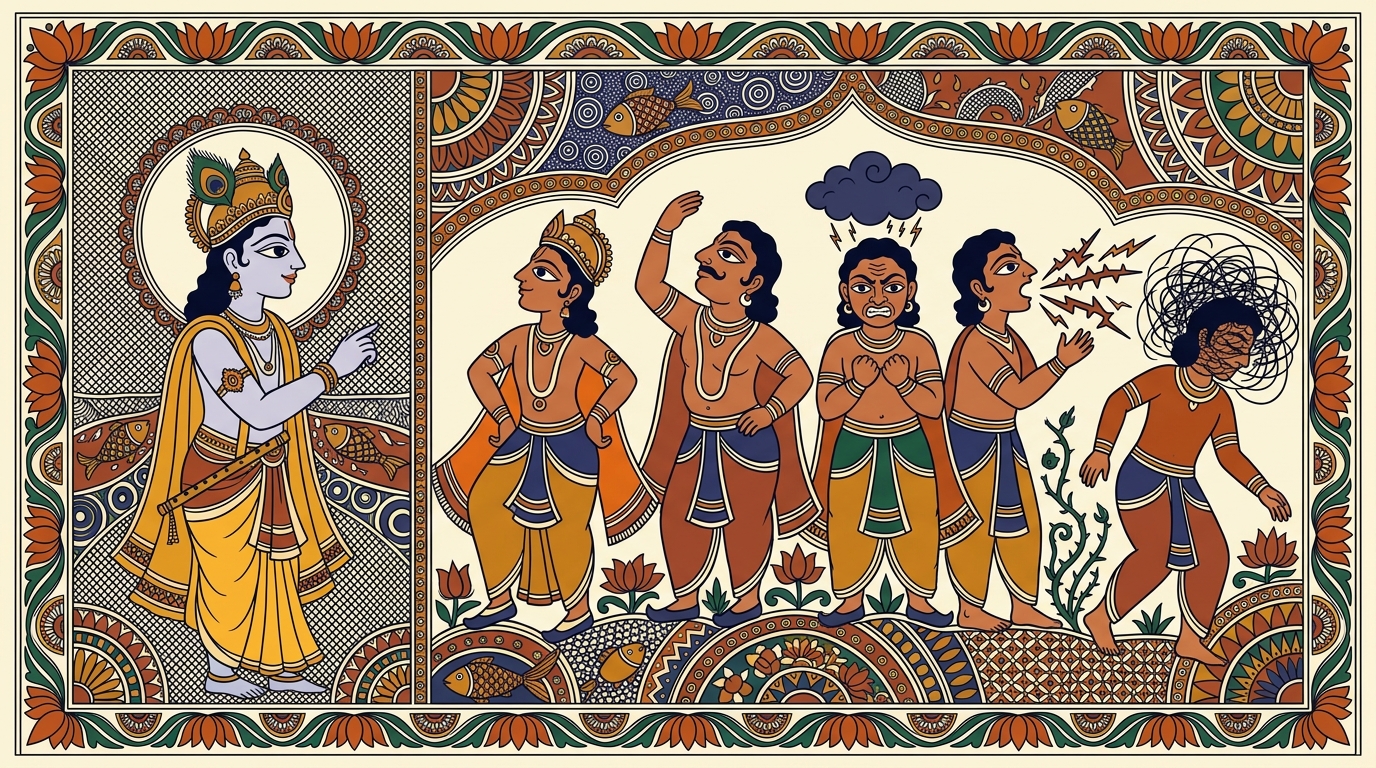
Hiranyakashipu was the mightiest king of his age, and he knew it. His
palace was carved from gold. His throne sat higher than any other. When
he walked through his halls, a hundred courtiers bent so low their
foreheads touched the marble.
But all that bowing was never enough for him.
"Who is greater than I?" he would roar, and the frightened courtiers
would cry, "No one, great king! No one in all the worlds!" He loved to
hear it. He made them say it again and again. This was his arrogance:
his swagger that needed an audience.
He thought himself a god. He ordered the people to worship him and no
other, and he pretended his harsh rule was for their good. "I protect
you," he would say grandly, though everyone knew he protected only
himself. This was his hypocrisy: wearing the mask of a guardian over the
face of a tyrant.
When anyone displeased him, his anger came down like a hammer. A servant
who spilled a cup, a minister who gave honest advice — all met the same
rough, cutting words, the same flash of rage. The whole palace learned to
walk softly and speak only what the king wished to hear.
And here was the strangest thing. For all his gold and power,
Hiranyakashipu could not see the simplest truth — that the people feared
him but did not love him, that no amount of forced worship would ever
fill the hole inside him. His conceit had made him blind. This was his
ignorance: a mind too full of itself to see clearly.
His own small son, Prahlada, gentle and unafraid, once said to him,
"Father, the greatness you chase cannot be grabbed. It grows only in a
kind heart."
Hiranyakashipu did not understand the boy at all. How could he? Showing
off, swagger, conceit, anger, harsh words, and a blind mind — Krishna
calls these the demonic set. They had grown so tall in the king that they
had crowded out everything gentle, and left him, for all his thrones,
poor.