Sanjaya stopped describing the shapes and the ornaments. He had run out of
ordinary words. There was a brightness in the vision, and he did not know how
to make the blind king feel it.
"My king," he said at last, "you have stood in the courtyard at midday in the
hot season. You remember how the single sun can be too fierce to look at —
how it presses on the back of your neck, how it makes the white stones glare
until your eyes ache and you must turn away."
"I remember," said Dhritarashtra.
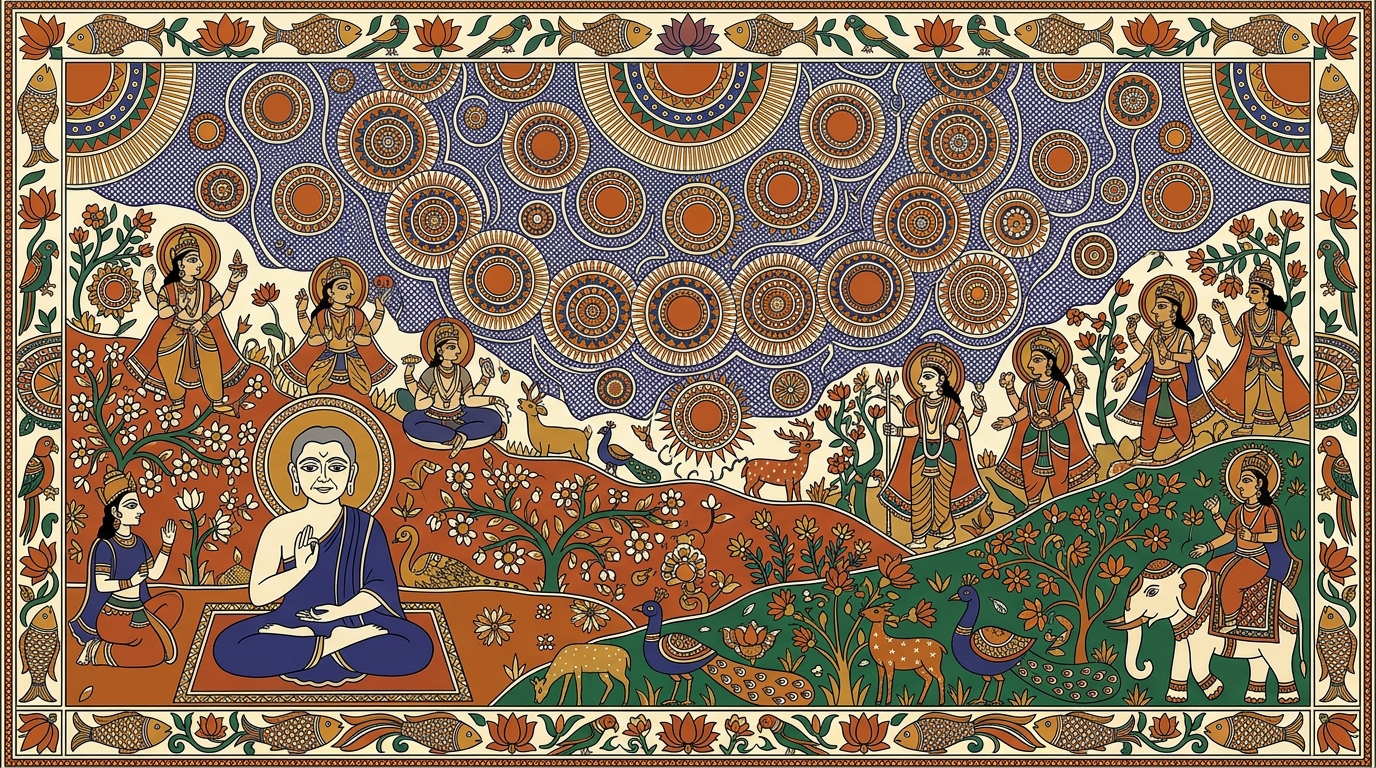
"Now hold this in your mind," Sanjaya said. "Not one sun. Imagine the sky
suddenly filled with a thousand suns, all rising together in the same moment,
each one as bright as the one we know. A thousand mornings breaking at once.
A blaze with no shadow anywhere in the world, no cool corner, no dusk, no
night — only one enormous flood of light pouring from every part of heaven."
The old king's hands tightened on the arms of his chair, as if even
imagining it were too much.
"That," Sanjaya said quietly, "is the nearest I can come. If a thousand suns
rose together, their splendour might begin — only begin — to resemble the
radiance pouring from this great-souled One. And the strange thing, my king,
is this: Arjuna can look at it. He should be blinded. He should be burned to
nothing. But he was given a divine eye, and so he stands and beholds a light
that a thousand suns could not outshine."
Arjuna, on the chariot, felt the truth of it. The light did not hurt him now,
yet he understood that without the gift of the divine eye it would have
swallowed him whole. He was looking at the brightness behind all brightness —
the light from which the sun itself borrows, the way the moon borrows from the
sun.
"There is the sun we wake to," he whispered to himself, "and behind it, this.
All this time, behind the sun, this."