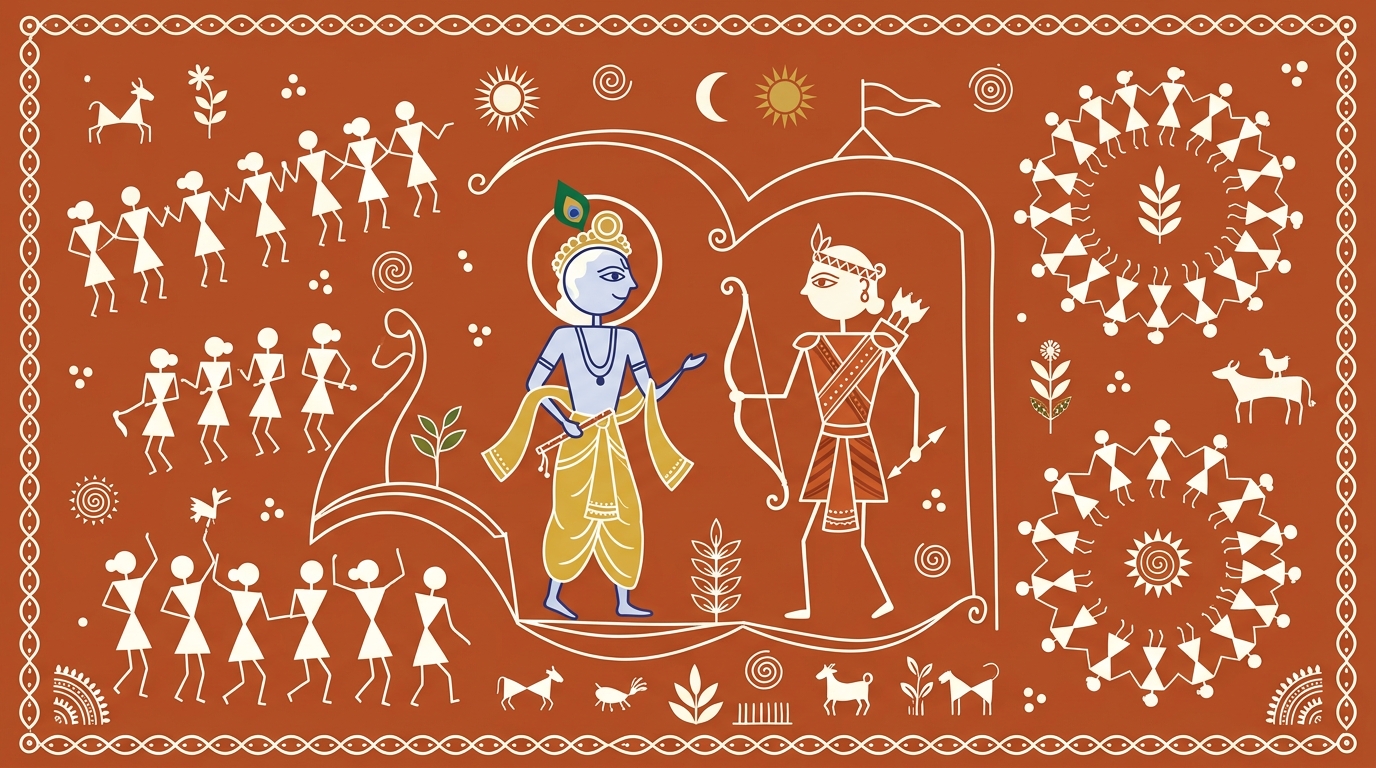
Jeeva had done something he was not proud of.
His little cousin Manju had been working all afternoon on her very first
Warli painting — a row of wobbly white dancers on the mud wall by the
cooking fire. She had been so happy with it. And Jeeva, in a sour, jealous
mood because his own painting had smudged, had wiped a corner of hers with
his sleeve and pretended it was an accident.
Manju had cried. And Jeeva had walked away and said nothing.
Now it was evening, and the shame sat in his stomach like a cold stone. He
did not want to look at the wall. He did not want to look at anyone. He sat
in the dark corner of the courtyard, certain he had ruined everything, that
he was now simply a boy who did mean things.
Aaji found him there. She did not scold. She sat down beside him on the
smooth earth floor and waited until he told her, all in a rush, what he had
done.
"Ah," she said softly. "And now you think the smudge is the whole story."
Jeeva nodded miserably.
"Listen to me, child." Aaji took his rice-paste pot and pressed it gently
into his hands. "A heart that feels bad about doing wrong is already turning
back toward good. You do not have to crawl for a hundred years to be
forgiven. The very moment you turn around and walk toward kindness — that
fast" — she snapped her fingers — "you are already on the good path again.
And the God we paint on these walls never, ever throws away someone who is
trying to come home."
Jeeva looked up. "Never?"
"Never," said Aaji. "Now. The fire is still warm. Manju is still awake."
So Jeeva carried the little pot across the courtyard. He sat down beside
Manju, dipped his stick in the white paste, and very carefully repaired the
corner of her painting — better than before, with two extra dancers added,
holding hands. Manju watched, then took the stick from him and painted one
more dancer at the very end.
"That one is you," she said.
And the cold stone in Jeeva's stomach was gone, replaced by something quiet
and warm that felt, he thought, a great deal like peace.