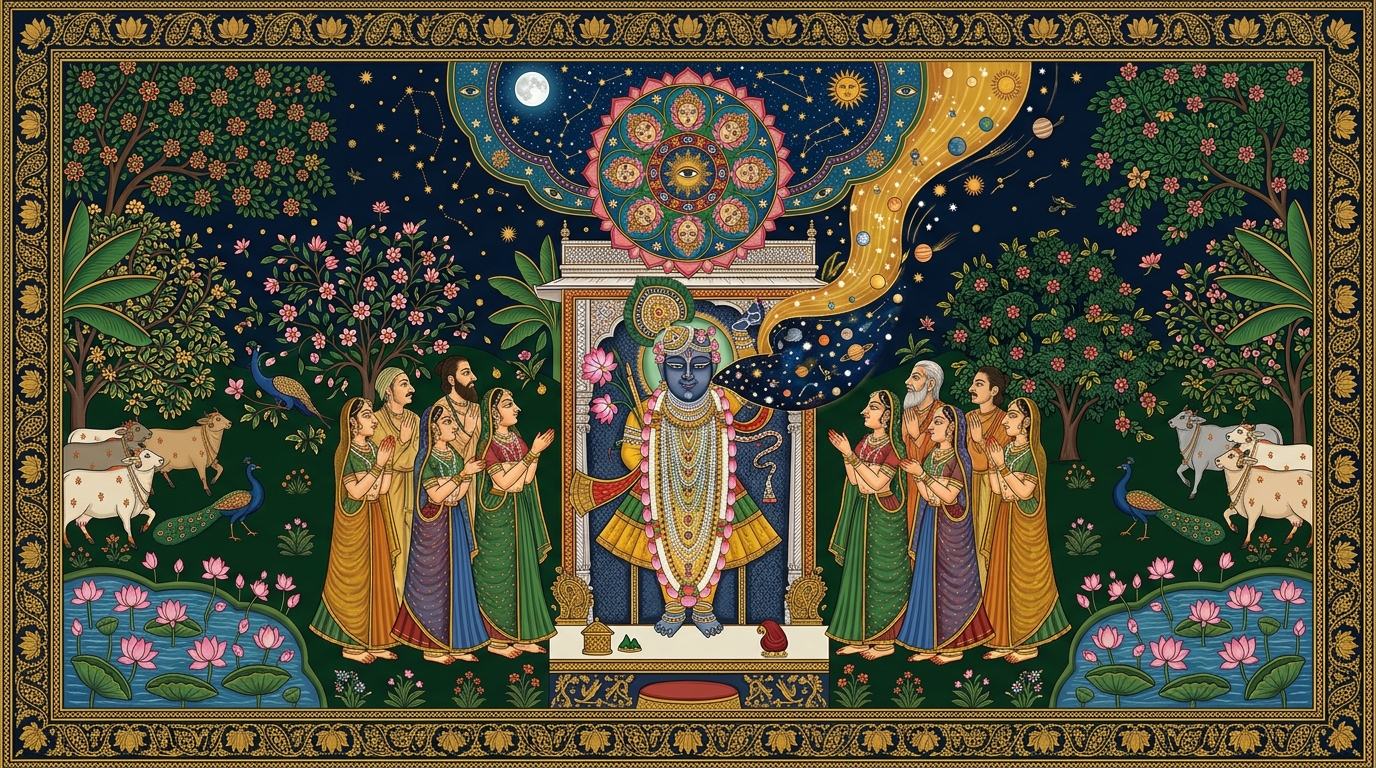
Yashoda was sure, this time, that she had caught him.
The morning in Gokul had started peacefully enough — the cows lowing, the
butter churning, the smell of warm milk filling the little house. Then the
other cowherd children had come running, all talking at once, their voices
high with tattling delight.
"Mother Yashoda! Krishna has been eating mud again!"
"We saw him! He picked it right up off the ground and put it in his mouth!"
"Scold him, Mother, scold him!"
Yashoda's heart sank. Mud! Her precious, naughty, dark-eyed boy, eating dirt
like a little animal. She wiped her buttery hands on her sari and marched out
to where Krishna stood under the tree, looking — as he always did — perfectly
innocent, which was always the most suspicious thing of all.
"Krishna," she said, hands on her hips. "Have you been eating mud?"
"No, Mother," said Krishna, his eyes round and clear. "Who told you that?
They are only teasing. Look at my hands — they are clean. If you do not
believe me, look in my mouth."
And he opened his mouth wide.
Yashoda bent down to look for the telltale dirt on his tongue, ready to fish
it out and wash his face.
But there was no mud.
Inside the little open mouth of her small son, Yashoda saw — the whole world.
She saw the wide blue sky and the white drifting clouds. She saw the sun and
the moon and the cold scattered stars. She saw mountains and oceans and great
rivers winding to the sea. She saw all the lands, all the seasons, all the
creatures that crawl and swim and fly. She saw Gokul itself, and the tree,
and her own little house — and inside that house, herself, bending down to
look into her son's mouth. Worlds within worlds, suns without number,
everything that ever was, all spinning quietly inside the mouth of the child
she had thought was only hers.
Her head went light. She had believed him a small boy — sweet, mischievous,
hers to scold and feed and hold. She had never guessed that the formless,
endless, unchanging All had chosen to wear the shape of her little son, and
that all her love had been wrapped, this whole time, around the infinite.
Then Krishna closed his mouth and smiled up at her, an ordinary butter-faced
smile. The vision melted like mist. And Yashoda — wisely, lovingly — chose to
forget, scooped him up, and held him close, her small son who was also the
whole wide sky.