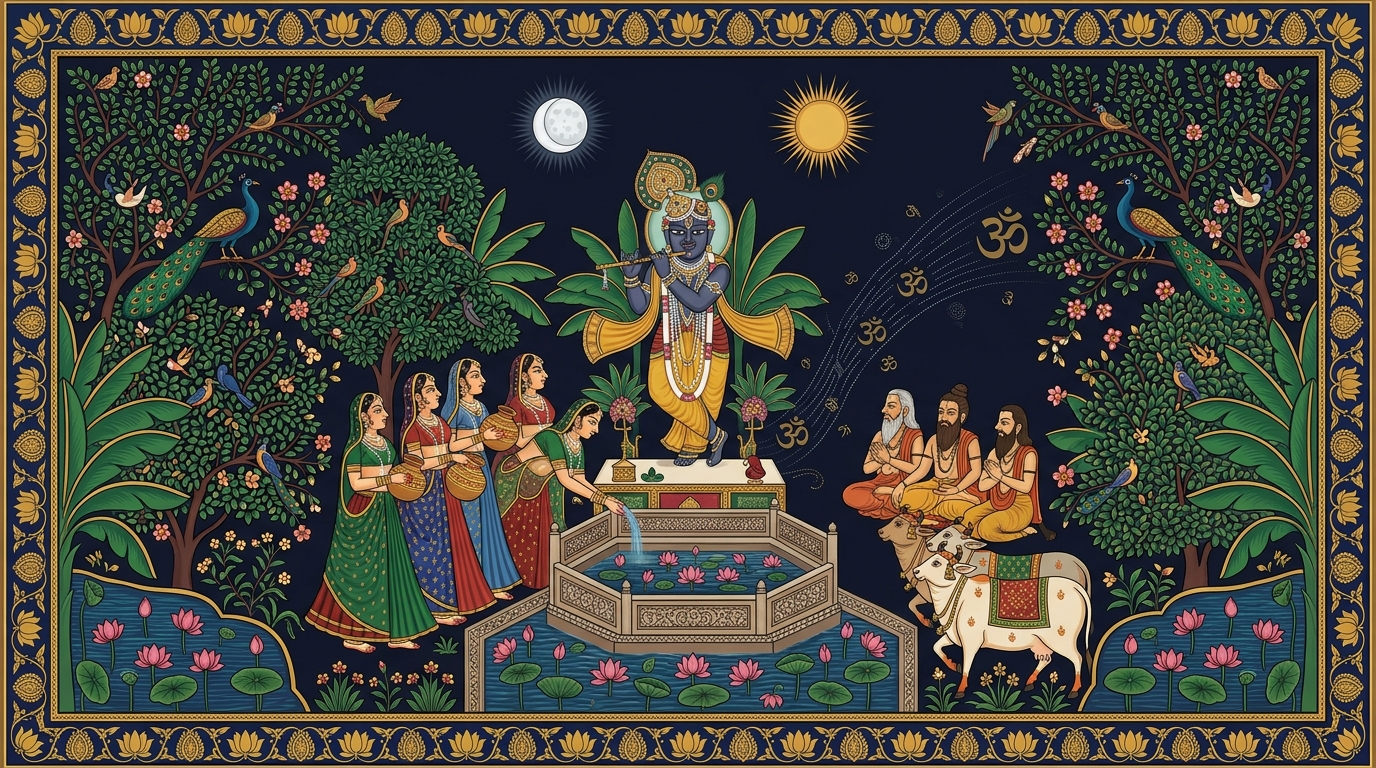
The desert did not forgive mistakes.
For three days the pilgrim had walked across the flat white sands of
Rajasthan, his lips cracking, his water gourd long empty. The sun was a
hammer. The horizon shimmered and lied to him, showing lakes that
vanished as he came near. By the third afternoon he had stopped praying
for the temple he was journeying toward. He prayed only for water.
He had heard the rishis speak, back in the green river country of his
childhood. They sat under trees and said strange, beautiful things — that
God was everywhere, that the Divine filled all things, that one who looked
rightly would find the Lord in every corner of creation. He had nodded
politely. But out here, with his tongue swollen and the sand burning
through his sandals, those words felt like smoke. Where was God in this
emptiness?
Then, near sunset, he saw the low stone rim of a step-well.
He half-ran, half-stumbled to it. A rope and a clay pot hung from a
wooden beam. With shaking arms he lowered the pot down, down into the cool
dark, heard it splash, and hauled it up brimming. He did not wait. He
lifted it to his mouth and drank.
And the world stopped.
It was only water — plain, cool, clear well-water. But after three days of
dust and thirst, that first swallow was the sweetest thing he had ever
tasted in his life. It ran down his throat like music. Tears came to his
eyes. He could feel it reaching every dry corner of him, waking him up,
bringing him back to life.
And in that taste — that pure, simple, astonishing sweetness — he suddenly
understood the rishis.
This. This was what they meant. He had been looking for God on
mountaintops and in grand temples, somewhere far away and difficult. But
the Divine had been waiting for him right here, in the sweetness on his
own tongue. "I am the taste in water," the Lord had said. Not the water.
The taste — the very thing that made him gasp with gratitude.
He drank again, slowly this time, and he was no longer only drinking. He
was meeting someone.
He filled his gourd, bowed once to the quiet well, and walked on into the
cooling dusk. The temple was still three days away. But he had already
arrived somewhere.