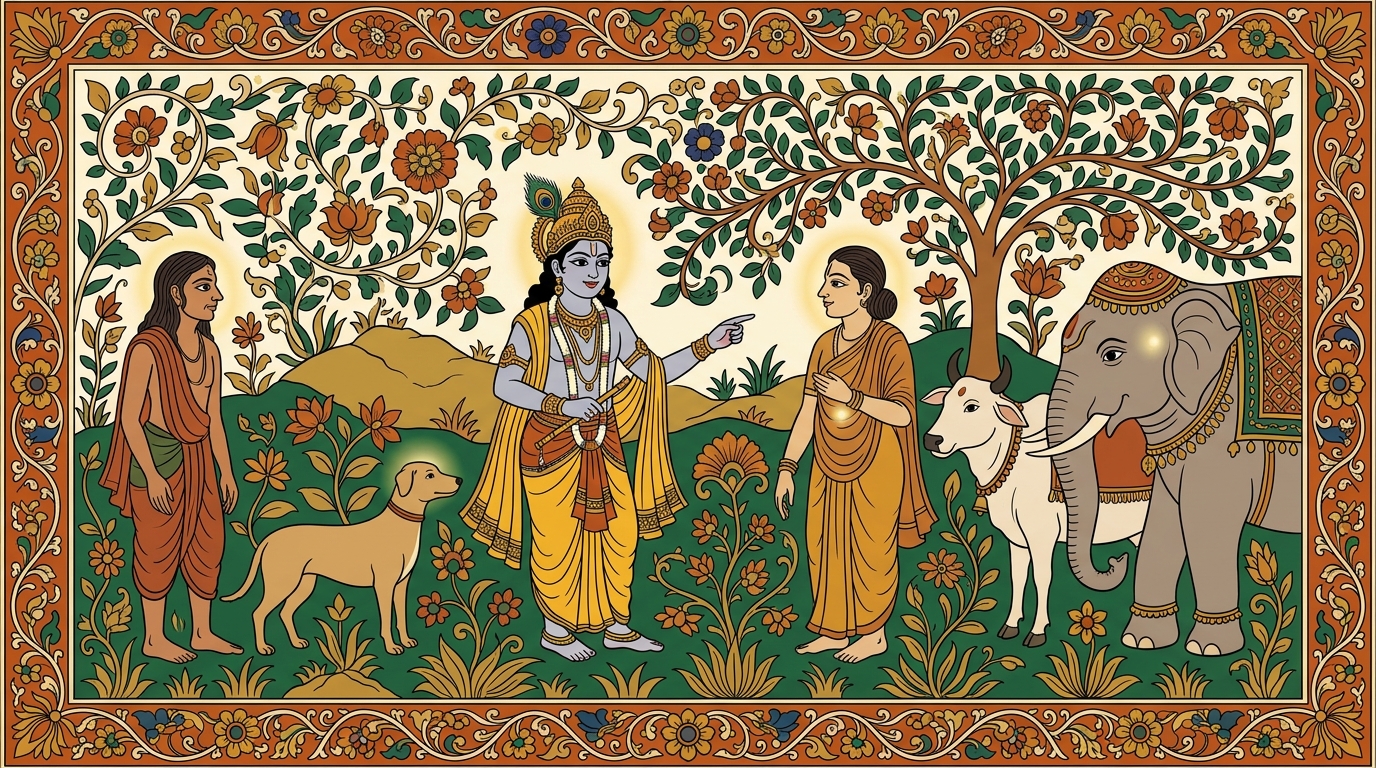
Surya was new to the camp kitchens, and on his first morning he made a
mistake he would remember all his life.
An old cook named Bhima Rao had sent him to fill water for everyone. As
Surya carried the heavy pots back, he passed a cow dozing in the shade,
an elephant being scrubbed by its keeper, a thin street dog nosing for
scraps, and a man sitting apart at the camp's far edge — a man others
walked wide around, because his work was the work nobody else would do.
Without thinking, Surya gave water generously to the cow and the
elephant, hurried past the dog, and did not even look at the man at the
edge.
Old Bhima Rao watched all this. He did not scold. Instead, that evening,
he set a single lamp in the middle of the kitchen and called Surya over.
"Tell me," he said, "this flame — does it shine more brightly on the
silver bowl than on the cracked clay cup?"
Surya looked. The light fell on both the same.
"Does it warm the cook's hand more than the water-boy's hand?"
"No," Surya admitted. "The same."
"There is a light inside every living thing," said Bhima Rao, "the same
way this flame is inside this lamp. The lamps are all shaped differently:
some are gold, some are clay, some are chipped, some are small. But the
light is one light. A foolish person stares only at the shape of the lamp
and decides which to bow to and which to ignore. A wise person looks past
the shape and sees the one flame burning in them all."
Surya thought of the dog he had hurried past, and the man he had not
looked at, and his face grew hot with shame — and then quiet with
understanding.
The next morning he gave water to everyone, and to the man at the edge he
gave it first, with both hands and a bow, the way you offer something to
someone who carries the same light you do.
Far away, in his chariot, Krishna was saying the very same thing to
Arjuna: the wise see equally, because they see the one Self in all.