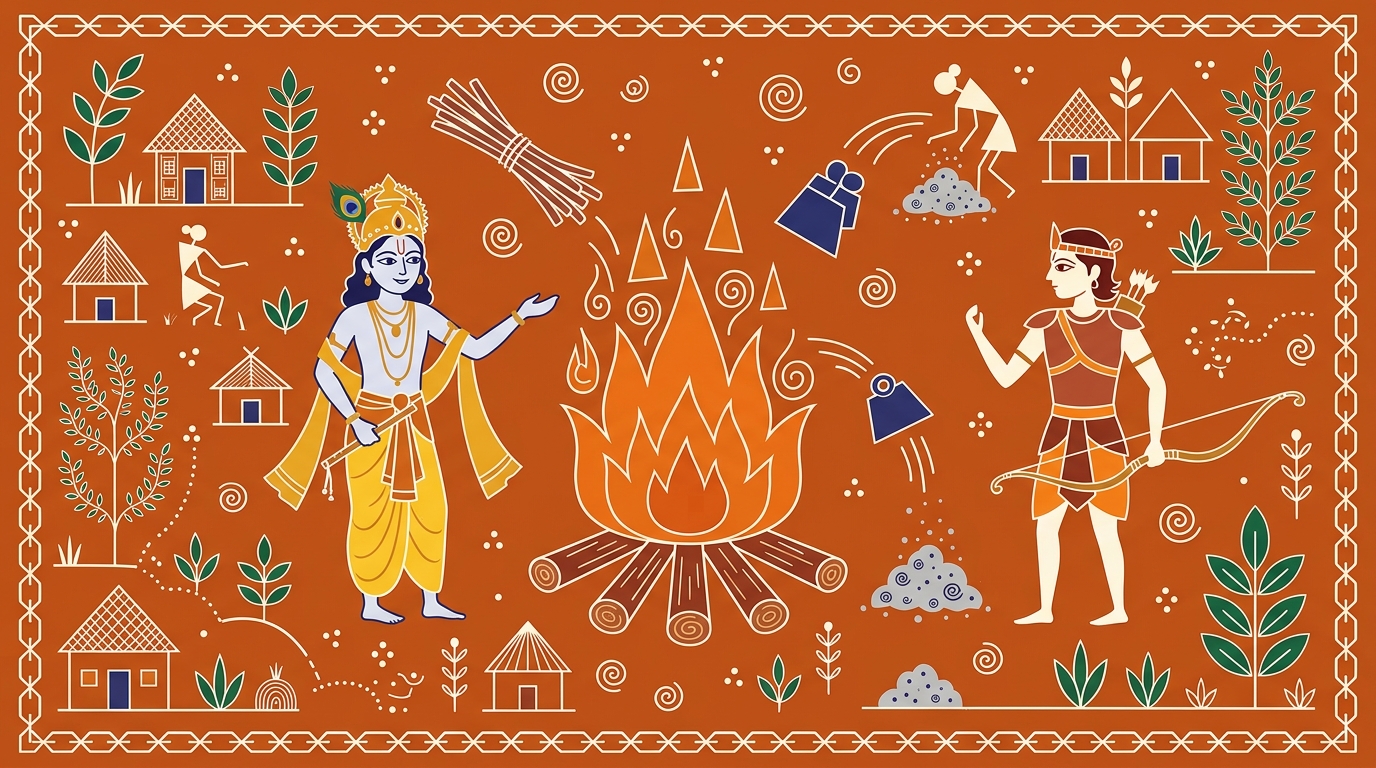
On the cold nights before the great battle, the soldiers built fires
along the edge of Kurukshetra. Around one of them sat a young
spearman named Ketu, who could not sleep. He kept feeding the flames,
log after log, watching them disappear.
Krishna walked among the camps that night, as he sometimes did, and he
paused at Ketu's fire. The young man looked up, startled, then made
room on the log.
"You are burning a great deal of wood," Krishna observed.
"I cannot stop watching it," Ketu admitted. "Look — I put a whole
branch in, thick as my arm, knots and bark and all. And by morning it
will be a handful of ash I can blow away with one breath. Where does
it go? All that weight, all that hardness — gone."
Krishna picked up a dry stick and turned it in the firelight. "A
strong fire does not argue with the wood," he said. "It does not ask
whether the branch is straight or twisted, old or green, heavy or
light. Whatever you give it, it takes, and it leaves only ash."
He dropped the stick into the flames. It caught at once and flared
bright.
"There is a fire like that inside a person too," Krishna went on. "It
is the fire of really understanding, seeing things at last as they
truly are. When that fire is well lit, it does to your old deeds what
these flames do to the wood. Every action you ever worried over, every
burden you carried from things long done — it takes them all and turns
them to ash. Not one log is too big. Not one knot is too hard."
Ketu stared into the heart of the blaze, where the wood glowed
orange-white and lost its shape.
"Then a person could be set free," he said slowly, "of everything?"
"Once the fire is truly burning," said Krishna, "yes."
The flames snapped and rose. Somewhere a horse nickered in the dark.
And Ketu sat a long while watching heavy branches become weightless
grey ash, thinking that perhaps a heart could be made just as light.