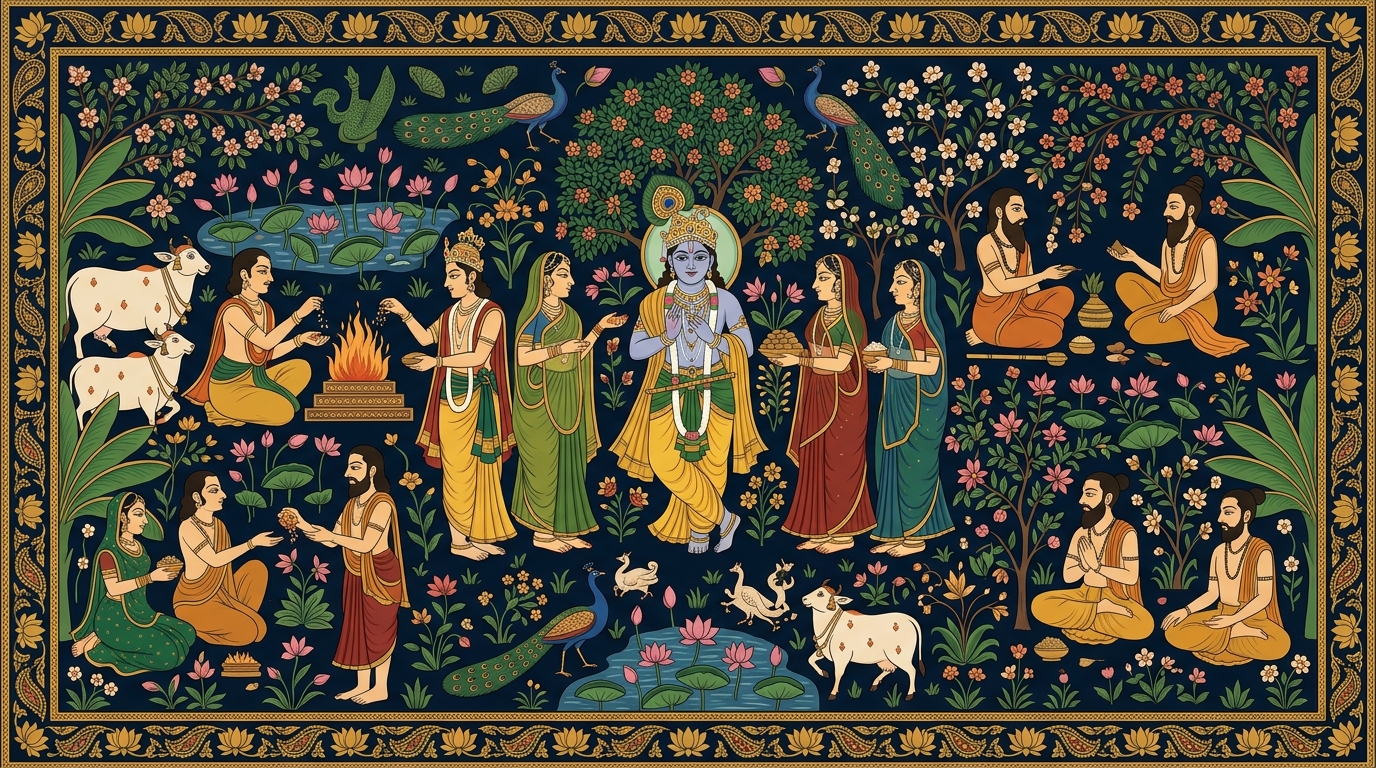
In a hermitage by a slow green river, a seeker named Shvetaketu had been
studying for many years. He could recite the hymns. He kept the fire. He
gave food to every traveller who came to the gate. And still he felt that
something in him was tied down, like a boat roped to a post.
One evening he sat beside his teacher, Uddalaka, as the lamps were lit.
"Teacher," he said, "I do everything the rules ask. But when I give a gift,
a small voice in me whispers, 'Now you deserve a good harvest.' When I keep
a hard discipline, the voice says, 'Now the gods owe you something.' I want
to be free, but that voice keeps me roped to the post. What do I do?"
Uddalaka picked up a single grain of barley and held it in his open palm.
"You know the great word 'Om,'" he said. "There is a second word the
free-hearted use. It is small — only this: 'Tat.' It means 'That.'"
"Just 'That'? That is all?"
"That is everything. When you say 'Tat,' you point past your own hands, past
the gift and the reward, to the Boundless that has no name we can hold. You
are saying: 'This act is not mine to bargain with. It belongs to That.'"
He tipped the grain of barley off his palm onto the offering tray, gently,
without looking to see where it landed.
"See? I gave the grain. I did not lean forward to watch what it would buy me.
The seekers of freedom do all their giving and all their discipline like
this — they whisper 'Tat,' and they let the fruit fall where it will. The
rope loosens. The boat drifts free into the wide water."
Shvetaketu sat with this a long while. Then he reached for a grain of his
own, lifted it, and let it fall onto the tray.
"Tat," he said softly.
And he noticed, to his surprise, that this time the small whispering voice
had nothing to say at all.