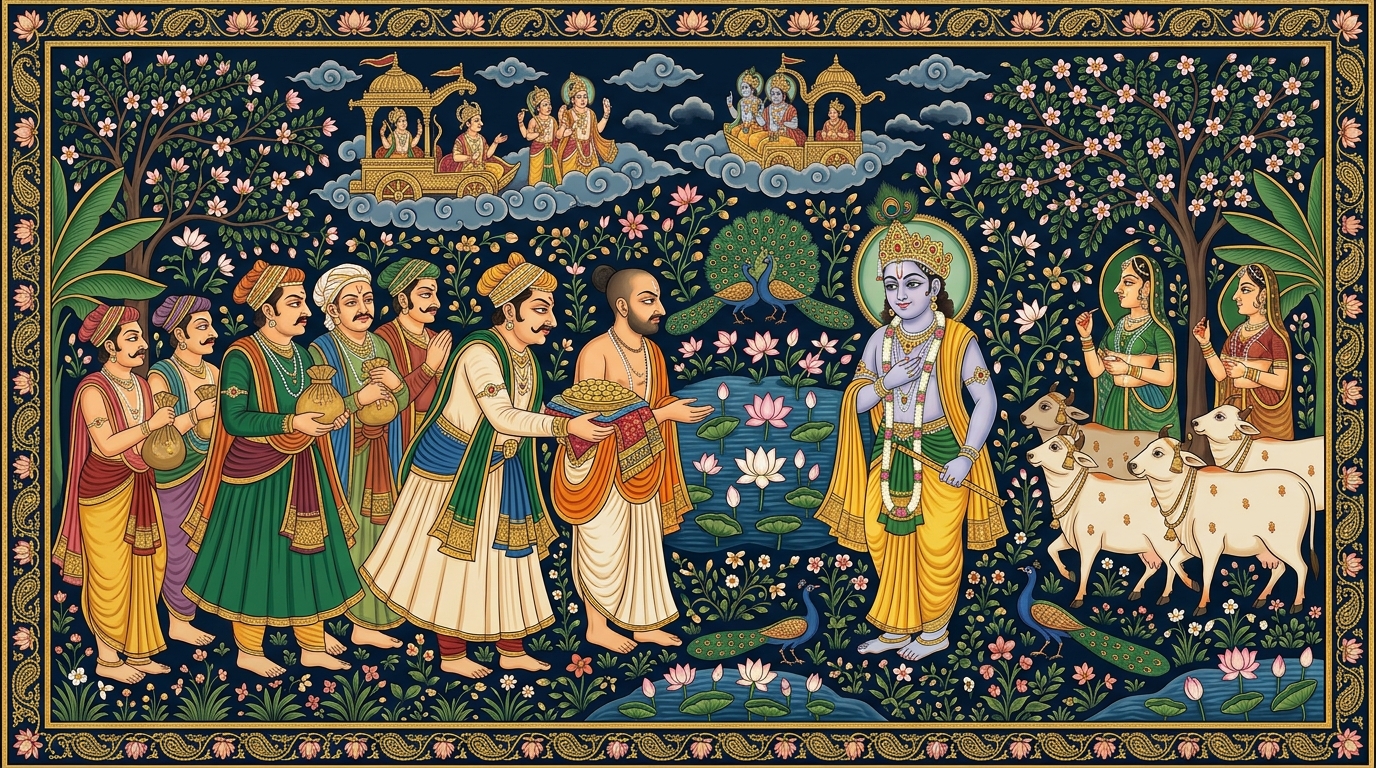
In a busy trading town lived a rich merchant named Dhanapal, whose
storerooms overflowed with grain, cloth, and gold. He was known across the
bazaar for his wealth — and, quietly, for how tightly he held it.
One festival day, a respected teacher came to the town to build a school for
poor children. He went from house to house asking for help. Word spread fast,
and soon everyone was watching to see how much each big family would give.
When the teacher reached Dhanapal's grand doorway, a small crowd had already
gathered. Dhanapal felt their eyes on him. He could not say no — not in front
of all these people, not with the other merchants watching to compare. So he
called for a bag of coins.
But as the servant brought it, Dhanapal's fingers tightened. He counted the
coins twice. He pulled a few back out. He sighed loudly, the way a person
sighs when something is being pulled from them against their will.
"Here," he said at last, pressing the bag into the teacher's hands. Then,
leaning close, he added in a low voice, "Remember this when my caravans pass
through your district. A good word from a man like you opens many gates. We
help each other, yes?"
The teacher looked at the heavy bag and then at the merchant's face. The gift
was real. The school would be built a little sooner because of it. But the
teacher had seen pure giving before, and he knew this was not it. This gift
came wrapped in three strings: it was given for show, given hoping for a
favour in return, and given with a wince, as if each coin were a tooth being
pulled.
"Thank you," the teacher said kindly. "Your coins will help the children."
As he walked away, a young student asked him, "Was that not a generous gift,
guruji? So much gold!"
"It was a real gift," the teacher said, "and it will do real good. But notice
how it was given — for praise, for a return favour, and grudgingly. Such
giving is restless. It keeps one hand reaching out even while the other hand
gives. The purest giving lets go completely, and asks for nothing back."