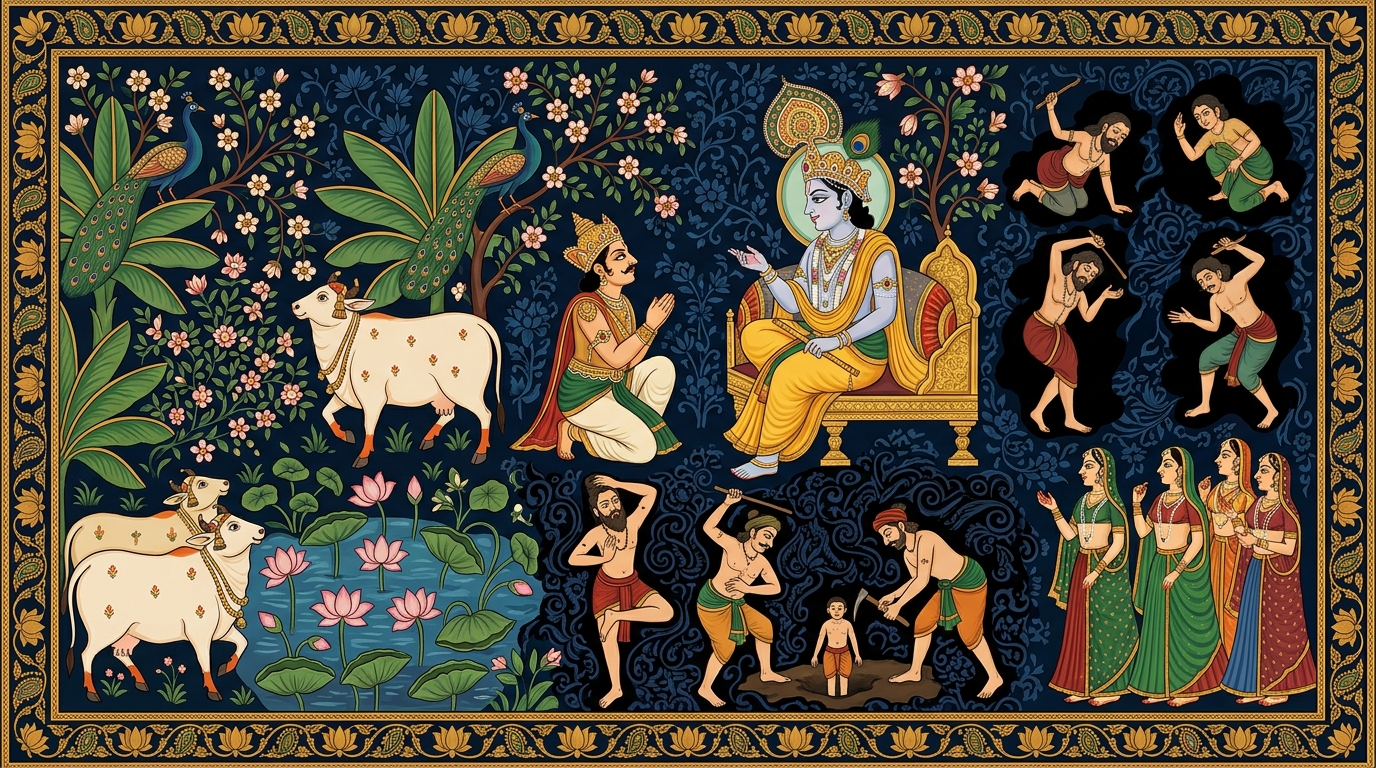
Deep in a forest, where no birds dared to sing, a man stood on one leg in a
ring of fire.
His name was Bhandasura's servant, but the village folk had long forgotten
his real name and called him only the Burning One. For years he had punished
his own body. He stood in flames in summer and in icy rivers in winter. He
starved until his ribs showed like the bars of a cage. Holy men passed by and
shook their heads, for they could see that something had gone wrong inside
him.
A young pilgrim named Devadatta once stopped at the edge of the clearing.
"Great one," he asked, "why do you hurt yourself so terribly? What gift do
you seek from the gods?"
The Burning One opened his eyes, and they were red and bitter. "I do not seek
a gift," he rasped. "I seek a weapon. When my penance is fierce enough, the
gods will be forced to grant me power — and with that power I will crush the
king who shamed my master. I will burn his city to ash."
Devadatta stepped back. He had been taught that true discipline made a person
calmer, kinder, lighter — like a lamp slowly trimmed until it burned clean.
But this was something else. The Burning One's penance was not lifting him
up. It was twisting him, like a rope wrung tighter and tighter until the
strands snap.
"You are not climbing toward heaven," Devadatta said gently. "You are digging
a pit. You torture your own body, which the gods gave you to care for, and you
do it only to ruin another. Even if the gods answered, what would come back to
you would be made of the same darkness you are pouring out."
The Burning One snarled and turned away. But that night, alone, his fire
sputtered. No bright vision came. No divine voice. Only the cold ache of a
body harmed for nothing, and a heart so full of wanting-to-hurt that it had
no room left for peace.
Devadatta walked on at dawn. He understood now that discipline can wear a
holy costume and still be the lowest thing of all — when it springs from a
confused mind, harms the one who does it, and aims only to wound somebody
else.