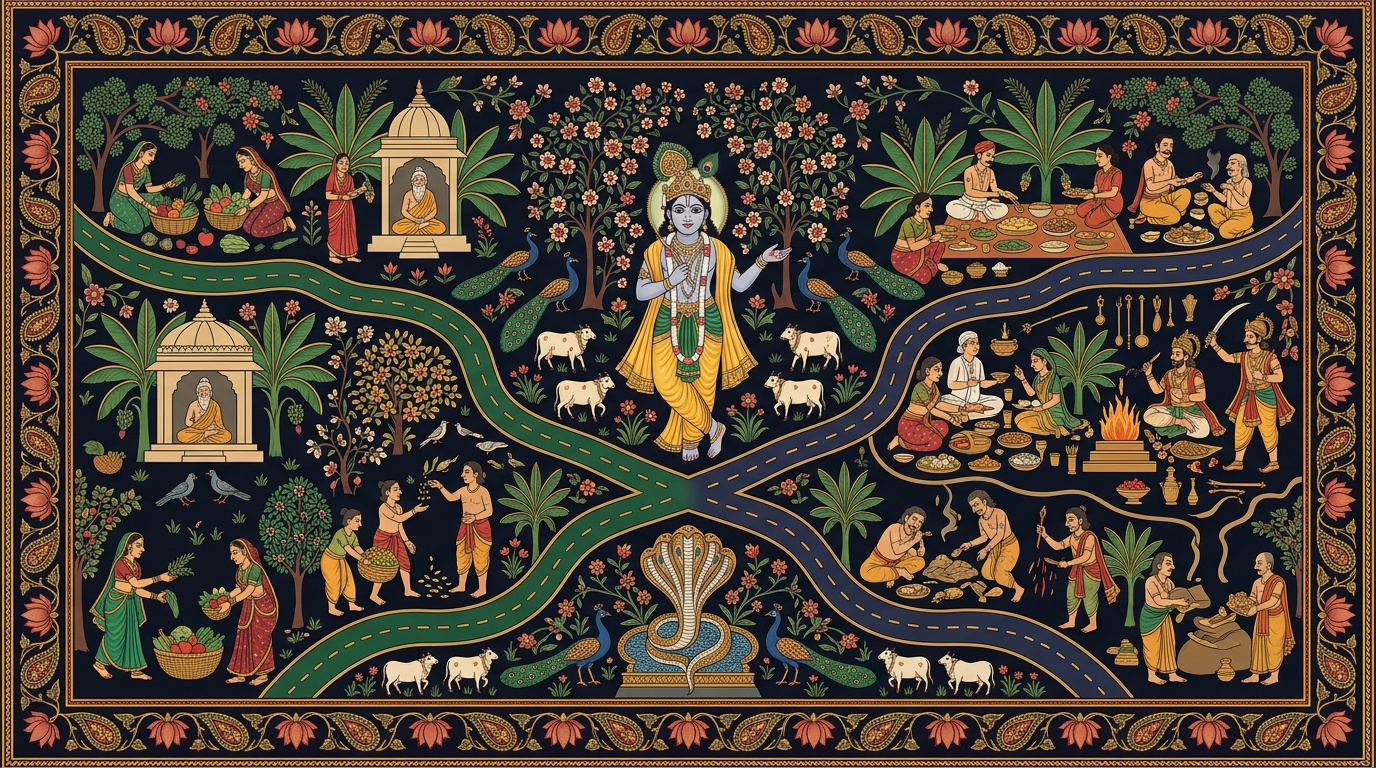
On the eve of the great war, two sages sat by a slow river far from
Kurukshetra, watching the same sun sink that the armies watched.
The younger one, Vatsa, was troubled. "Master," he said, "I have walked
through many camps these past days. I have seen warriors who eat plain
cooked rice and sleep early, calm as ponds. I have seen others who feast on
fiery, salty meats and pace all night, quick to anger. And I have seen a few
who eat whatever is left over and cold, and lie about half-asleep even at
midday. Why are people so different, when they all sit under the same sky?"
The old sage, Maitreya, smiled and drew three lines in the riverbank sand
with his finger.
"Think of one travellers' crossing," he said, "from which three roads run
out. One road climbs gently toward clear hills. One road is fast and steep
and rocky, full of dust. One road sinks down into a dark, sleepy marsh.
Every traveller stands at the same crossing, but each chooses a road, and
the road slowly makes the traveller."
Vatsa watched the river. "And the food?"
"Food is only the first of the three roads I will name," said Maitreya. "The
same three colours run through everything a person holds dear: the food
they love, the worship they offer, the discipline they keep, and
the giving they do. Each of these splits into the bright, the restless, and
the dull, just as a single beam of white light splits into colours through
a drop of water."
He smoothed the sand and drew it fresh: three roads again, and beside them
three more, and three more.
"Tomorrow the Lord Krishna will speak this very thing to Arjuna on the
chariot," Maitreya said quietly, as if he could hear it across the miles.
"He will say: even food is of three kinds, and so are worship, discipline,
and giving. Listen to their differences, he will say. For once you can see
the three roads in a plate of food, you begin to see them everywhere, and
seeing them is the first step to choosing the bright one."
Vatsa looked down at the lines in the sand for a long time. Then, very
softly, he asked the question that would shape the rest of his life: "Master
— which road am I on right now?"
Maitreya did not answer. He only handed the young sage the stick, and let
him draw his own crossing in the sand.