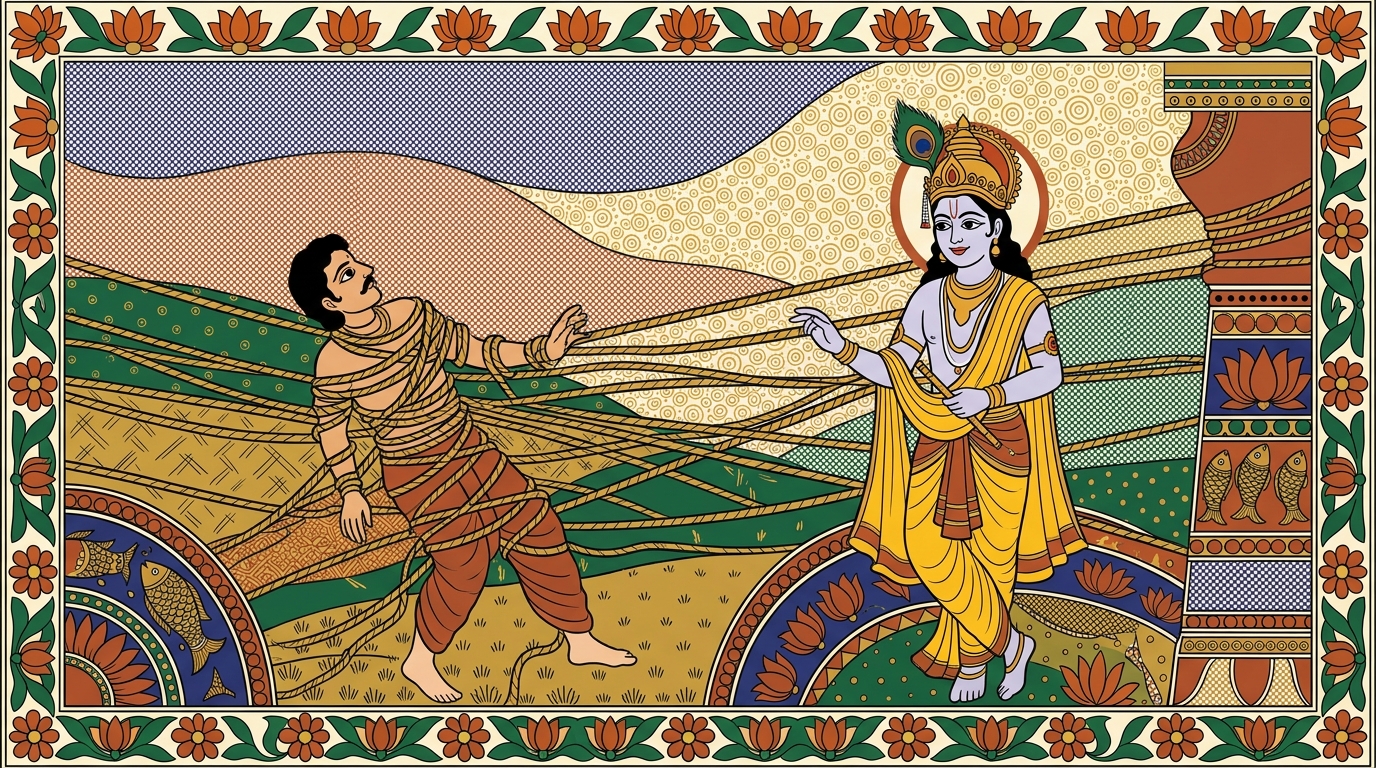
Ravana wanted one thing more than anything: to carry off Sita, the wife
of Rama, and keep her in his garden in Lanka. It was an unfair wish, a
wrong wish, and a wise person would have let it go. But Ravana could no
longer let anything go.
For years his longings had been tying themselves around him, one by one,
like ropes. I hope to be the strongest. I hope to be the richest. I hope
no one ever says no to me. I hope to have whatever I see. A hundred such
ropes of hope were knotted around the ten-headed king, and though he
thought himself the freest being alive, he was the most tightly bound.
Two masters ruled him now: his craving, which whispered take it, and his
anger, which roared at anyone who stood in the way. He obeyed them both
like a servant obeys a king.
So he schemed. To get what he craved, he used a trick — a golden deer to
lure Rama away, a disguise to fool the kind and trusting Sita. He gathered
his armies and his gold and his clever plans, all bent toward one unfair
end. Every treasure he heaped up was heaped for the same reason: to feed
the craving that never stopped asking.
His brother Vibhishana begged him: "Return Sita. Cut the rope. You will
be free, and Lanka will be safe."
But Ravana could not imagine letting go. He had spent his whole life
pulling, and he did not know how to open his hands.
"Here is the picture complete, Arjuna," Krishna said. "A hundred ropes of
hope, two harsh masters — wanting and anger — and a life spent grabbing by
crooked means for things that never satisfy. It looks like power. It is
really bondage. And the way out is the simplest and the hardest thing in
the world: to open the hands, and let the ropes fall."