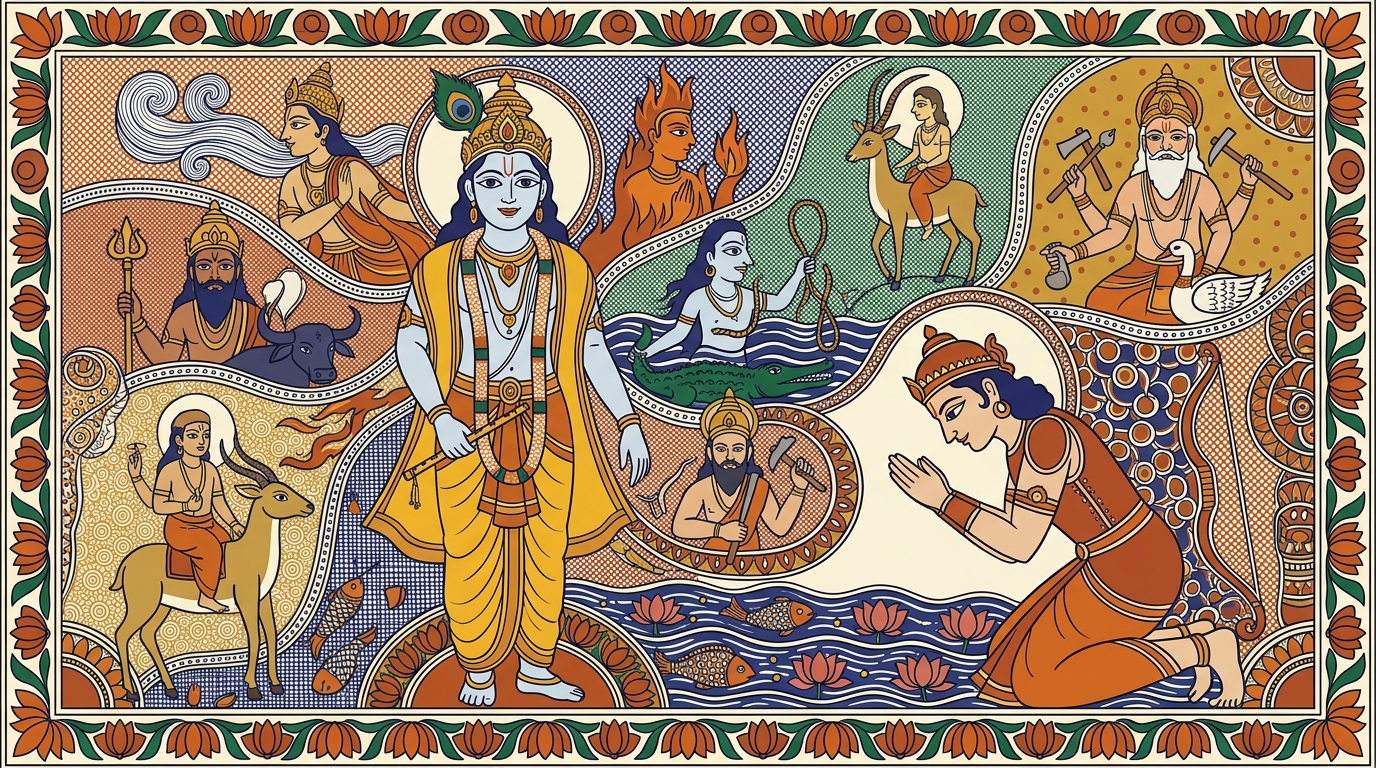
Arjuna had spent his whole life among the names of the gods. As a boy he
had poured offerings into Agni's fire and watched the flames carry his
prayers upward. He had felt Vayu the wind rush past his arrows. He had
bowed to Yama, who keeps everything in its right place, and to Varuna,
whose waters fill the rivers and the rain. On clear nights he had looked
up at the moon and felt small and calm.
He had always thought of them as many — many gods, in many places, doing
many different jobs, like a great household full of busy uncles and aunts.
But now, gazing into the cosmic form, Arjuna saw them all at once. And he
saw something that took his breath away.
They were not separate. They were faces of the One.
"You are Vayu," he sang, and there in the vision was the wind, breathing
out of Krishna's own being. "You are Yama. You are Agni. You are Varuna.
You are the cool moon in the night sky. You are Prajapati, who fashions
every living creature. You are the great-grandfather of all, older even
than the grandfather Brahma."
Each name he spoke, he found inside the single form. The wind he had run
against, the fire he had fed, the moon he had loved — all of them were
Krishna, wearing different masks for different tasks. The whole crowded
household of heaven turned out to be one face after all.
Arjuna could not hold it. There was nothing clever left to say, no more
grand words to reach for. There was only one thing a heart can do when it
is full to overflowing. He bowed.
"Salutations to you," he said, pressing his forehead low. "A thousand
times, salutations." And he could not stop. "And again — and yet again —
salutations to you, salutations to you." The words rolled out of him like
waves on a shore, the same simple homage over and over, because some
feelings are too big for new words and can only be said again and again.