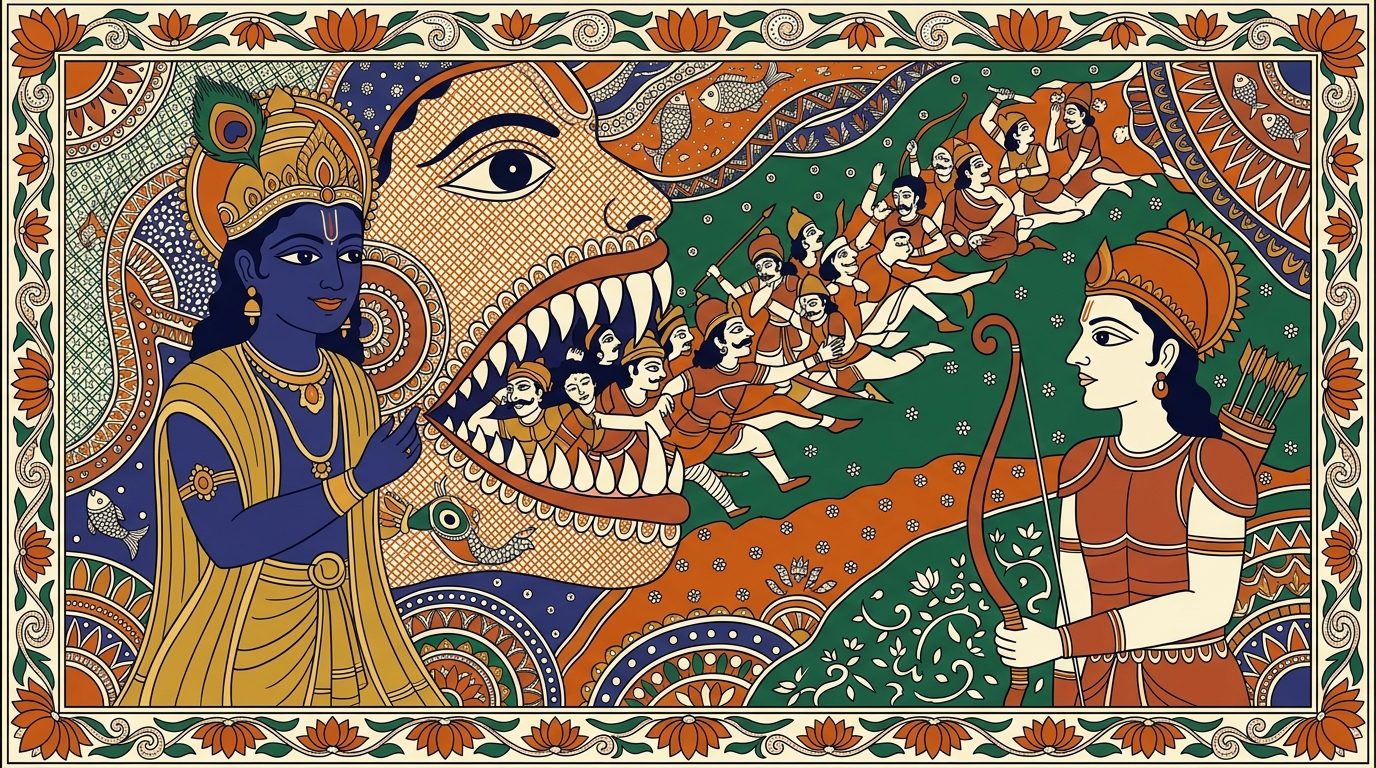
Arjuna had asked, only a moment before, what would happen when the warriors
reached the mouths of the cosmic form. Now the vision answered him, and the
answer took his breath away.
They did not stop at the edge. They rushed in — twaramāṇā, hurrying,
hastening, as though pulled by something they could not resist. The proud
sons of Dhritarashtra, the allied kings in their gleaming crowns, the great
teachers and the great rivals, all poured forward into the blazing,
fang-rimmed mouths of the One who held the universe.
It was the most fearsome thing Arjuna had ever beheld. He wanted to cry out,
to warn them, to pull them back. But this was no ordinary battle he could
join. This was the deep truth of how the world is made: that everything which
is born must one day return to its source, the way a wave that rises from the
sea must one day sink back into it.
Some of the warriors, Arjuna saw, were caught between the enormous teeth,
their proud heads bowed at last before something far greater than any king.
The old stories he had heard as a boy — about how all things end, how even
the mightiest empires turn to dust, how time swallows every age — were no
longer just stories. He was watching the truth of them with his own divine
eye.
And yet, even in his fear, Arjuna understood something he had never quite
grasped before. These warriors were not being destroyed by a monster. They
were being gathered home by the very Lord they had all, in their own ways,
come from. The mouths were terrible, yes. But they belonged to Krishna — the
same Krishna who steadied his chariot, who spoke to him as a friend.
Arjuna did not look away. He let the great vision teach him the hardest
lesson it had to give: that everything passes, and that even the passing
rests in the hands of God. It made him tremble. It also, in a strange deep
way he could not yet name, made him bow.