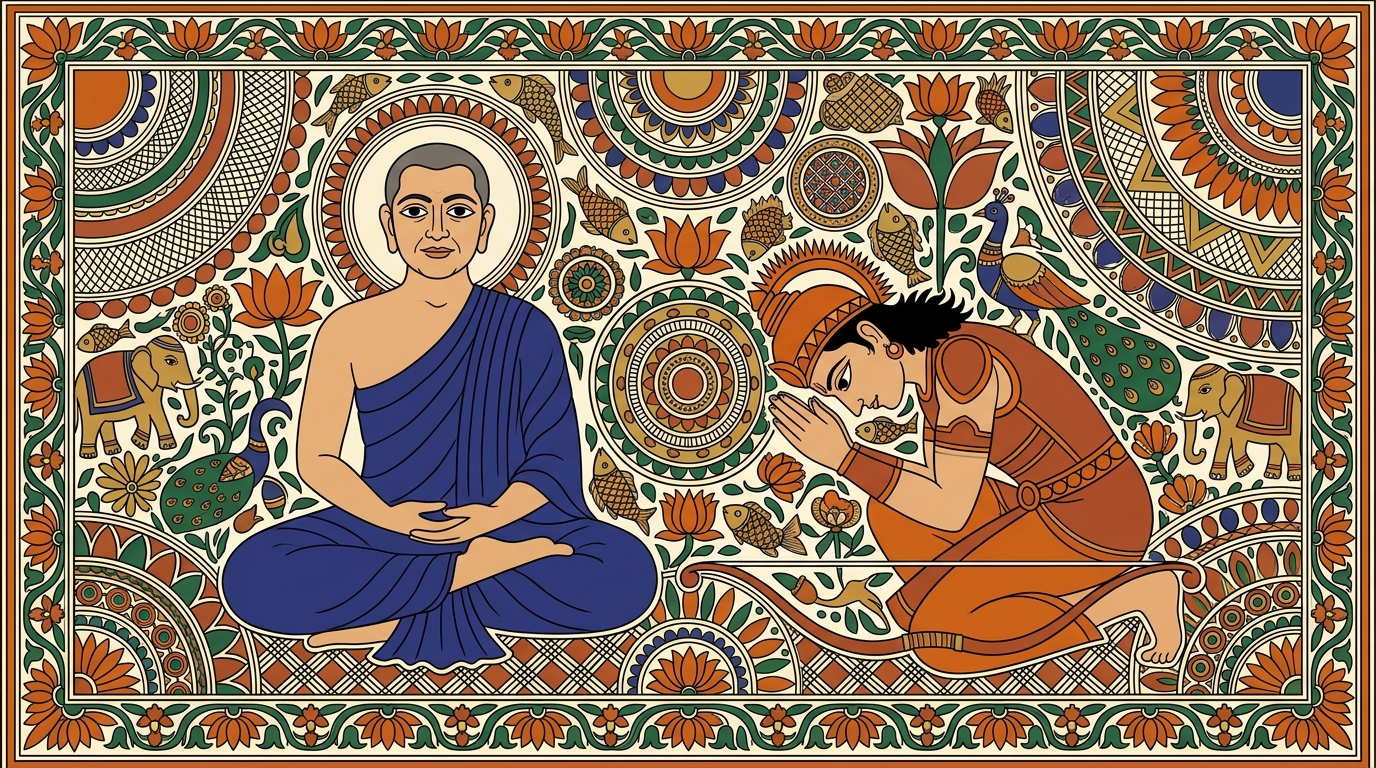
Arjuna had walked onto the battlefield as one of the greatest warriors the
world had ever known. Dhananjaya, they called him — the winner of wealth, the
archer no enemy could best. He had faced charging elephants and walls of
spears without flinching.
But there is a kind of seeing that no courage can stand up to. And it had come
for him now.
His body knew it before his mind could catch up. The little hairs on his arms
rose. A shiver ran from the top of his head down through his whole frame — not
the cold shiver of fear alone, but the deep thrill that comes when something
far too large and far too beautiful enters your life all at once. He felt it
the way you feel thunder in your chest, the way you feel the first enormous
wave at the sea.
He could not stay standing tall. The proud straight spine of the great archer
simply would not hold. Slowly, helplessly, Arjuna's head bent down. His knees
softened. Everything in him wanted to grow small before something so vast.
And his hands — without his deciding it — came together, palm against palm,
and lifted in front of his bowed head. The same gesture a child makes before
a temple lamp. The same gesture Arjuna himself had made a thousand times,
half without thinking, at morning prayers. Now it rose out of him from some
place far below thought.
"He bows, my king," Sanjaya whispered to Dhritarashtra. "The mightiest archer
alive, the conqueror Dhananjaya — he bows his head like the smallest child.
His hair stands on end. His hands are folded. He is full of wonder, so full
there is no room left in him for pride."
And then, with his palms still joined and his heart pounding against his ribs,
Arjuna opened his mouth to speak to the God of gods. The words that came next
would be a prayer such as no one had ever spoken — but first there was only
this: a great warrior, made gentle and small and shining-eyed by the sight of
the One who holds the world.