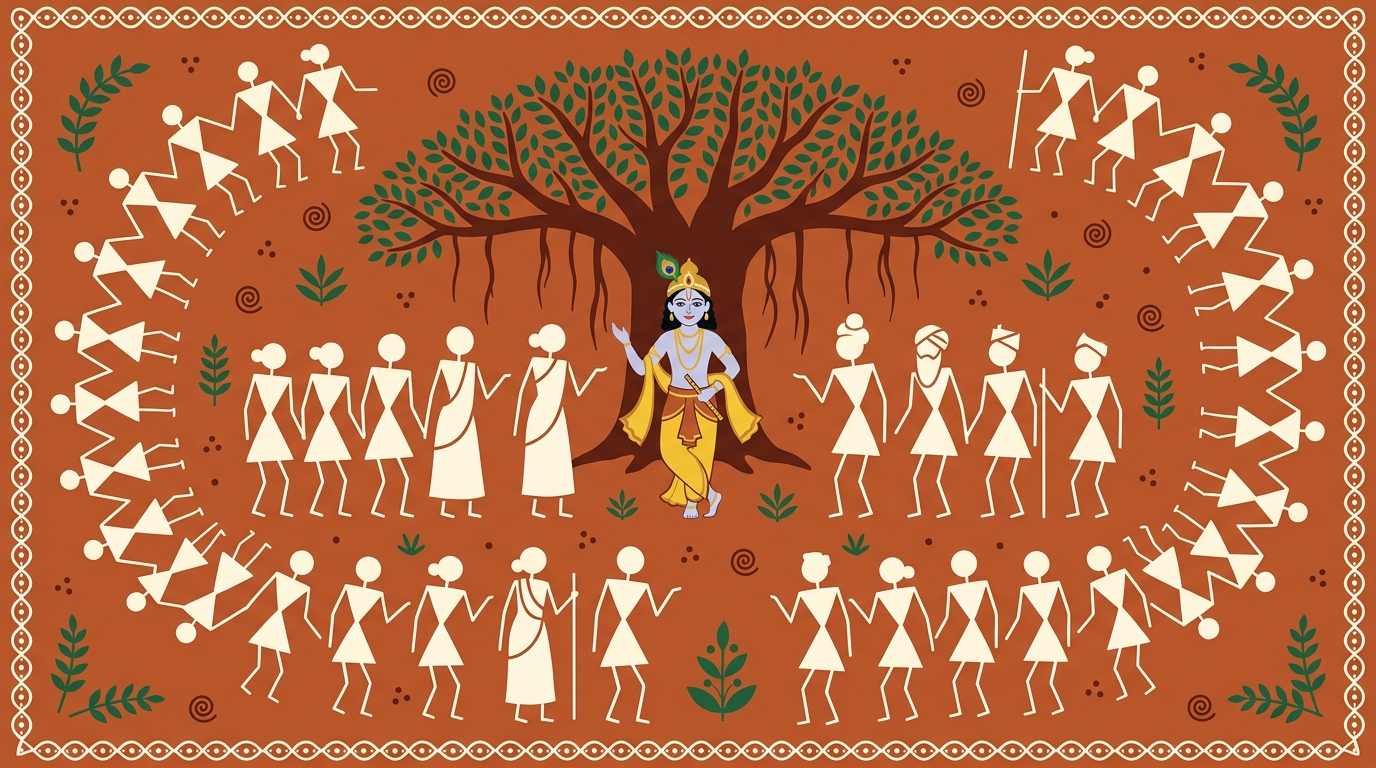
On the night of the full moon after the first rains, the whole village
gathered under the great banyan tree at the edge of the fields. It was the
one night of the year when everyone came — everyone, with no exceptions.
Jeeva sat cross-legged on a mat, watching them arrive. The village headman
came in his good white cloth. So did Sakhu the potter, his hands still
stained with clay. The wealthy grain merchant from the next hamlet came on
his cart, and right behind him walked old Mhatari, who had nothing at all
and slept by the temple steps. Mothers came with babies on their hips.
Farmers came straight from the muddy paddies. Even the children too small
to understand anything came, half-asleep, and were laid down on folded
shawls.
A lamp was lit before the wall where Aaji had painted God in white — the
figure surrounded by the sun, the trees, the animals, and the dancing
people, all in one great circle.
Then they sang. And here was the thing that made Jeeva's chest feel wide and
full: everyone sang the same song. The headman and the beggar. The rich
merchant and the potter. The old and the very young. And when the song was
over, every single person — without anyone telling them to — folded their
hands and bowed their heads at the same moment, toward the same lamp, toward
the same God.
Jeeva leaned toward Aaji. "Everyone is here," he whispered. "Even people who
never talk to each other any other day."
Aaji nodded, her eyes on the lamp. "That is the secret of this path,
child," she said quietly. "It does not ask who your father was, or how much
grain is in your store, or whether you can read the old books. It only asks
whether you love. And so there is room in it for every single one of us —
the wise and the simple, the grand and the small. We all bow under the same
tree."
The lamp flickered. The bowed heads rose. And above the banyan, the full
moon poured its light down equally on every upturned face.