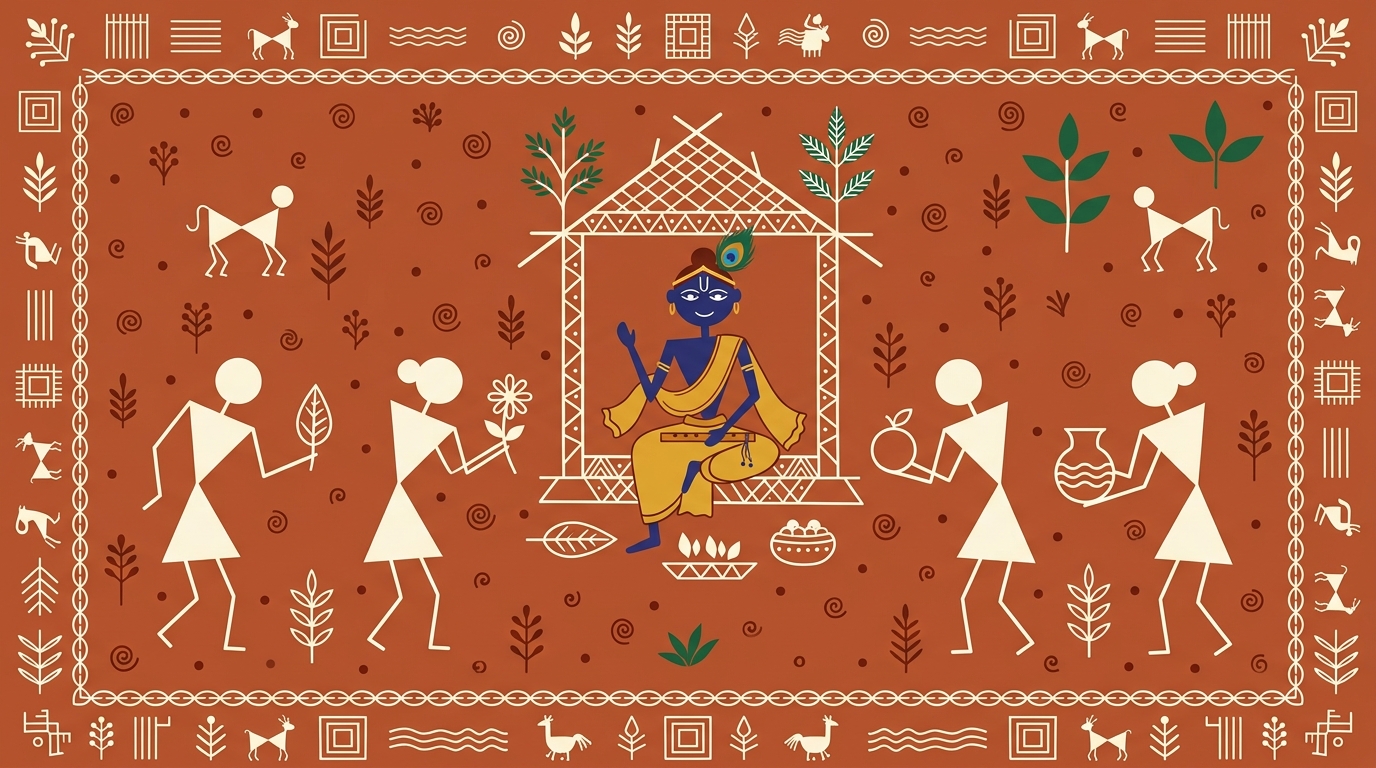
The festival had come to the village. Along the path to the little shrine in
the sacred grove, the families of Palghar walked in their brightest clothes,
carrying offerings. Jeeva walked at the end of the line and felt very small.
The potter's family carried a brass tray heaped with sweets. The farmer
brought a whole basket of mangoes, golden and heavy. A merchant from the
next village had a garland of marigolds so long it took two people to hold
it. Jeeva looked down at his own two empty hands and his heart sank.
"Aaji," he whispered, tugging his grandmother's sleeve, "everyone has
something beautiful to give. I have nothing. We have no money for sweets or
garlands. I'll have to stand at the back with empty hands."
Aaji did not hurry. She stopped at the edge of the path, where the rains had
coaxed a single small wildflower out of the red earth — pale violet, no
bigger than a fingernail, the kind of flower nobody planted and nobody
noticed.
"Pick that," she said.
Jeeva looked at it doubtfully. "That little thing? Next to a basket of
mangoes?"
"Pick it," said Aaji, "and as you pick it, put your love into it. Then it
will not be a little thing at all."
So Jeeva knelt in the dust and picked the tiny wildflower as carefully as if
it were made of glass. He cupped it in both palms all the way up the path,
and he thought, with his whole heart, This is for You. I don't have anything
else. But I have this, and I have my love, and I'm giving You both.
At the shrine he hung back, shy, while the grand offerings were laid down in
shining heaps. Then he stepped forward and set his one small flower at the
very front, on the cool stone.
"It's so small," he said again, softly.
Aaji put her hand on his head. "Listen to what Krishna himself promised,"
she said. "A leaf, a flower, a fruit, or water — offered with love, I accept
it. He did not say a leaf if you cannot afford a mango. He said a leaf. The
flower is enough, Jeeva, because your love is in it. God does not weigh the
gift on a scale. He weighs the heart."
Jeeva looked at his little violet flower sitting bright and brave among all
the grand things, and for the first time that day he stood up straight. It
was, he understood, the largest thing he owned.