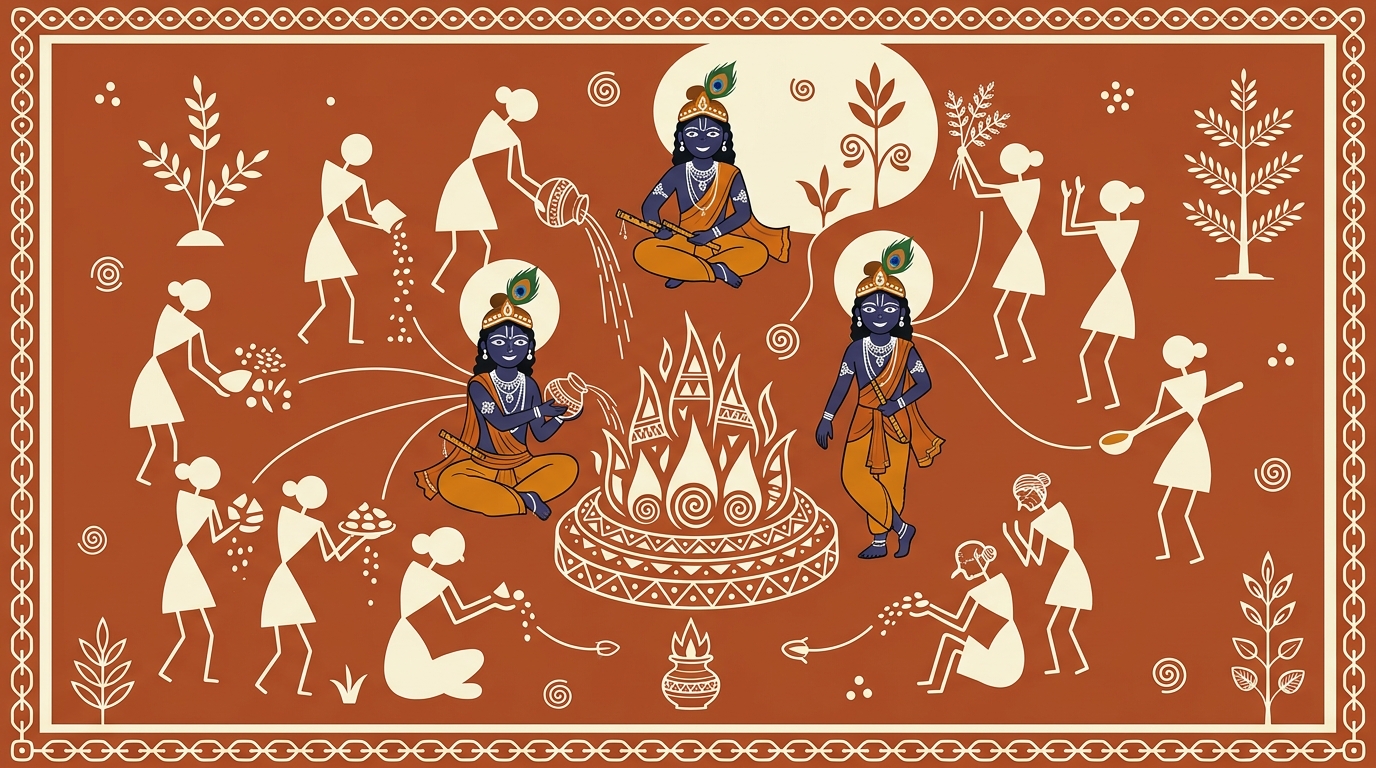
Long ago, in the age when rishis kept sacred fires burning day and night,
a boy named Devadatta came to live at his uncle's hermitage. His uncle
was a priest who performed the great fire-offerings, and Devadatta had
come to learn.
On his first morning, the boy watched his uncle prepare. He gathered dry
sticks, ground fragrant herbs, poured ghee into a small copper cup, and
laid out grains and sacred water. Then he kindled the fire, and as the
flames rose, he began to chant in a low, rolling voice, dropping the
offerings into the fire one by one.
Devadatta was puzzled. "Uncle," he said when it was done, "why do you
bow to so many different things? You bowed to the herbs, to the ghee, to
the fire, to the words. Which one is God? Which one are we really praying
to?"
His uncle smiled and sat down beside him in the warm light of the embers.
"You think God is hiding in one of these things, like a coin under one
of three cups," he said. "But come closer. Where did the herbs grow?"
"From the earth," said Devadatta.
"And who made the earth? And the cow whose milk became this ghee? And the
grain, and the water, and the very fire that eats them? And the breath in
my chest that shaped the chant?"
Devadatta was quiet.
"There is only One," his uncle said softly. "The ceremony is God. The
offering is God. The chant is God. The ghee, the fire, the thing thrown
in, the very act of throwing — all of it, God. We are not sending a gift
away to a distant king who lives somewhere else. We are the gift, and the
giving, and the One we give to, all at once."
He stirred the embers, and a last small flame leapt up, gold and alive.
"When you understand that," he said, "the fire stops being a thing you do.
It becomes a way of remembering what is already true everywhere: that
nothing, not one stick or one drop or one word, is outside of God."
Devadatta looked at the fire for a long time. He never again wondered
which part was holy. He had begun to see that all of it was.