There was once a proud chieftain named Vajraketu who scoffed at the sages
and laughed at the gods. "Hopes and prayers are for weaklings," he said. "I
trust only my own strong arm and my clever mind."
He had heard a rumour of a buried treasure in the dry hills beyond his
fort — chests of gold guarded, the old stories said, by nothing but a
riddle carved in stone. The riddle read: *What you grasp with a greedy
heart turns to dust; what you receive with an open one turns to gold.*
Vajraketu sneered at the carving. "Silly words," he said, and set his men to
digging.
They dug for days under the burning sun. His hopes grew wild — he pictured
crowns, palaces, armies bought with gold. At last their spades struck a
great iron chest. Vajraketu shoved his men aside and threw back the lid with
his own hands.
Inside, gold coins gleamed up at him, more than he had ever dreamed.
Laughing, he plunged both fists in and snatched up two great handfuls. But
the moment his greedy fingers closed, the coins crumbled — they ran through
his fingers as plain grey sand and pattered to the ground.
He grabbed again. Again the gold turned to sand at his touch. He scooped and
clawed and screamed, but the harder he grasped, the faster it all slipped
away, until the chest held nothing but a heap of dust and the wind carried
it off across the hills.
A quiet shepherd who had followed them, hoping only to fill one small water
pot, knelt at the empty chest. He reached in gently, with no greed at all,
and lifted out a single coin to buy bread for his family. In his open palm
it stayed bright and golden.
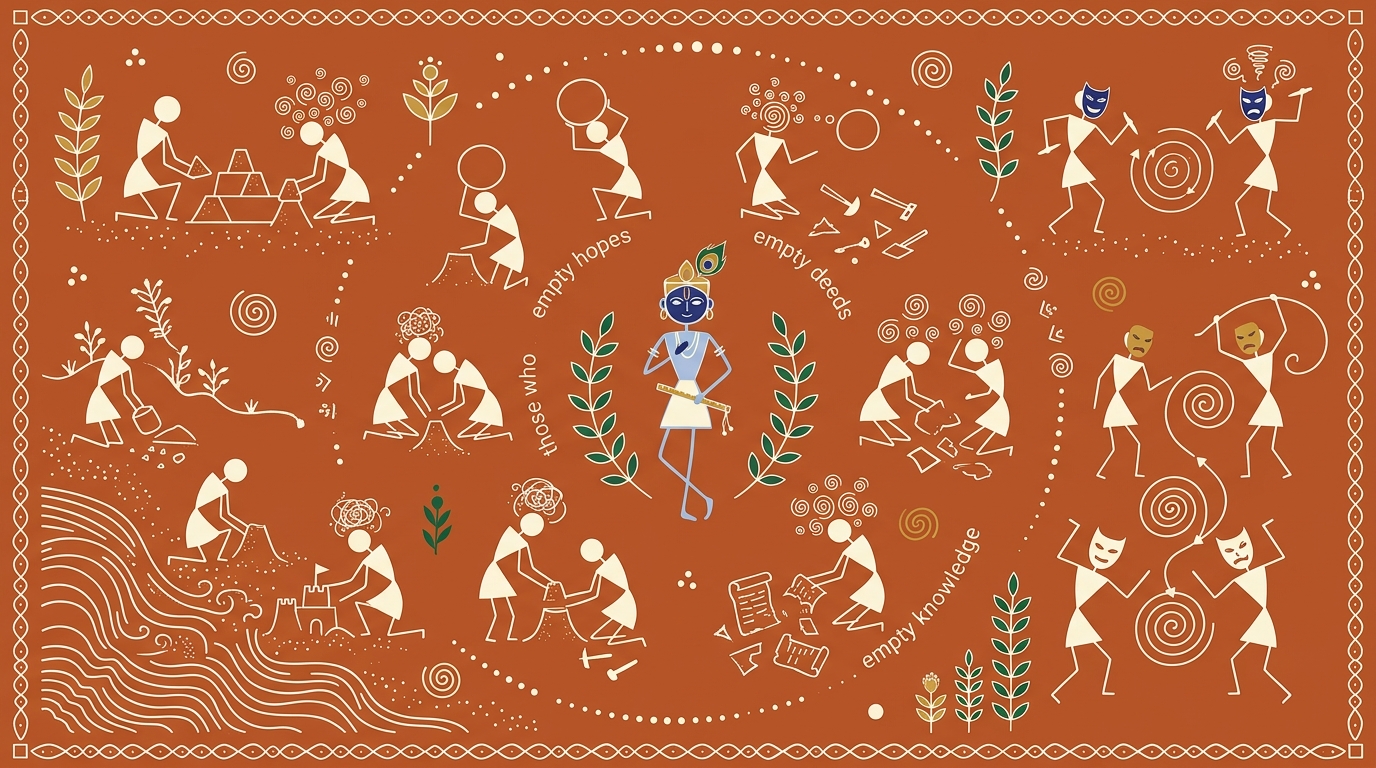
The sages tell this tale to explain Krishna's warning. The chieftain had
empty hopes, empty deeds, and empty knowledge, for he never understood the
one true thing. He had chased a hollow prize with a fierce and grasping
heart, and everything he reached for turned to nothing in his hands.
The world is full of treasure, the sages say. But it gives itself only to
the open heart, never to the clutching fist.