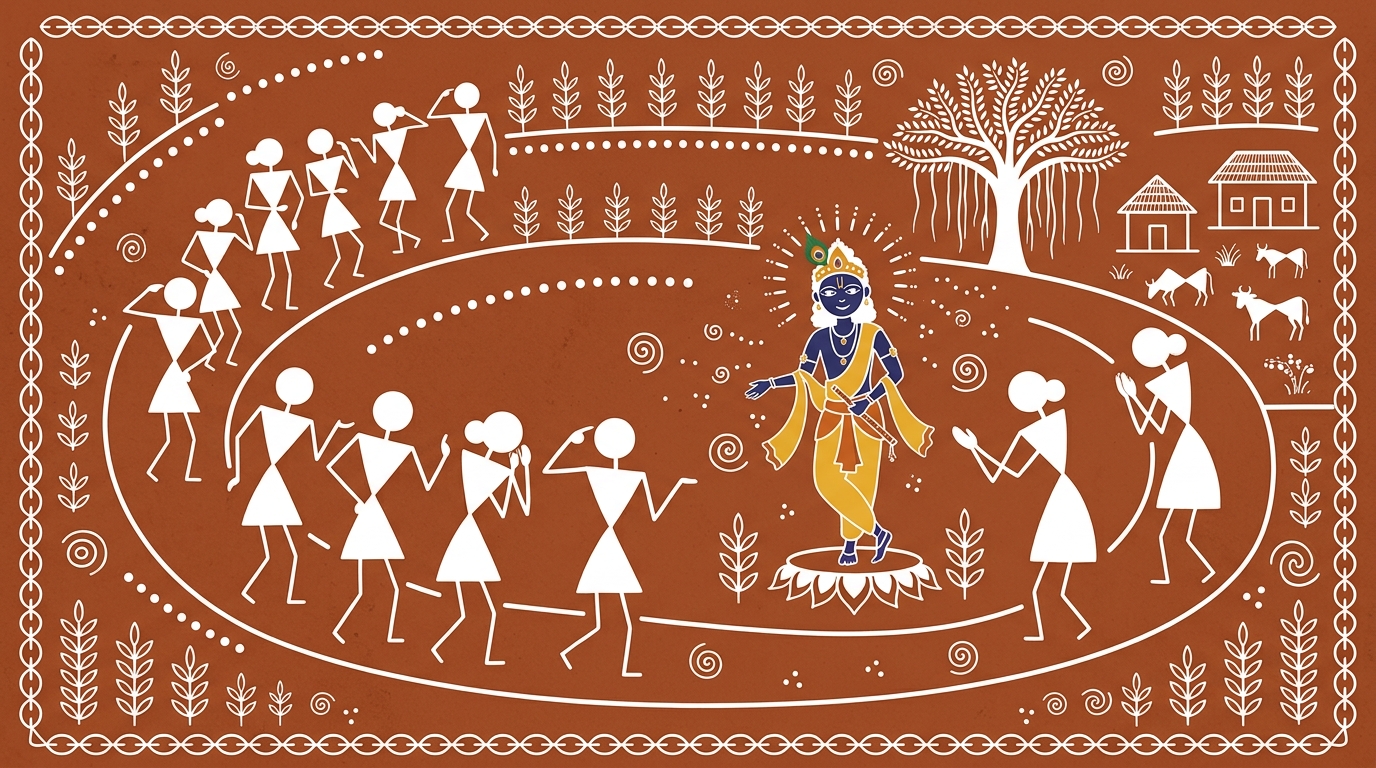
When Krishna was a young man, before the great war, he came once to the
proud city of Hastinapura as a messenger of peace. He came simply, without
an army, riding in on a plain chariot, dressed as a cowherd of Vrindavan.
At the palace gates, a haughty guard barred his way. "And who are you?" the
guard sneered, looking him up and down. "A herdsman? We have kings and
princes inside. Go tend your cattle."
Krishna only smiled and waited.
Inside the great hall, the blind king's son Duryodhana laughed when he heard
that the visitor was "only the cowherd from the cattle-villages." "Let him
wait," he said, and went on eating sweets. To Duryodhana, Krishna was
nothing — a barefoot boy who smelled of butter and the river.
But in a small room off the courtyard sat an old, lame servant named Vidura,
who had loved Krishna all his life. When he heard who had arrived, his eyes
filled with tears. He hurried out, bowed to the ground, and wept with joy.
"My Lord," he whispered. "You have come to my house."
The same man stood at the gate. To one, he was a dusty cowherd to be turned
away. To the other, he was the great Lord of every living being, the master
of the stars and the seasons, walking the earth in a borrowed human shape.
Later, sitting in Vidura's humble home, eating simple greens from a clay
bowl, Krishna said something his old friend never forgot.
"Vidura, the proud ones inside the palace looked at me and saw only a body,
a man in plain clothes, and they looked down on me. They do not know my
higher nature. They cannot see who really stands before them.
"But you," he said gently, "you did not look at the clothes or the dust. You
looked with love, and love sees true. That is the only way anyone ever
recognises the Lord — not with proud eyes, but with a loving heart."
Vidura bowed his head, and the cowherd who was the Lord of all the worlds
ate his simple meal, perfectly content, in the home of the one who had eyes
to see him.