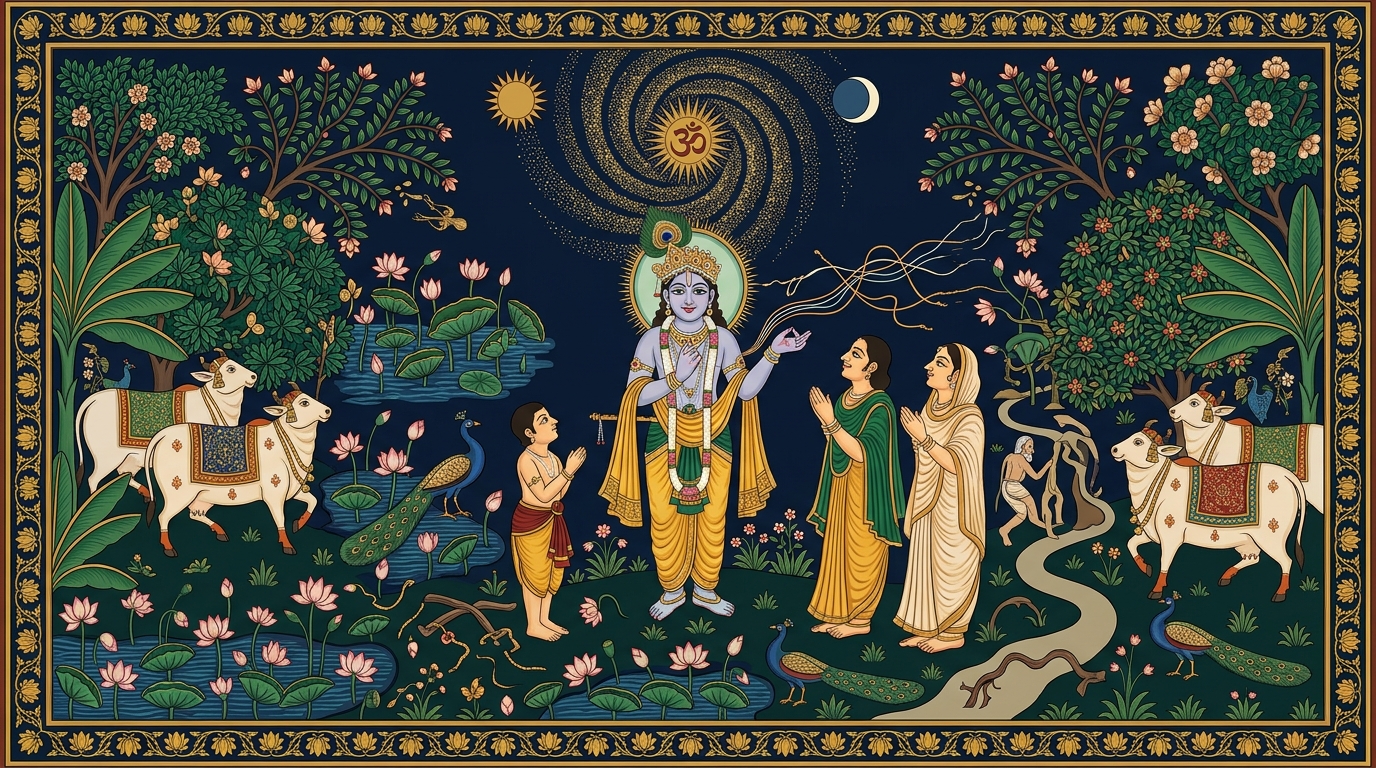
A boy named Nachiketa stood at the gate of the House of Death, and he had
been waiting three whole days.
It had happened strangely. His father, in a fit of temper, had once said,
"I give you to Death!" — and Nachiketa, who took truth very seriously, had
set off to keep his father's word. He had walked to the realm of Yama, the
lord of death, and arrived to find Yama away. So the boy simply sat down at
the gate and waited, without food or water, for three days and three nights.
When Yama returned and saw the young guest who had waited so long, he was
troubled. "To make a guest wait three days is a great wrong," he said. "I
will grant you three wishes, one for each day, to set it right."
For his first wish, Nachiketa asked that his father not be angry with him
anymore. Granted. For his second, he asked to learn a sacred fire ritual.
Granted, and gladly.
Then came the third wish, and the boy's voice was steady. "When a person
dies, some say they still are, and some say they are nothing at all. Teach
me the truth. What lies beyond death? I want to know the Self that does not
die."
Yama's eyes widened. This was the deepest secret of all, and he did not want
to give it away so easily. "Ask for something else," he urged. "Ask for
gold, for cattle, for elephants and horses. Ask to be a king. Ask to live a
very, very long life. Ask for the loveliest music and the fairest companions.
I will grant any of it. Only release me from this third question."
Nachiketa shook his head. "All those things wear out. The pleasures fade, the
years end, even the longest life runs down like a lamp running out of oil.
What good is more of what must vanish? I came to learn the one thing that does
not grow old and does not die. That is the only wish I want."
Yama looked at the boy for a long moment — and then he smiled, the way a
teacher smiles when he has finally found a student worthy of the highest
lesson.
"Because you turned away from all that passes," he said, "and longed only for
the deathless — you are ready. Listen now, and I will teach you the Self
beyond old age and death."
And so, taking refuge in the truth and striving for what does not perish,
Nachiketa came to know what almost no one knows.