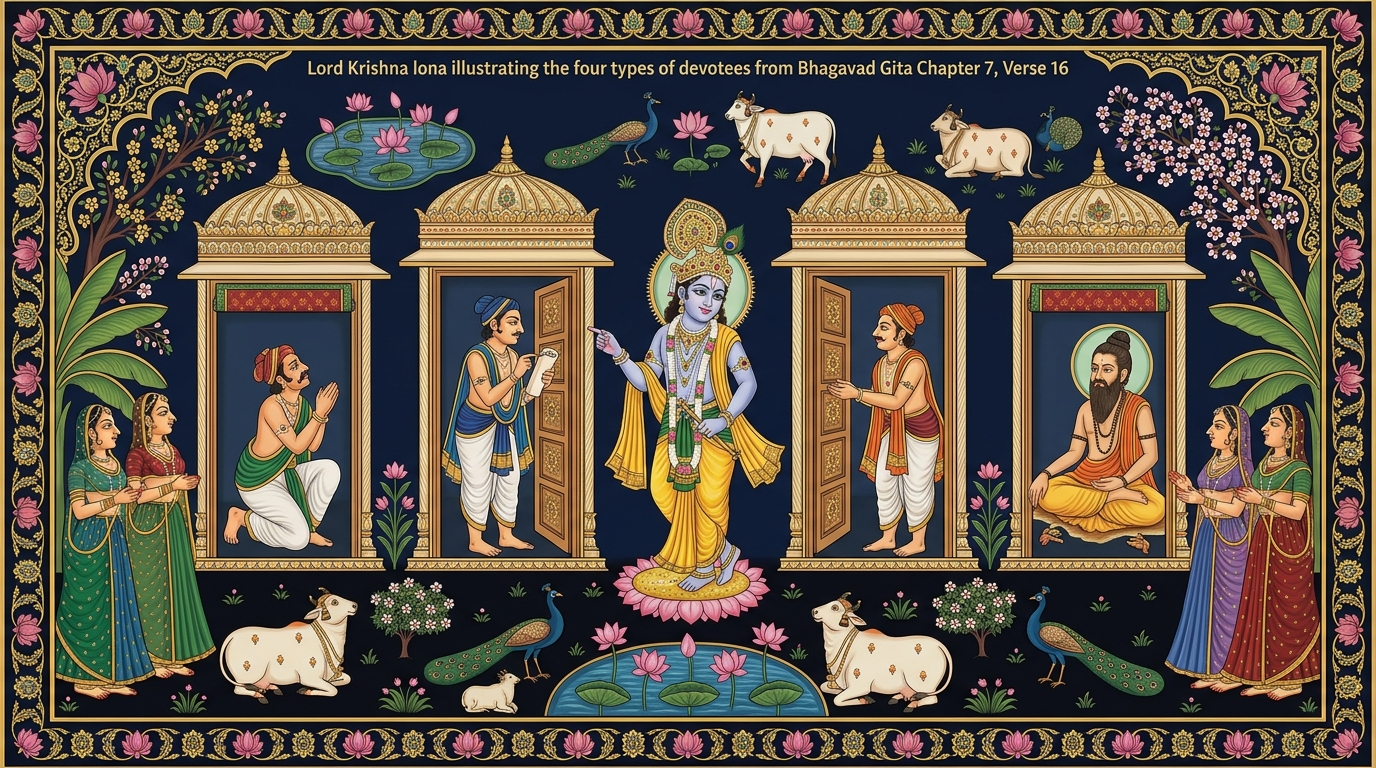
Long ago there were four seekers, and no two were alike.
The first was an elephant named Gajendra, king of his herd. One hot
afternoon he waded into a lake to drink, and a great crocodile clamped its
jaws around his leg and began to drag him under. Gajendra pulled with all his
mighty strength — for days he fought — but slowly he was losing. At last,
half-drowned and out of strength, he lifted a lotus in his trunk and cried
out to God, "Save me!" That was all. A cry from the middle of trouble. And
God came at once. Gajendra was the distressed one — the ārta.
The second was a boy named Nachiketa, who travelled all the way to the house
of Death itself. Death offered him gold, horses, long life, every pleasure on
earth. The boy refused them all. "I do not want toys," he said. "I want to
understand what happens to the soul. Teach me that." He hungered only to know.
Nachiketa was the seeker of knowledge — the jijñāsu.
The third was a small prince named Dhruva, only five years old, who had been
told he was not good enough to sit on his father's lap. Stung and hurt, he
marched into the forest to pray — at first wanting just one thing: a place
higher than anyone else's, a throne above the stars. He prayed for a reward.
Dhruva was the seeker of gain — the arthārthī. (And God, who gave him far
more than he asked, did not turn him away.)
The fourth was the sage Shuka, who wanted nothing at all. Not rescue, not
answers, not gifts. He had already seen that God was everywhere and in
everything, and he loved that truth the way you love sunlight — simply, with
no reason and no list of wishes. Shuka was the wise one — the jñānī.
Four hearts, four very different calls: one crying in pain, one burning with
questions, one hoping for a gift, one quietly in love. And the strange,
beautiful thing, Krishna says, is this — every single one of them turned
toward him. He welcomed all four. There is no wrong door, only the doorway
you happen to be standing in. What matters is that you walk through it.