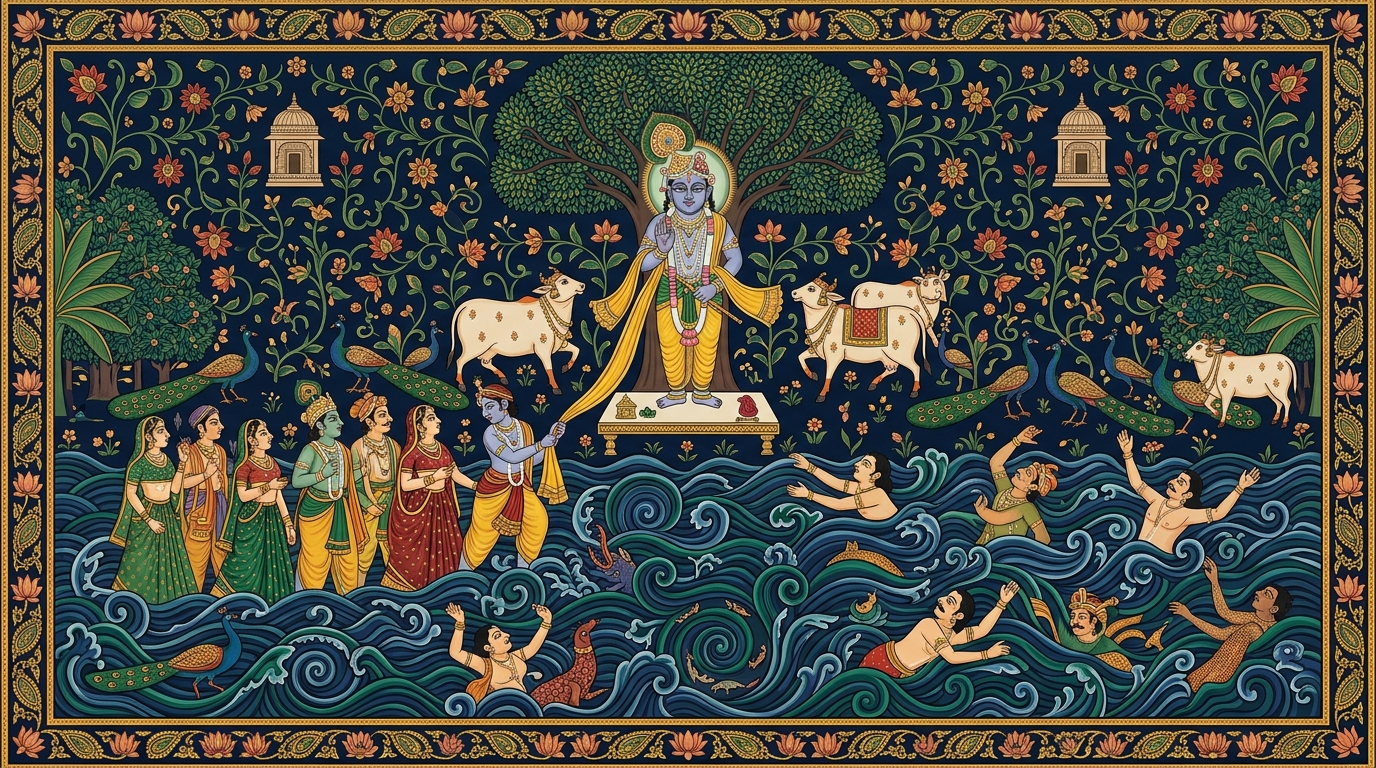
It was the darkest, wildest night Mathura had ever known.
Inside the prison, the wicked king Kamsa slept at last, and his guards
slumped in a deep, strange sleep beside their spears. The chains that had
bound Vasudeva for years fell open by themselves, ringing softly on the
stone. And in his arms lay a newborn baby — small, perfect, glowing faintly
in the dark like a lamp seen through cloth.
A voice had told him what to do. Carry the child across the Yamuna, to the
village of Gokul, and trade him for a baby girl there. Vasudeva did not
understand it all. But he wrapped the baby in cloth, lifted a flat basket
onto his head, and stepped out into the storm.
The rain came down like rivers turned sideways. Thunder split the sky.
Lightning showed him the road, then snatched it away again. And ahead, in
the white flashes, he saw the Yamuna — swollen, roaring, leaping its banks,
a wall of black water no man could ever cross. Trees were torn loose and
spinning in it. The far shore could not even be seen.
Vasudeva's heart sank. He could not swim that. No one could. He would drown,
and the child with him.
But he did not turn back. He held the basket steady, fixed his whole mind on
the divine child above his head, and walked straight into the flood.
The water rose to his knees. To his waist. To his chest, to his chin. He
lifted the baby higher. The river thundered around his throat —
And then a small foot slipped from the cloth and touched the racing water.
The Yamuna went still.
The roaring softened to a hush. The waves lay down. The flood, which no
strength on earth could have crossed, parted and sank until it lapped gently
at Vasudeva's feet, as if bowing. From the deep rose the great serpent Shesha,
spreading his thousand hoods like an umbrella over the child, keeping off the
rain.
Vasudeva walked across the bed of the river as easily as crossing a courtyard.
The uncrossable had let him pass — not because he was strong, but because of
the one he carried, the one he had given himself to completely.