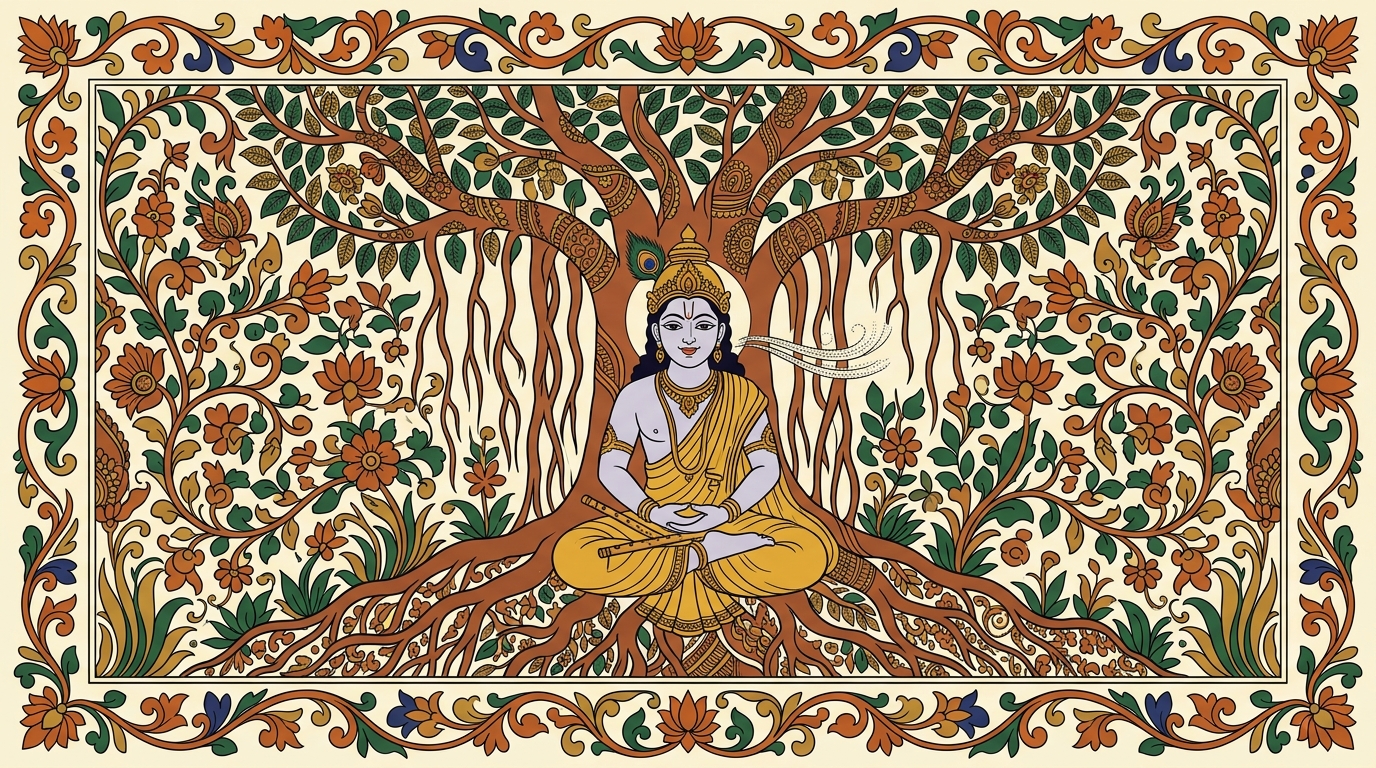
"Before a person can know the peace within," Krishna said, "they
must learn to grow quiet. Let me show you how it looks."
Arjuna nodded.
"Picture a girl named Nila, sitting beneath a great banyan tree at
dawn. All around her the world is calling. A bright butterfly drifts
past — her eyes want to chase it. A cart rattles down the far road —
her ears want to follow it. The smell of someone's cooking fire
drifts over — her thoughts want to wander toward breakfast. The
world is full of little hooks, and each one wants to pull her away."
The horses had quieted. The whole chariot seemed to listen.
"So this is the first thing Nila does," said Krishna. "She gently
sets all those outside touches outside. She does not fight them. She
simply lets the butterfly pass, lets the cart pass, lets the smell
pass, the way you let clouds pass overhead without trying to grab
them. Outside things stay outside."
"Then she softens her gaze and lets it rest in the quiet space
between her eyebrows — not staring hard, just settling, like a bird
folding its wings. Her eyes stop darting about. They come home."
Arjuna found himself breathing more slowly, just listening.
"And last," Krishna said, "she lets her breath grow even. The breath
going out and the breath coming in move smooth and equal through her
nose, like calm waves on a still morning lake — no gasping, no
holding, just a gentle in and out, in and out, until the breath
becomes so quiet she can barely feel it. And as her breath grows
calm, her whole self grows calm with it."
Krishna paused. The sun had cleared the mist entirely now, and the
field lay washed in soft gold.
"She is not asleep, Arjuna. She is more awake than ever. She has
simply gathered herself in, like a flower closing for the night, so
that nothing is scattered and everything is whole."