Before dawn, the valley below Kurukshetra was a bowl of darkness.
A young water-carrier named Vidha picked her way along the riverbank,
feeling for the path with her bare toes. She could hear the river but
not see it. She could smell the cookfires of the camp but not find
them. Shapes loomed and dissolved — was that a boulder, or a sleeping
ox, or only her own fear wearing a costume of night?
She set down her clay pots and waited, because waiting was wiser than
walking blind.
Then it happened the way it always happens, and never stops being a
small miracle. A thin line of gold appeared along the eastern ridge.
The line widened. And all at once the sun lifted its head over the
hills, and the valley simply — appeared.
The boulder was a boulder. The ox was an ox, chewing slowly, entirely
unbothered. The terrifying shape near the water was a heron, standing
on one leg. Nothing had changed in the valley. Every stone and tree
and animal had been there all along, exactly where it was. The only
thing that had changed was that now there was light, and with light,
Vidha could see what was true.
She laughed out loud at her own night-fears, picked up her pots, and
walked the path easily.
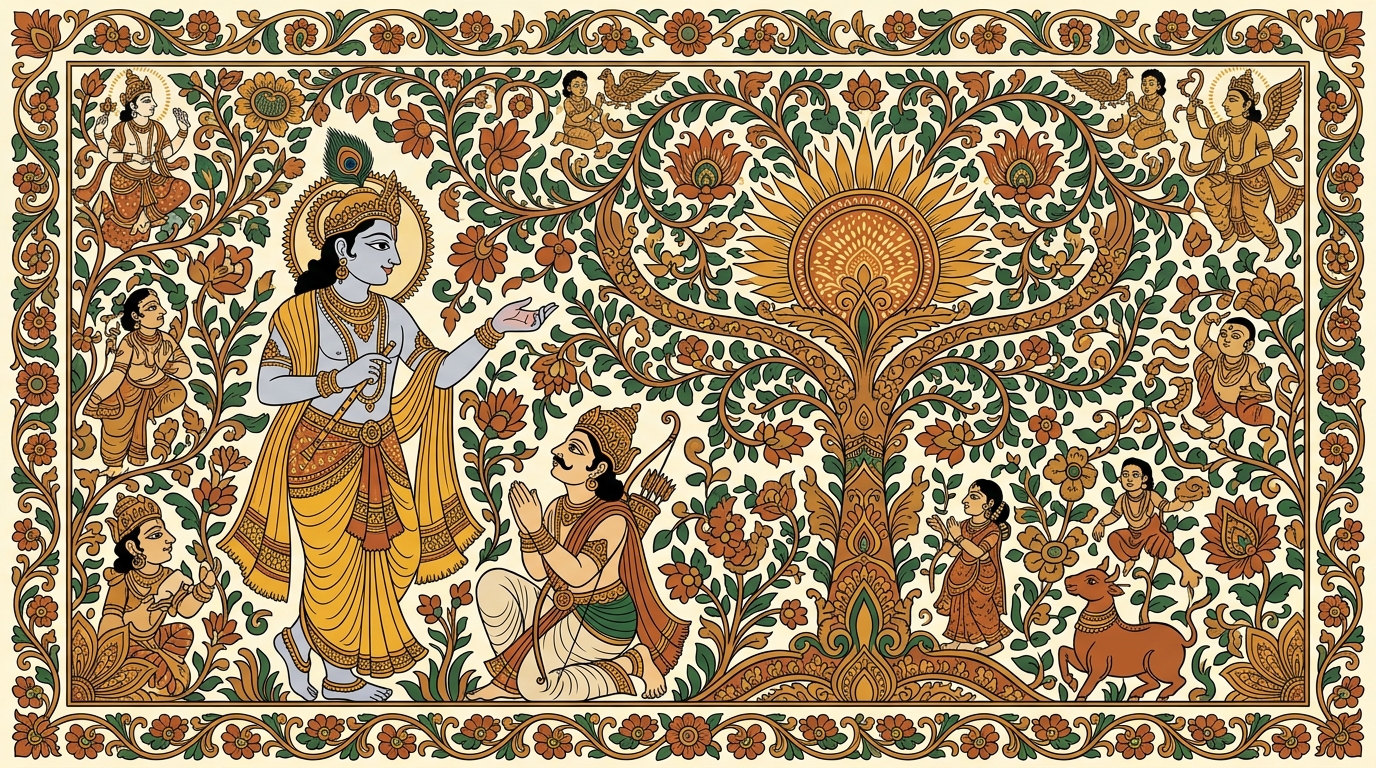
Krishna, in his chariot, was telling Arjuna about a different kind of
sunrise. "Ignorance," he said, "is like that darkness. It does not put
new things into the world. It only hides what is already there. We
stumble. We mistake herons for monsters and friends for strangers. And
then knowledge rises in the heart like the sun over the ridge, and
suddenly we see what was true all along: one Self, shining in every
living thing, the way one sun shines on every stone in the valley."
Arjuna looked east. The real sun was climbing now, gilding the spear-tips
of two great armies, touching every face on both sides with the same
warm, impartial gold.
He understood. Light does not choose where to fall.