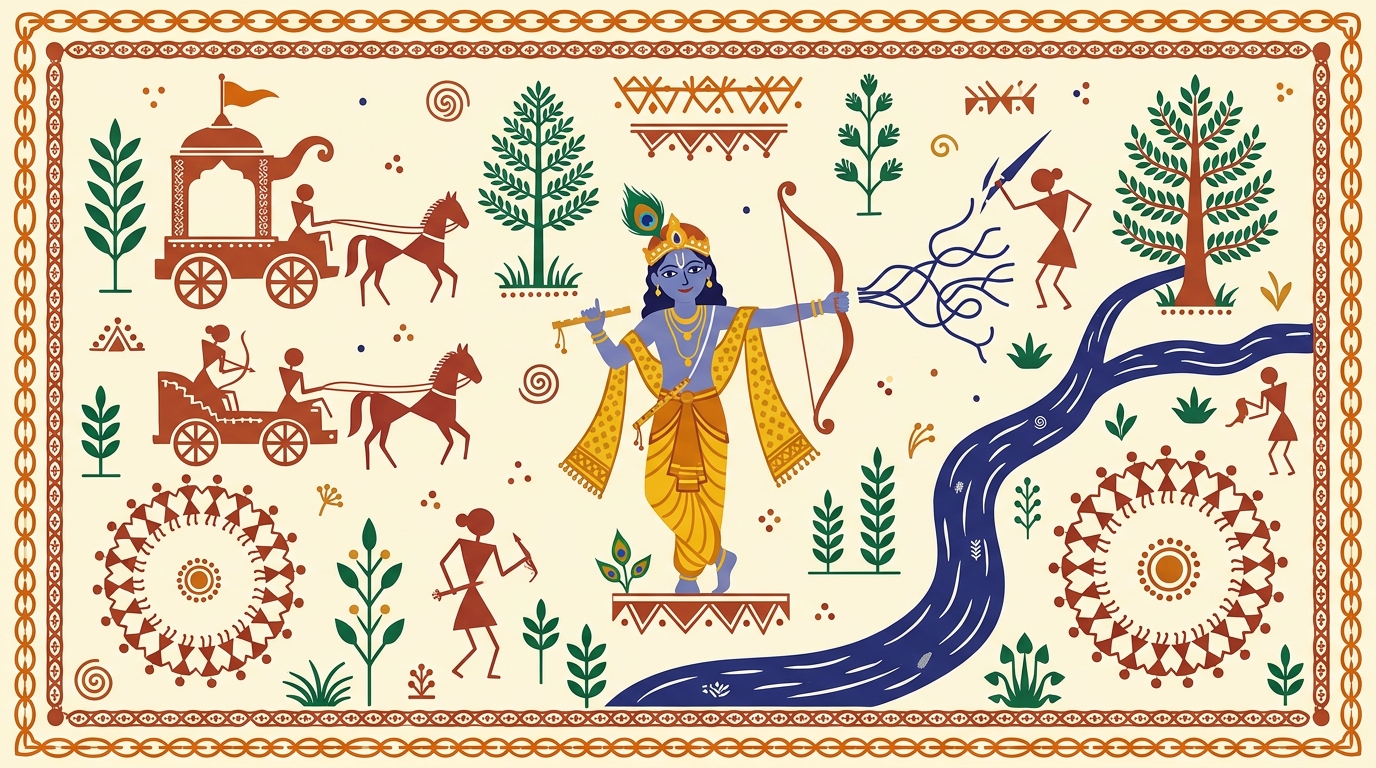
Krishna pointed across the chariot to Arjuna's own hands. "Look at how
you loose an arrow," he said. "Watch your fingers."
Arjuna, curious despite his heavy heart, drew an imaginary string. He
pulled it back to his cheek, held — and let go. His fingers opened
completely. The phantom arrow flew.
"There," said Krishna. "Did you see? At the very moment of release, your
fingers do not grip. They open. If an archer clenched the string and
refused to let go, the arrow would never fly, and his own hand would be
torn. The shot needs the holding *and* the releasing. Pull with all
your skill — then let go entirely."
Arjuna looked at his open hand.
"A person can live their whole life this way," Krishna went on. "Act
with full effort: draw the bow, aim true, do the work the moment
asks of you. But at the moment of release, open your fingers. Do not
clutch at what comes next. This is acting through yoga: doing the deed
without gripping its fruit."
A breeze moved across the field. Arjuna said nothing, listening.
"And there is a second thing," said Krishna. "A doubting mind is like a
rope wound round the archer's arm, every old hesitation, every 'what
if,' tying him so he cannot draw at all. True knowing is a blade. It
cuts those ropes clean through. The arm comes free."
He laid a hand on Arjuna's shoulder.
"When a person acts with open hands, when knowledge has cut his doubts
away, and when he stays settled and steady inside himself — then his
actions cannot bind him. He can do great deeds, terrible deeds,
necessary deeds, and walk away from all of them as free as the air.
The arrow flies. The hand is empty. Nothing is tied to him at all."
Arjuna opened and closed his fingers slowly, feeling the difference
between a fist and an open palm.
"Free," he said, almost to himself, "even while doing."
"Especially while doing," said Krishna. "That is the whole of it,
Dhananjaya."