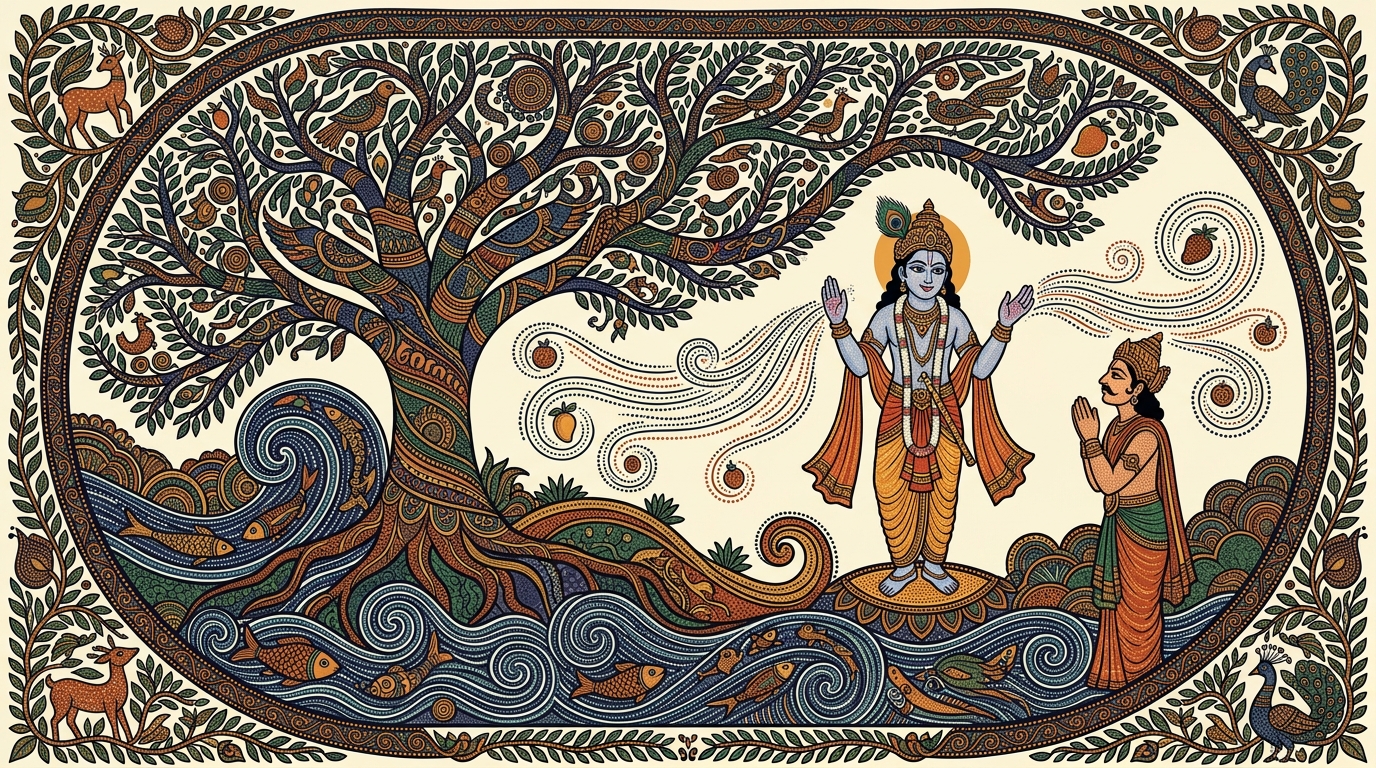
There is a moment — and every great story has one — when
everything before it was preparation, and everything after it
is changed. This was that moment.
Krishna had been building toward this verse the way a river
builds toward a waterfall. Forty-six verses of philosophy and
transition, all leading here, to four lines that would echo
across three thousand years and never stop.
He did not raise his voice. He spoke the way a mother speaks
to a child she is about to release into the world — quietly,
clearly, with a steadiness that says: this is the most important
thing I will ever tell you.
Karmaṇyevādhikāraste. Your right is to action alone.
The battlefield went still. Not the forced stillness of soldiers
at attention, but something deeper — a held breath across a
million bodies, as though the field itself had leaned in to
listen. The wind dropped to nothing. The white horses did not
twitch. The dust did not move.
Mā phaleṣu kadācana. Never to its fruits.
Think about what he was saying. Not "pretend you don't care
about results." Something more precise: you do not own the
results. They were never yours. You own the arrow, the aim,
the release — but the moment the arrow leaves the string, it
belongs to the wind, to gravity, to a thousand forces you
cannot see or control. Your jurisdiction ends at your fingertips.
Mā karmaphalaheturbhūḥ. Do not let the fruit be your motive.
Most people misunderstand this. They think Krishna is saying
"don't want things." He is not. He is saying: do not let your
wanting be the reason you act. Act because the action is right.
Act because you are an archer, and archers shoot — not because
the target owes you something.
Mā te saṅgo'stvakarmaṇi. Nor let there be attachment to inaction.
Here is the knife's edge. The easy escape from fear of failure
is to not try at all. To put down the bow. To sit in the chariot
and call it peace. Krishna closes that exit too: you do not get
to opt out. The world needs your arrow, even if you never see
where it lands.
Arjuna sat motionless. His eyes, which had been red from
weeping, were dry now and wide. He was not yet healed — that
would take the rest of the Gita — but something had shifted
behind his ribs, the way a bone shifts when set back in place.
It hurt. And it was exactly right.
Three thousand years later, this is still the verse people
whisper when they are afraid to begin. Four lines. Thirty-two
syllables in Sanskrit. The most famous words the Gita ever spoke.
And the wind remembered every one of them.