Shvetaketu came home full of himself.
He was twenty-four. He had spent twelve years at the gurukul —
twelve years of memorizing the Vedas, learning the fire rituals,
studying grammar and astronomy and the rules of sacrifice. He
could recite entire chapters without a single error. He knew the
correct pronunciation of every syllable, the exact quantity of
ghee for every offering, the precise angle at which the sacred
grass should be laid. His teachers had declared him complete.
His father, Uddalaka Aruni, watched him walk through the door
and saw the swelling. Not of the body — of the mind. The boy
carried his learning the way a peacock carries its tail: spread
wide, bright, impossible to miss.
"Son," Uddalaka said, "do you know That by knowing which
everything else is known?"
Shvetaketu blinked. He did not know what his father meant.
"Bring me a fruit from the banyan tree," Uddalaka said.
Shvetaketu brought a small red fruit, no bigger than a pea.
"Break it open."
He split the fruit. Inside were tiny seeds, dozens of them,
smaller than grains of sand.
"Take one seed and break it."
Shvetaketu crushed the seed between his nails. Inside there was
— nothing. Just pulp. Just wet dust.
"What do you see?" his father asked.
"Nothing, Father."
"From that nothing," Uddalaka said, "this entire banyan tree
grows. That invisible essence — that is the truth. That is the
Self. And that, Shvetaketu, is what you are."
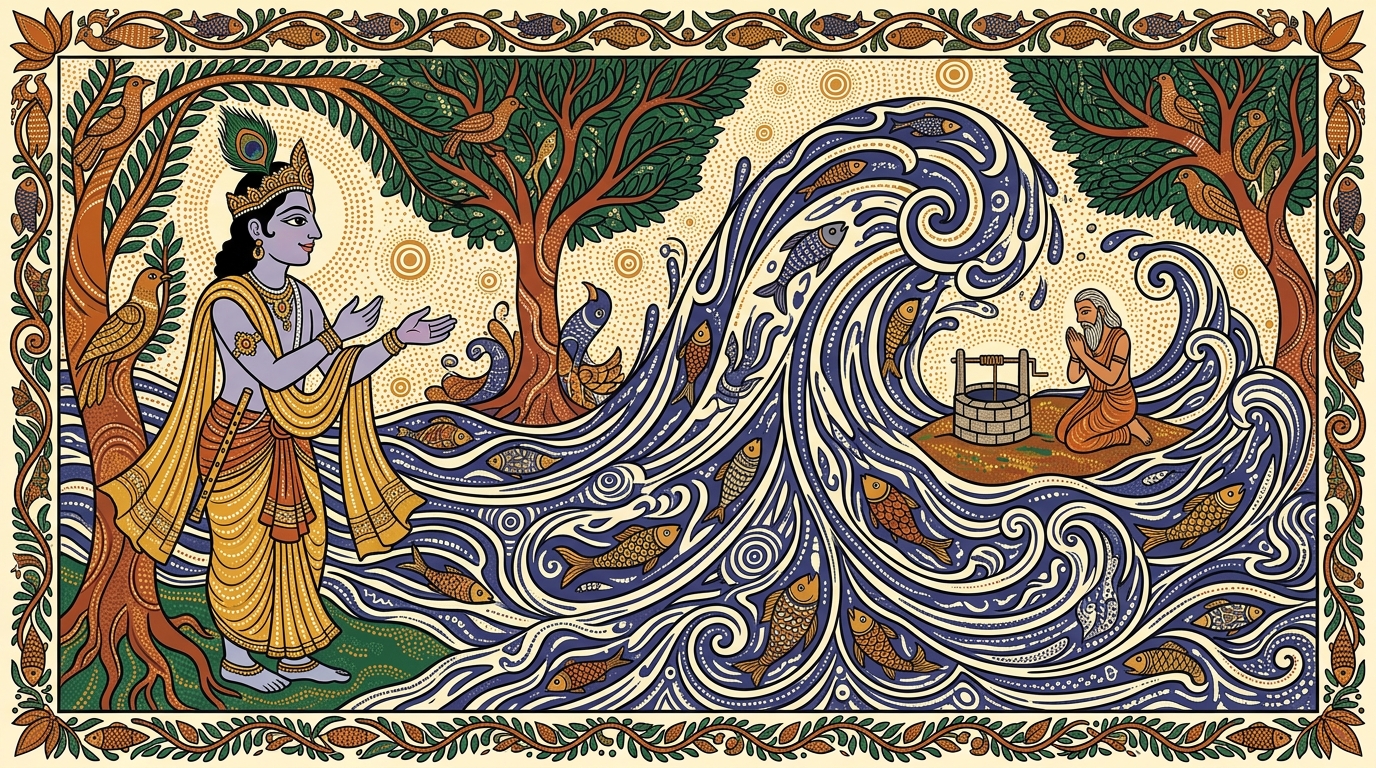
The boy was quiet. He was beginning to understand that twelve
years of memorized scripture had been a well — useful,
necessary, good — but that his father was pointing at the ocean.
"Now," Uddalaka said. "Place this lump of salt in a bowl of
water and come back tomorrow."
Shvetaketu did as he was told. The next morning, the salt had
vanished. The water looked the same as any water.
"Sip from the top," his father said.
Shvetaketu sipped. "Salty."
"From the middle."
"Salty."
"From the bottom."
"Salty."
"Can you see the salt?"
"No."
"Can you hold it in your hand?"
"No."
"And yet it is there — in every part, invisible, indivisible,
pervading the whole." Uddalaka placed his hand on his son's
head. "That which you cannot see, that which no ritual can
contain, that which fills everything the way salt fills water —
that is Brahman. That is the Self. Tat tvam asi, Shvetaketu.
You are That."
Shvetaketu was silent for a long time. The Vedas he had
memorized were still in his mind — all four, complete, perfect.
But they felt different now. Like a well feels different when
you are standing in the rain.